Monday, January 06, 2025

In which there's some alternative reading and viewing, and the Caterist and the onion muncher for those who are silly season desperate ...


Some pedants insist that the 12 days of Xmas last until the 6th January, so the pond feels perfectly respectable linking to Parker Molloy's updated A Look Back at the "War on Christmas", People have been freaking out about the "War on Christmas" for more than a century.

It was one of the tragedies of this Xmas that the reptiles abandoned the war, and there were only a few feeble offerings of the bromancer and craven Craven kind.

While visiting, you might checkout other offerings by Molloy, such as Meta's AI "Users" Are the Last Thing Social Media Needs, Mark Zuckerberg's latest scheme involves filling Facebook and Instagram with fake people, because that's definitely what was missing from social media.

That reminded the pond why it's never been on Facebook.

While visiting sub-stackers, you might also come across Paul Krugman, as in this outing about tariffs, Never Underestimate the Ignorance of the Powerful, When you’re a star, people let you think you're smart.

Previously while visiting Krugman, you might have bumped into shady characters idling in the corridor, like David Brooks and Ross Douthat. These days Krugman can cheerfully take down the bothsidesing NY Times, as in Bothsidesing, With a Republican Slant: Here We Go Again.

Krugman also uses social media to rant about social media, The Plot to Poison Children’s Minds, but frequently provides links to social media hosted music as a closer (in this case Feist).

The pond's partner is reluctant to visit sub-stackers, insisting that the site is a haven for neo-Nazi scribblers, and that might be so or not, but while mentioning neo-Nazis, the pond would like to slip in a kind word for The Order, which demonstrates that actors get better as they age.

Now long past his inept, insufferable pretty boy days, Jude Law has a good time (in a thespian sense) as a worn and torn FBI agent dealing with neo-Nazis in the American backwoods in the 1980s. 

Based on "real events", as they say, there's an Oz auteur, Justin "Snowtown" Kurzel at the helm. As with many dramadoc style productions, it's remarkable how "real events" conform to Hollywood structures and genre - anyone who can't predict what will happen to Tye Sheridan's local innocent young cop needs to get out and about more often - but it's slickly done, and it concludes with a warning of where the far right rabbit hole can lead, from the Oklahoma City bombing to the January 6th attack.

Speaking of far right rabbit holes, it's time to go down the lizard Oz rabbit hole, and without complaint, because the pond has recommended plenty of alternative reading and viewing.


Sheesh, it's going to be a hard year and not just because of King Donald I and President Leon - it's also election year, and so the reptiles are going to be full of endless hard times stories ...

You know, simplistic "here no conflict of interest" Simon blathering about bipartisan courage ...


As usual, a visit to the rabbit hole involves sacrifices. 

The pond has neither the energy nor the desire to deal with Goulburn's beefy boofhead, Angus Taylor, in full election mode in Labor’s profligacy is draining our sources of prosperity and talent, No amount of spin or unfounded optimism from Jim Chalmers will restore our prosperity without a change in direction. But the good news is there is a better way.

Not the gospel of the beefy boofhead! If that's the good news, then bring on some bad news or at least a belated war on Xmas.

For some reason the reptiles couldn't summon up a thumb snap of the beefy boofhead, which signals their interest in what he has to say.

They could find a snap of the onion muncher for his outing, Conservatives must resist tyranny of officialdom, Conservative governments have tended to be in office but not really in power – because they lacked an agenda of their own or because what agenda they had was thwarted by a leftist establishment.

That was the reason the pond had to save its strength. Any visit to the mad monk of Manly involves extreme stress.

The best thing about reading a failed politician like the onion muncher is the way he automatically goes into regrets mode, as in "if I had my time again".

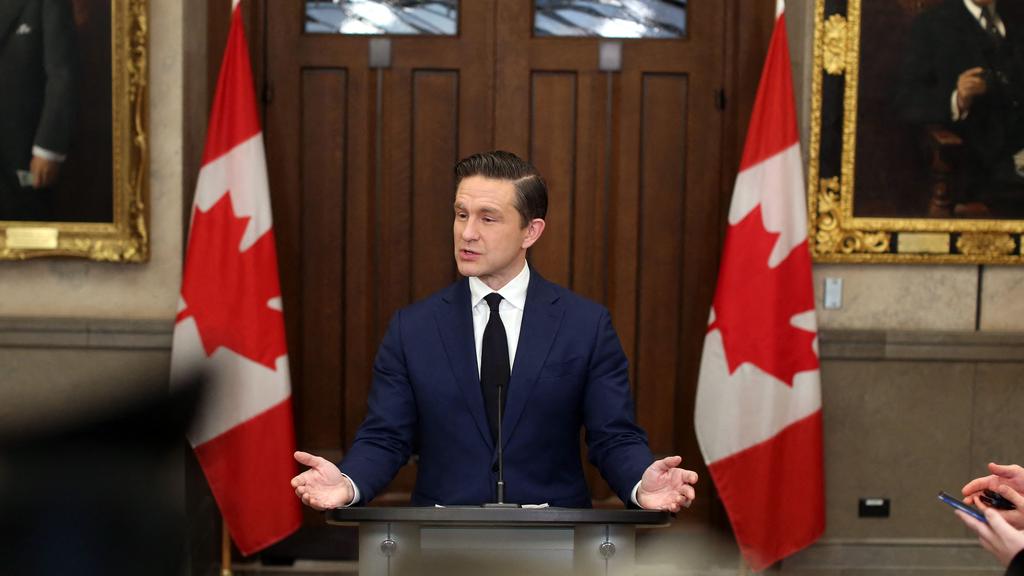
The joy is that he'll never have his time again, instead he's been reduced to a gadfly on the Emeritus Chairman's rump ... and the best he can do is seek out like minds, like the opening snap, featuring Conservative Party of Canada leader Pierre Poilievre speaks during a news conference in Ottawa. Picture: AFP


The mad monk is fond of using terms and concepts like "Anglosphere",  a reminder that The Turner Diaries aren't just something that turns up in films such as The Order ... (yes, it was shot in Canada and post-produced in Australia)...

Across the Anglosphere, recent conservative governments have tended to be in office but not really in power – because they lacked an agenda of their own or because what agenda they had was thwarted by a leftist establishment.
In 2016, Donald Trump was first elected on a promise to “drain the swamp” but eventually “the swamp” got him.
As someone who had never been in government and was unfamiliar with Washington, he had instincts rather than well-developed policies or even well-thought-through ideas for how to develop policy.
So he churned through a series of cabinet outsiders, businessmen such as Rex Tillerson and generals such as Jim Mattis, who were clueless about making a difference or turned out to have little like-mindedness with their boss.
Trump’s cuts to red tape and tax were enough to create an economic revival but his failure to tame the administrative state – which took over the pandemic response and then united behind a left-establishment challenger – doomed his first bid for a second term.

What always bemuses the pond is the way that politicians of the onion munching kind actually hate the concept of government and then wonder why they fail when in government.

 King Donald I is an excellent example, and naturally featured ... Donald Trump gestures at supporters as he holds hands with Melania Trump on election night in Florida. Picture: AFP


These snowflakes are always victims of the times and circumstances and dire enemies such as cardigan wearers ... but there are surely great times, always just ahead ...


The onion muncher is an expert at conjuring up explanations for dismal past failures, including his own and the likes of Boris ...

The British Conservative government first elected in 2010 was initially handicapped by being in a coalition with the centre-left Liberal Democrats, then internally divided over Brexit, then led from the insipid centre under Theresa May and finally sabotaged by a “remoaner” establishment that the previous Labour government had empowered via the Equality Act, devolution and changes to the judiciary that no Conservative leader had the gumption to repeal.
Boris Johnson had the potential to be a great prime minister but squandered working people’s support on the altar of climate change-driven policy gimmicks such as mandatory electric cars and heat pumps replacing gas boilers.

Cue interrupting (huge) snap of Former British prime minister Boris Johnson. Picture: AFP


Then thar he blows, in his Cher moment, If the clock could be turned back. Sing along, if I could turn back time...

Eventually, furious conservative voters with an understandable desire to punish the party that had let them down ended up punishing themselves by electing an incompetent and clueless Labour government.
The Australian centre-right Liberal-Nationals Coalition government that I led into office in 2013 started strongly enough by stopping a wave of illegal immigration by small boat and by repealing a carbon tax and a mining tax. But Senate obstruction sabotaged its first, economically reforming budget and internal policy differences then led to a revolving-door prime ministership.
If the clock could be turned back, I would have insisted all my frontbenchers provide a detailed blueprint of what needed to change to make a difference in their portfolio area, and explain how their proposed changes reflected our “smaller government, bigger citizen” political instincts.
I would have insisted that at least a version of their thinking be made public well before an election. That way the bureaucracy – or at least that section of it still motivated by traditional Westminster ideals of impartial public service – would have had more guidance in policy formation.
And incoming elected and accountable ministers would’ve been less susceptible to being snowed by unelected and unaccountable officials. An example of this was the introduction, by ministers who had been captured by bureaucrats, of the social engineering, gender fluidity encouraging Safe Schools program that was masquerading as an anti-bullying initiative, even though it had been devised under my predecessors.
This is where incoming ministers need to have thought through all the key issues they are likely to deal with and be sufficiently robust to interrogate and stand up to officials urging caution or assuring them that the “experts” know best.
Judging by the blizzard of announcements and appointments since his 2024 election, Trump is much better prepared this time. He seems to have used his time out to ponder how he may do better and since his election he has been acting quickly. It’s not clear how much collaboration there was between Trump’s team and efforts such as the Heritage Foundation’s Project 2025, but at least a group of clever policy analysts at various think tanks has been pondering doable centre-right options for the incoming administration.
If I had my time again, I would have worked in advance with like-minded institutes to prepare more detailed plans for key incoming ministers rather than have them largely directed by the bureaucracy based on sometimes thin pre-election policy announcements.
Winning an election on a promise to be different and subsequently having to make excuses when not enough changes is the trap to be avoided by every centre-right political movement on the verge of victory.

How wondrously pathetic, how perfectly coulda woulda shoulda ...

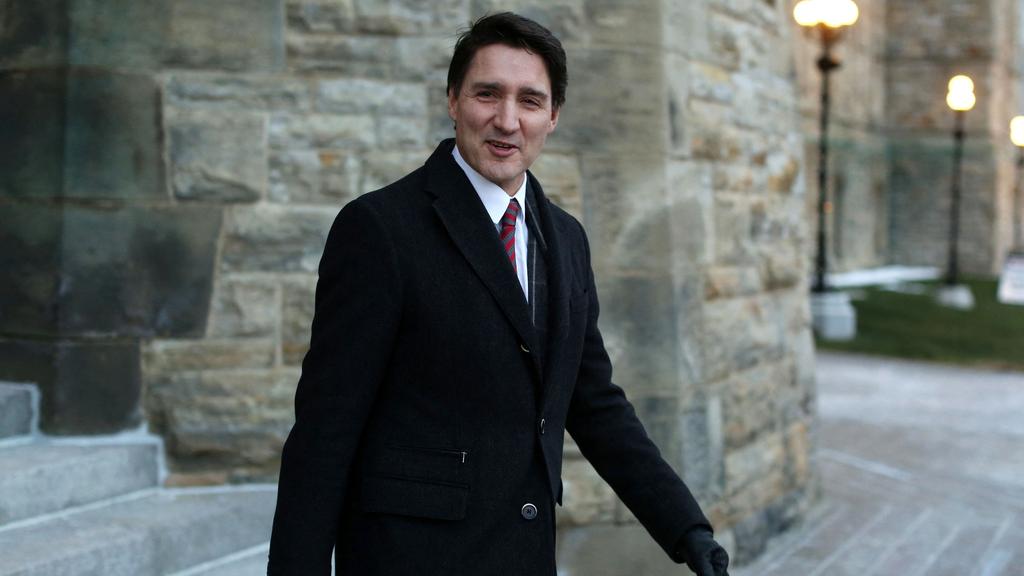
And then it's off to Canada ...Canada's Prime Minister Justin Trudeau. Picture: AFP


As well as wanting to turn back time, the onion muncher wants to repeat himself ...

In a recent op-ed for Canada’s National Post I set out this track record for centre-right parties and offered some advice on how best to avoid these trap for incoming governments, as the turmoil in Justin Trudeau’s government suggests a future Conservative win in Canada is ever more likely.
Naturally enough, shrewd politician that he is, Conservative leader Pierre Poilievre will be taking nothing for granted and will be trying to win every possible vote. Still, after almost a decade of Liberal rule, culminating in a housing crisis, a cost-of-living crunch and a crime wave, a smart opposition would be thinking almost as much about how to govern well as about how to win the coming election.
Up against a shop-soiled government, winning an election is the relatively easy part of an opposition party’s job; the hard part is getting ready to run a good government, especially with the bureaucracy, judiciary and upper house all likely to be obstructive.
Even a big majority in the Canadian House of Commons does not guarantee that an incoming Poilievre government will be able to implement a strong conservative program.
For one thing, incoming ministers – most of whom will have little practical government experience – will face difficulties with policy implemen­tation.
For another, Canada’s appointed-until-retirement Senate is stacked with political progressives who are bound to be, at best, sceptical towards the new government. And Canada lacks even the hard-to-do and rarely used mechanisms for breaking a deadlock between the two houses of parliament and for changing the Constitution to overcome judicial activism that Australia has.
This is where it’s especially important for an incoming Canadian government to have the strong and explicit mandate for change that only detailed policy proposals can generate.
Across the past two years, Poilievre has brilliantly mobilised and crystallised opposition to the Trudeau government with his political mantra: axe the tax, build the homes, fix the budget, stop the crime. This clearly identifies some of the key problems an incoming government will tackle but is less clear about how that might be done. It’s never easy in opposition to get the balance right between saying too much and too little.
But the more specific an opposition party that’s about to form a government can be, the likelier it will be to succeed, because when voters back a clear and specific plan, that signals to all the unelected senators, bureaucrats and judges that the public wants the proposed changes.
The winds of change are sweeping across the Anglosphere. Poilievre can ensure that this will mean more than voting out the failed incumbent; it will mean delivering a new agenda for a better Canada.
Tony Abbott was prime minister from 2013 to 2015.

There we go, more mindless blather about the Anglosphere. The Turner Diaries aren't far from his heart.

2015 and now it's 2025, and visiting the mad monk is like discovering a sock gone mouldy in the Sydney humidity.

Here, have a nostalgic moment to celebrate his passing, spinning the platters that matter to amuse the mugs in the trenches.


As for the Caterist, he was out and about this day with Brown’s Greens wouldn’t recognise their own party under Bandt, Bob Brown was inclined to be passionate, but he seldom let his passions get the better of him. Anthony Albanese is unlikely to find Adam Bandt as accommodating if the 2025 election results in a hung parliament.

There's something particularly fragrant, piquant, like the smell of an outdoor dunny in Tamworth during the summer season, watching the Caterist pretend that he's a guardian of greenie traditions, and can speak for Bob Brown.

This journey began with a snap, Leader of the Australian Greens Adam Bandt and Anthony Albanese during Question Time at Parliament House in Canberra. Picture: Martin Ollman


Then it was into the rant, a tiresome outing by an extremely tiresome man, growing ever more tired in his weekly outings.

In the annals of identity politics, Penny Wong lays claim to the title of Australia’s first openly gay government minister.
Yet as a loyal ALP senator she put her own feelings to one side in the 2010 election campaign when she was questioned about gay marriage in a Channel 10 interview. ‘‘The party’s position is very clear that this is an institution that is between a man and a woman,” she said. ‘‘I am part of a party, and I support the party’s policies.”
The backlash, such as it was, was muted. The Star Observer labelled Wong a hypocrite and Bob Brown declared he was “horrified”. Yet his horror was not so great as to prevent the Greens leader from signing a coalition agreement with Julia Gillard five weeks later when the election didn’t go as well as the prime minister had hoped.
Brown was inclined to be passionate, but he seldom let his passions get the better of him. He understood politics offered no solutions, only trade-offs. “Here is a very good example of us saying, ‘we accept what the people of Australia say, and we’re moving to get them a good outcome’,” he told the ABC at the time.

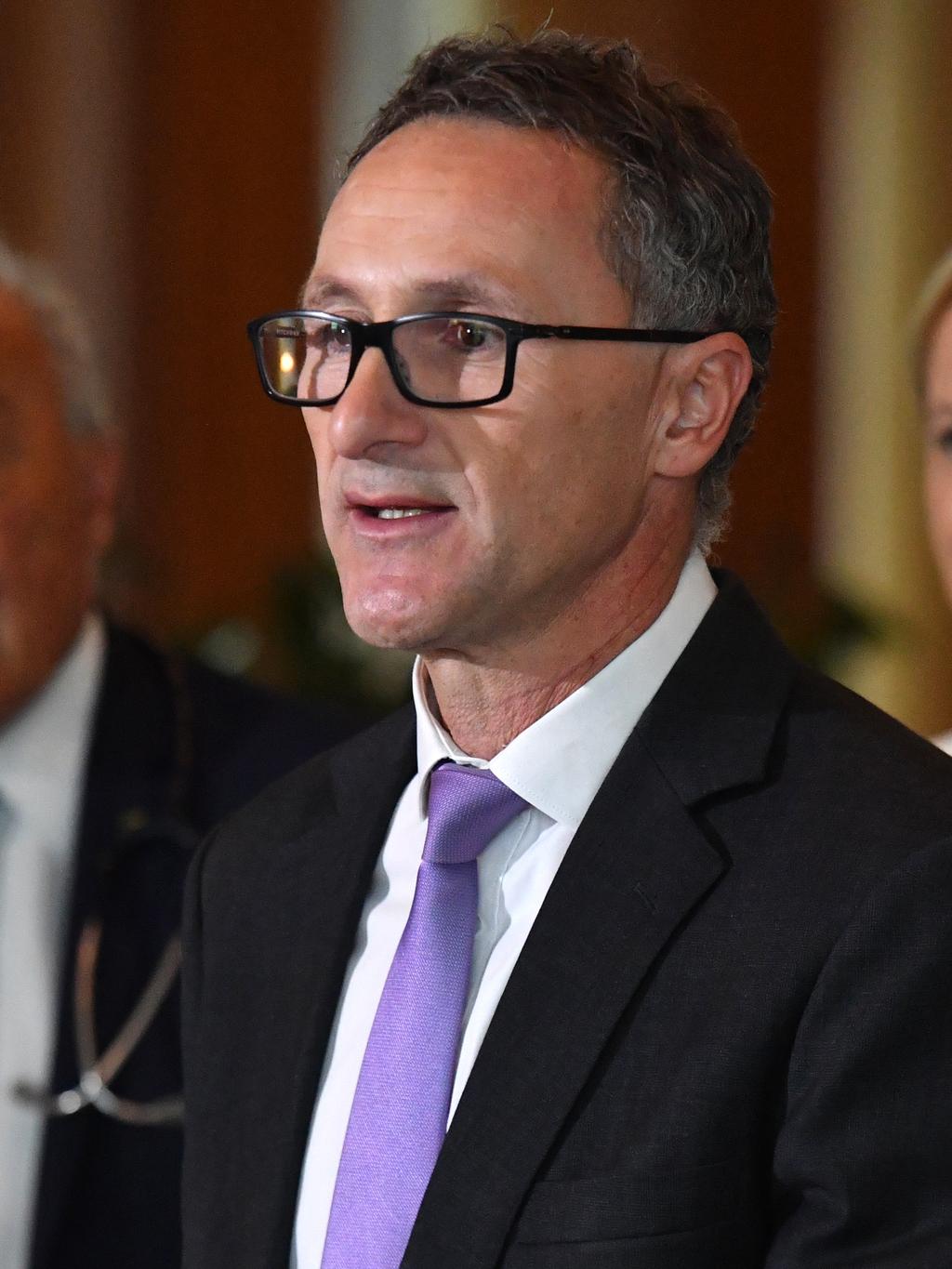
There is a point to this farce, and it's not the snaps of Bob Brown and Richard Di Natale.


It takes until the very last line for the Caterist to get there, and there's much distraction offered up before hand ...

Anthony Albanese is unlikely to find Adam Bandt as accommodating if the 2025 election results in a hung parliament, as conventional wisdom tells us it will. The Greens stopped playing by grown-ups’ rules about five years ago when the pragmatic Richard Di Natale resigned as leader and was replaced by the hardline Bandt.
The election of three new Greens MPs in 2022 and three more senators was seen as an endorsement of Bandt’s uncompromising radicalism. The Greens are no longer satisfied with incremental gains in bending the arc of the moral universe towards justice. The new regime’s strategy is not to persuade but to conquer.
For Bandt, legalising same-sex marriage wasn’t a victory but merely the elimination of “one part of a system that bombards LGBTIQ people from every angle”. Trans rights are non-negotiable, Bandt assures his followers on social media. Gender-affirming healthcare should be free on Medicare. The carbon tax Brown persuaded Gillard to adopt was a sellout. Now, the Greens demand the immediate cessation of coalmining and gas extraction.
Bandt calls for “radical, nonviolent civil disobedience against big corporations backed by the state”. He supports Extinction Rebellion’s tactics of shutting down the streets but says “there needs to be more … more protests, more rallies and more power and wealth back to the people”.
His rhetoric in recent months signals his intention to draw Labor into a governing partnership if neither major party achieves a clear majority at the election. If Albanese were to accept an agreement on Bandt’s terms, the country would be in deep trouble.

Yes, yes, the greenies are a dire threat, terrify the hive mind with a snap ...Leader of the Australian Greens Adam Bandt, Senator Sarah Hanson-Young, Senator Larissa Waters, Senator Nick McKim and Max Chandler-Mather MP hold a press conference at Parliament House in Canberra.


Naturally the Caterist was amongst the terrified, the terrorised ... you know, the long march, the Commie swine, the filthy Marxists, etc., etc., the climate scientists, yadda yadda ...

The contraction of the resources sector would constrain Australia’s wealth-earning capacity for decades. The adoption of Bandt’s fiscally incontinent policies of including dental and mental care in Medicare, waiving students’ debt and the wholesale construction of public housing would entrench a suicidal level of recurrent public spending. Yet Bandt, believe it or not, is the acceptable face of today’s Greens. Wealth redistribution and climate change justice are merely the beginning.
The Greens no longer are content with changing institutions. Their goal is to pull them down.
The ideological ambitions of today’s Greens extend far beyond the preservation of the natural environment. Their goal is a full-scale cultural revolution replacing individual rights with group-identity-based rights, the race-based redistribution of wealth and power, the silencing of dissent and the collapse of the old order.
The path the Greens have taken towards a racially charged, new Marxist agenda mimics the transformation of the US progressive left analysed by Christopher Rufo in America’s Cultural Revolution: How the Radical Left Conquered Everything, one of the most important books published since the advent of the Black Lives Matter movement.

Want an irony? How about I get by with a little help from my friends, Frank Bongiorno reviews Nick Cater’s The Lucky Culture, from 2013, concluding this way, co-joining the onion muncher and the Caterist ...

...I often think of the sage advice of Mr Chips to his schoolboys when their Latin lesson at Brookfield School during the first world war was disrupted by a German air-raid: don’t judge the importance of something by the noise it makes. Whether Cater’s book presages a renewal of the kind of culture wars that disfigured Australia during the Howard era is unclear. Cater might be up for it, but Abbott may well turn out a more reluctant warrior than the neo-cons at the Australian would like. Perpetual warfare with a third or so of the population no doubt looks more attractive from News offices in Wapping and Surry Hills than from inside the political bunker, especially to a potential prime minister desperate, for sensible electoral reasons, to moderate his image as the hard man of Australian politics.

Those were the days, and meanwhile, it's back to the lizard Oz supporting the Gaza genocide with an AV distraction, Greens Leader Adam Bandt claims Labor is “slowly moving” towards his party’s position on the Israel-Hamas war. The minor party has been calling for a ceasefire shortly after the October 7 attack. During an interview, Mr Bandt says the Albanese government agreed a ceasefire was necessary after supporting a UN motion earlier this month. The Greens leader believes Labor has been “forced to admit” his party was “right all along” regarding Middle East policy.


Back to that irony ... 

This at the start ...

When I read that Nick Cater, a senior editor at the Australian, was writing a book about “the rise of an Australian ruling class” I was a little puzzled. The only people I knew who still talked and wrote about “an Australian ruling class” were a few irrepressible Marxist friends and colleagues. And although I was unfamiliar with Cater, it seemed implausible that Rupert Murdoch would permit one of that small band of true believers to exercise any influence over the flagship of his Australian fleet.
The mystery, of course, was soon solved. Cater’s “ruling class” was the same crowd that John Howard called “elites” and others, following the Yugoslav communist Milovan Đilas, called “the new class.” The average reader of Inside Story is a member of Cater’s “ruling class.” So is its editor, Peter Browne, and probably all of the contributors. But Nick Cater, oddly, isn’t – despite his tertiary education, cultural power and (I presume) hefty salary; and nor, apparently, is his multi-billionaire employer, Rupert Murdoch, although it’s difficult to tell because he only receives five entries in the index of this 300-page book. Gina Rinehart is mentioned once.
Cater’s “ruling class” is a self-serving, tertiary-educated middle class that believes itself superior in every way to ordinary Australians. Australia is a naturally virtuous and egalitarian country whose culture is being wrecked by this cosmopolitan clique. Cater occasionally pretends that his argument is not about left and right – that his elite crosses political boundaries. The pose should not be taken too seriously, for Cater is a right-wing author, and much of his book is given over to intemperate attacks on the usual targets of such authors in this country: “progressives,” environmentalists, refugees, the ABC, universities, the Human Rights Commission, the National Museum, the external affairs power and the Labor Party. Other people – notably “progressives” – have ideology; Cater and the ordinary Australians for whom he professes boundless admiration have common sense.

2013, and yet here we still are ... though these days the Caterist enjoys a sinecure at an organisation partly funded by the Australian taxpayer ...

Rufo traces the revolutionary left’s conscious strategy from the 1960s onwards of the long march through the institutions starting with the universities. The embrace of critical theory and the high-minded condemnation of “isms” – capitalism, imperialism, sexism and colonialism – were the means for radicalising academe. The strategy is set out in the writings of the movement’s intellectual leaders like Herbert Marcuse, Angela Davis, Paula Freire and Derek Bell, none of whom were squeamish about declaring allegiance to a Marxist cultural revolution.
With the BLM movement, America’s cultural revolution reached its endgame, Rufo writes. Herbert Marcuse’s critical theory of society, which he developed in near obscurity, has embedded itself in every major institution from Ivy League universities to Fortune 100 corporations.
Anti-racism has become a substitute for morality. Society is divided along a crude moral boundary of “racist” and “anti-racist”. The Greens have been captured by this subversive narrative, particularly in the Senate under Bandt’s deputy, Mehreen Faruqi. Faruqi fell for the BLM line and its crazy conclusion that the way to fight racism was to de-fund the police.
“In Australia, we should be having the same conversations about the viability of a so-called justice system that perpetrates violence on Indigenous people,” she said after attending a BLM rally in Sydney in June 2020. “We should not be afraid of a conversation about rethinking the very idea of policing and incarceration.”

Naturally there has to be a demonic figure for these modern times, and here she is ...Senator Mehreen Faruqi.



Her thought crime?

Faruqi says the country that welcomed her as a migrant from Pakistan more than 30 years ago is beset by racism.“We must proactively dismantle the racist system we live in, a system that oppresses and silences people of colour.” When the Senate passed a motion congratulating the King on his accession to the throne, Faruqi switched to full victimhood mode, declaring it “a painful reminder to people of colour like me, who migrated here from a place that was colonised, ravaged and looted by this very British Empire”.

Well yes, millions died in the partition and millions more were displaced, and while it's possible to argue about the numbers, it isn't possible to avoid the blight that the British Empire produced inn the sub-continent, and elsewhere, most notably the middle east. Nor is it easy to ignore the racism inherent in the way references to the Anglosphere trippingly emanate from the tongue of the onion muncher.

Sorry, the pond didn't mean to interrupt the one time sociology student, latterly 'flood waters in quarries' expert ...

Faruqi’s essentialist view of race, and claim to special status as a “person of colour”, is not shared in the wider community. Her demand for the abolition of horse racing on cruelty grounds and her ritual petulant performance on Melbourne Cup day is further evidence of a Senator who is off with the fairies, wholly unsuited to the administration of public affairs. 

Actually there's a lot to be said for taking out horse racing (and dog racing while we're at it), and what a relief it was to read stories such as Melbourne Cup forced to seek new appeal as race no longer stops the nation.

Even Sky News had a sob story, 'Turn their back on it': Bruce McAvaney's sad confession about the Melbourne Cup, Legendary commentator Bruce McAvaney has confessed that horse racing's greatest prize, the Melbourne Cup, is now the race that "no longer stops the nation". (caution, Murdochian link)

But now to the real point of the story. The Caterist, and other reptiles, are clearly terrified that all their campaigning will see a hung parliament, which would see a revival of greenies working with Labor.

It's unthinkable, a betrayal, endless suffering, endless hysteria, and that's why the Caterist purported that he could channel Bob Brown, like ectoplasm emanating from a Caterist nostril ...

A Labor-Greens partnership should be unthinkable while Faruqi remains deputy leader, controlling the passage of legislation through the upper house.
As leader of business in the House of Representatives under Gillard, Albanese would be aware of the damage to Labor’s reputation from its 2010-13 alliance with the Greens. By comparison with today’s Greens leaders, Brown stands out as a moderate and eminently reasonable.
The Prime Minister would be well advised to rule out negotiations with Bandt and Faruqi in the event of a hung parliament, together with any suggestion of an exchange of preferences. He might contemplate the Bible’s message in the Book of Proverbs: “He that walketh with wise men shall be wise: but a companion of fools shall be destroyed.”

That biblical quote said with a monstrous lack of self-awareness, proving that the pundits might well be right, and that the silly Xmas season has lasted into this Monday ...

Why do they despair? Surely all will be well? Surely the undertoad is waiting in the waves, while an actual undertoad lurks on the beach, expectant and hoping?


Sunday, January 05, 2025

In which Polonius is as usual the pond's Sunday seer, while the lizard Oz editorialist helps set the 2025 war in motion ...


The pond remains entranced by the state of things in the US, which has led to some splendid suggestions, Why Don’t the Tech Bros Just Hire from MAGA?, (paywall), and some splendid comparisons ...Before Crackpot RFKism There Was Crackpot Lysenkoism.

Better still, Uncle Leon has taken to monstering the Poms and the Germans, as recorded in Trolling the UK: the issues enraging Elon Musk, world's richest 'pub bore'.

Andrew Egger tried to make sense of it in The GOP's Twin Stars:

How does a conversation driven by Musk differ from one driven by Trump?
For starters, Trump is an online creator, but he isn’t much of an internet consumer. He cooks his brain the old-fashioned way, by mainlining the boob tube. He doesn’t even read articles on his phone; he has a lackey lug around a portable printer to keep him supplied with hard copies. And he rarely thinks about the world outside America beyond the degree it impacts himself.
Musk, by contrast, is a true power user/abuser of the internet, which means his attention span is cooked and his serial obsessions are wide-ranging and bizarre. Two weeks ago, there wasn’t a thing Musk cared about more than U.S. government spending. Today, as Republicans gear up to elect a speaker who will set their spending agenda, Musk is spending double-digit hours posting dozens of times about unprosecuted gang rape in northern England. (We’re sure Mike Johnson appreciates the absence of attention.)
This highlights another striking difference: Unlike Trump, Musk isn’t even putatively “America First” in any meaningful way. We’ve long joked about how American “nationalists” see other nations’ nationalists—rather than their own compatriots who disagree with them about politics—as their closest allies. But Musk has lately been taking this to new extremes. First it was his endorsement of Germany’s extreme AfD party. This week, it’s been his support for hard-right British figures like soccer hooligan turned anti-Muslim activist Tommy Robinson. Musk’s agenda isn’t national at all; he wants to ringlead a global populist movement.
What any of this means for our politics remains to be seen. But the “President Musk” stuff doesn’t seem to be going away anytime soon. Even if Trump tires of his schtick or starts to resent his place in the spotlight, Musk has his own massive megaphone and seemingly unlimited wealth. Going forward, the MAGA solar system orbits around two stars, each burning out in its own special way.

Sadly the reptiles at the lizard Oz aren't that keen on world affairs of late. Instead they seem super keen to stoke the fires of the 2025 domestic election war.

As a noble foot soldier in the cause, prattling Polonius was at the gates, preaching Don’t bet the rent on minority ALP government, The fact no first-term federal government has been defeated since 1931 is no guarantee the Albanese government will be returned with the support of the Greens. In politics, precedent means nothing.

That header seemed something of a mixed message, but the caption underneath the first header helped clarify Polonius's message ... Anthony Albanese faces an uncertain year, despite what the pundits are saying.


A pundit preaching about pundits, for just the right amount of post-ironic flavouring.

Frankly the pond hasn't the slightest interest in it all, not even the way that the reptiles keep on recycling images ...


And so on and on, as the tattered remnants of the graphics department at the lizard Oz flails and failes ... but never mind, it's Sunday, and Polonius traditionally has the floor, a bit like heading off to the Domain to hear Webster. Current speakers and hours uncertain.


BTW, the AGNSW seen in the b/g of that snap has dusted itself off and is well worth a visit ... the gallery has done some sensible rotations and comical juxtapositions of old and new, and has made an attempt to lift the amount of new works on display, as well as some oldies that amused the pond ...


Credit where credit is due ...


Eek, a Muslim Australian, what would the reptiles say?

Speaking of squatters, time to hear from the Sydney CBD squatter fond of repeating himself, and even fonder of boasting about how he loves to repeat himself ...

I am fond of writing words to the effect “as the saying goes it’s unwise to make predictions about the future”. A reader advises that the maxim has many parents but it’s probably a proverb of an unknown Dane translated into English.
Whatever the origin, it’s good advice – which, as the record demonstrates, is not always heeded – in the lead-up to the election to be held before the end of May.
On January 8, 2024, economist and former Labor Party minister Craig Emerson began his Australian Financial Review column by stating that “political pundits are predicting a poor year for the Albanese government, but circumstances, serendipity and strategy suggest a different story”.
While conceding that “some forces shaping Australian politics … are beyond our control”, Emerson concluded by stating that “with deft economic and political management, the Albanese government can end 2024 in a strong, election-winning position”.
The various opinion polls, including the authoritative News­poll, indicate that this is not the case. Moreover, a lack of serendipity cannot be blamed for the outcome.

It's always wise to repeat snaps of the enemy, and so Prime Minister Anthony Albanese. Picture: Thomas Lisson interrupted the primordial bore:


That's guaranteed to send Polonius off and sure enough ... it's time for a potted Polonial history, as only he and our Henry can really do ...

Currently, some political soothsayers in our midst are predicting that the election will lead to a minority government, most likely headed by Labor. This was the apparent view expressed by the usually sensible election analyst Antony Green in an interview with ABC News Radio this week. Green may be correct. However, before engaging in suggestions, even of the vaguest kind, it is worth considering some guidelines.
In politics, precedent means nothing – unlike in the law. The fact no first-term Australian government has been defeated since 1931 – when the Joseph Lyons United Australia Party prevailed over Jim Scullin’s Labor government in a landslide – is irrelevant. For starters, this election occurred during the Depression. Moreover, there’s no Australian who voted in 1931 who is still alive.
The two-party system in Australia, which has prevailed since 1910, is not going anywhere. Not yet, anyway. After all, it is protected by Australia’s unique electoral system that combines compulsory and preferential voting. Major parties have faded or disappeared in Britain and Canada. But not in Australia or the US (as the 2024 election indicated) where different electoral systems prevail.
Independents are not invincible. It’s correct that independents who win seats from major parties are capable of serving long terms in the House of Representatives. This is partly because they are not close to government, or attempting to become part of a government, and have lots of time to spare attending local community events. Independents have been particularly successful in winning seats from the Coalition. But not all continued in politics.
In 2010, NSW independents Tony Windsor and Rob Oakeshott (both of whom had backgrounds in the Nationals) supported Labor prime minister Julia Gillard to form a minority government. Neither stood again in the 2013 election when the Coalition under Tony Abbott won both seats in a landslide victory.
In 2022, the teal independents won six seats from the Liberal Party: Curtin in Western Australia; Goldstein and Kooyong in Victoria; and Mackellar, Wentworth and North Sydney in NSW.
All except Wentworth are on relatively small margins and all seats were won on Labor and/or Greens preferences. To the extent that Anthony Albanese and his government are unpopular, some teals will be subjected to Peter Dutton’s line that a vote for the teals is a vote for Labor.

At this point, with the pond wondering if the reptiles had paid Clive hard cash for the use of the pending patented "teal", cue a snap of the hero Opposition Leader Peter Dutton. Picture: Roy VanDerVegt/ NewsWire


Phew, each time the pond sees a snap of that former Queensland plod, the pond blanches ... it always seems an ominous portending of things to come, or of things that have already been ...


Never mind, a prognosticating Polonius helps keep Sunday a sleepy affair ...

The Greens political party and a Muslim political party are unlikely to inherit the Australian political earth – in the short term, at least. Despite much attention in large sections of the mainstream media, the Greens, under Adam Bandt’s leadership, are not making significant gains.
Indeed, a recent Resolve poll in Nine newspapers suggests that some younger voters have moved their support away from the Greens and towards Labor and the Coalition in recent months.
The Opposition Leader has called on the Prime Minister to demonstrate his opposition to anti-Semitism “flourishing within the Greens political party” and put the Greens last on Labor’s how-to-vote cards. Albanese has not reciprocated. Yet, in the long term, the Greens are a greater threat to Labor than the Coalition.
Obviously, not all Australian Muslims hold the same political views. Most vote Labor. But some support the Coalition. Even if all Muslims voted for a Muslim political party there would not be enough voters to elect a Muslim political party MP in western Sydney. As mentioned, the Coalition is likely to put Labor ahead of the Greens and/or a Muslim party in western Sydney seats such as Blaxland, McMahon and Watson.
In view of this, it is unlikely that Labor will lose seats to the Greens or a Muslim party in its safest Sydney seats.
Popularity does not matter all the time. As I have argued consistently, the four Liberals who led their party to victory from opposition were not popular. And all were politically conservative at the time. The reference is to Robert Menzies (1949), Malcolm Fraser (1975), John Howard (1996) and Abbott (2013).
As is widely known, at times of economic stress more voters in democracies are personally focused on the economy. The Albanese government’s particular problem does not merely focus on inflation and interest rates.
As research undertaken for Liberal senator Dean Smith by the Commonwealth Parliamentary Library reveals, costs for basic products such as insurance, gas, eggs, tobacco and vehicle spare parts have increased by more than 20 per cent between March 2022 and the September 2024 financial quarter. This is well above the underlying rate of inflation.

Oh no, not the eggies thingie goes down under...


As for the cost of insurance, is it possible to mention the unmentionable, that which shall go nameless in reptile circles?


And so to the final Polonial word ...

The task of the Albanese government is to convince voters that their economic lot will improve. It’s a difficult but not impossible task. Something that is clearly not understood by The Economist. After all, its coverage of Australia in its The World Ahead Report 2025 states that “given disarray in the conservative opposition, the government is set to win a new term in the lower house elections”.
There is no evidence that the Coalition is in disarray. And no certainty that the Albanese government will be returned with the support of the Greens and independents.
Making predictions about the future invariably carries with it the potential for reputational damage.

There you have it, and those who fancy a chuckle at Polonius imagining he has a reputation that might suffer reputational damage from daring to put a predictive toe in the war can start the jaffas rolling down the aisles ...

Meanwhile, as noted yesterday, the reptiles are intent on bringing the war on, and the sooner the better ...


Really reptiles? Can there be no peace in sacred January, when tradies plan their strategy to buy an even more offensive-looking truck with which to litter Sydney streets, while lolling on the beach in the sun ...

On the upside, there's a short way of catching up on the war, and that's to revert to the lizard Oz editorialist ... as in Dutton’s counter-revolution to win back the battlers, Peter Dutton has set his sights on the basics, promising to restore the good economic management and conservative social policy approach of John Howard and Peter Costello.

You might have thought he'd promised to nuke the country to save the planet, but the reptiles weren't convinced and had other fish to fry ... it's the basics, dude, the basics ...

The battleground for the coming federal election is starting to take shape. Anthony Albanese says sticking with Labor represents a vote for the future. Peter Dutton has set his sights on the basics, promising to restore the good economic management and conservative social policy approach of John Howard and Peter Costello. As the perception of a golden era under the Howard-Costello team is burnished in the face of the current harsh economic times, both have stepped up their public interventions as the Albanese government’s fortunes have waned.

Yep, the reptile campaign is starting to take shape. Roll out incessant stories featuring the lying rodent and Petey boy, burnishing their legacy, and never mind that unfortunate spectacle of a PM losing his seat, tossed out on his ragged bum ...

Suddenly it's the golden era, a golden era to rival the golden era of Ming the Merciless, a golden era beloved of nashos sent off to smash the Commie domino swine with splendid success ...

This week Mr Howard and Mr Costello criticised the Albanese government’s financial management, arguing the failure to arrest spending had put upward pressure on inflation and interest rates, worsening cost of living, while the economy had lost competitiveness and productivity was in decline. Jim Chalmers is promising that things will get better. But voters need more than promises. Both sides of politics have a lot of work to do between now and the election to explain exactly in detail what they intend to do. For the Opposition Leader, economic reform will not take care of itself; just as the Prime Minister’s promise of exciting new times ahead does not automatically translate into a better standard of living for middle Australia.

Better yet, pose deeply philosophical questions as only simplistic - here no conflict of interest, no conflict of interest here - Simon can do ... 

As political editor Simon Benson writes on Saturday, the next election is a tournament of deep philosophical dispute that goes to the purpose of government itself. The Albanese government’s first term has increased the footprint of government dramatically through wage subsidies for low-paid care economy jobs and vastly expanded the reach of the public sector. It has sought to tackle cost-of-living pressures through government handouts for electricity and childcare that have made the challenge of cutting inflation only more difficult for the Reserve Bank. The Albanese government has intervened further by revising the architecture of key economic institutions including the Reserve Bank and Productivity Commission. It has undertaken a bold experiment in reforming the nation’s energy system in a renewables-only approach; tested the boundaries on cultural reform with the voice referendum, and; been prepared to turn a deaf ear to concerns from the nation’s economic foundations of small business, where insolvencies are growing, big business, which has been hit with an unexpected overhaul of workplace laws that favour trade unions, and energy exporters, who have found themselves on the wrong side of the progressive climate change crusade.

Throw nattering "Ned" into the mix ...

Out of this, the Coalition has identified electoral opportunity in what it believes is a middle-class counter-revolution. Mr Dutton is working hard to prove the doubters wrong. And, as editor-at-large Paul Kelly has written, Labor again may have miscalculated the electoral appeal of another tough, conservative opposition leader as it did with Mr Howard and Tony Abbott, who managed to win the Treasury benches from Paul Keating and Kevin Rudd, respectively. Labor’s belief that Mr Dutton would be unelectable looks shaky given the latest Newspoll trends that show the 35-49-year-old voting demographic has turned sharply against Labor across the past six months. This is the same group that elected Scott Morrison in 2019, swung against him in 2022 and is now showing signs of deep displeasure with Mr Albanese.

Diss on Albo and celebrate the mutton Dutton ...

Mr Albanese’s loss of support proves the point that the business of government is more difficult than simply being a nice bloke. The enduring lesson is that voters will respond to strong leadership. Mr Dutton’s middle-class, counter-revolution strategy is designed to outflank Labor in the suburbs where Mr Howard won aspirational voters from Labor. Where Mr Albanese is asking voters to stick with the status quo, Mr Dutton is citing a sliding-doors moment in which the nation has a chance to dodge a bullet of three more years of Labor rule.

Attempt a little both siderism as a way of purporting and pretending to be neutral observers in the game ...  while sharpening fangs and claws ...

The challenge for both sides is to explain clearly what policies they have to deal with the fundamental problems that now beset the federal budget. By offering more of the same, Labor is putting its faith in the fact that bigger tax receipts from bracket creep will deal with the drag of increased government spending and higher debt payments. Voters ultimately are likely to lose patience with that approach. The Coalition is promising a return to budget discipline. This should include pegging government spending to a set proportion of GDP, as it was previously. Labor’s attack on Mr Dutton is that he will take things back to the future. On many of today’s cultural fancies that would be no bad thing. It also should be remembered that good economic management that gives incentive and rewards effort never goes out of style.

Yes, back to the 1950s and the picket fence, and what could possibly go wrong?

And there you have it, a reptile campaign strategy without a single mention of "nuclear"or the need to nuke the country to save the planet ... 

Forget the big spend on the nukes, just blather on about good old economic management of the lying rodent, Petey boy kind ... 

You know, A cost-of-living election: Howard ministers agreed to $4bn in last-minute spending in 2004, Cabinet papers released on 1 January show senior ministers signed off on funding the day parliament was dissolved before the October 2004 election

Yep, sound economic management, aka a boondoggle, pork-barrelling, back scratching, logrolling, payola, and perquisites and perks ... as in ...

The day parliament was dissolved for the 2004 federal election, senior Howard government ministers met to authorise almost $4bn in sweeteners to announce during the election campaign.
A cabinet minute from 31 August 2004 records that three of the biggest spending promises Howard announced in the five ensuing weeks were signed off at that meeting in the government’s final hours.
Released by the National Archives on 1 January, the records of cabinet’s deliberations throughout 2004 show Howard and his colleagues were acutely conscious of the politics of their decisions as they prepared to seek re-election.
In that 11th-hour meeting, a pared-down cabinet of unnamed “senior ministers” allocated more than $1.7bn to increase the Medicare rebate for all GP visits from 85% to 100%, to take effect from the following January. They spent another $1bn for a new tax rebate of up to $500 for mature-age workers – backdated to 1 July – and $83m increasing the rebate for local medical services to veterans from 100% to 115% of the schedule fee. That was on top of a veterans’ access payment which Howard had authorised the day before.
The previous day, cabinet’s national security committee had directed that legislation be drafted to implement the recommendations of a recently completed national intelligence review and authorised millions of dollars in extra funding for agencies.

Meanwhile, on with the new year in all its promise ...


And finally, speaking of the Streisand Bezos effect, Ann Telnaes on Why I'm quitting the Washington Post... as they say, “Democracy dies in darkness” (or in the hands of billionaire oligarchs) ...


Saturday, January 04, 2025

In the spirit of the rapidly closing Xmas season, the pond offers up a craven Craven, the Bjorn-again one and sociopathic Russian cheer ...


With the twelve days of Xmas almost done - as a reformed tyke, the pond takes the traditional view that the 5th January, Epiphany Eve or as Shakspere would have it, twelfth night, is the end of it all - looking back the pond was pleased to see how free of religious crankery, the war on Xmas, etc etc, that the reptiles managed to be, and so the pond.

The reptiles, and so the pond, meant no harm in not celebrating the Feast of Circumcision day, but in the usual way, of course the pond had basked in its freedom from Xmas, and had scribbled, in an optimistic, delusional way far too soon. 

There had to be at least one full on domestic Xmas war atop the digital edition ...


Dammit, election mode at the very beginning of January? Couldn't the reptiles wait until after 26th January?

And there had to be at least one pious Xmas bore, some professional Xmas nutter riddled with hectoring, lecturing piety ... scan the extreme far right of the digital Oz and you'll come upon him, and lo, the first shall be last, and the last shall be first ...


What a relief, a craven Craven outburst and that meant that the pond didn't have to spend time with garrulous Gemma wilfully ignoring a genocide ...

The craven Craven was in full indignant spleen, and all the pond had to do was watch ...

Truth that transcends a materialist world, We compete to give the most expensive presents, resent others for not reciprocating, then gorge ourselves stupid on the day. A week later, we drink enough alcohol to inebriate Godzilla. Is this all Christmas is about now?

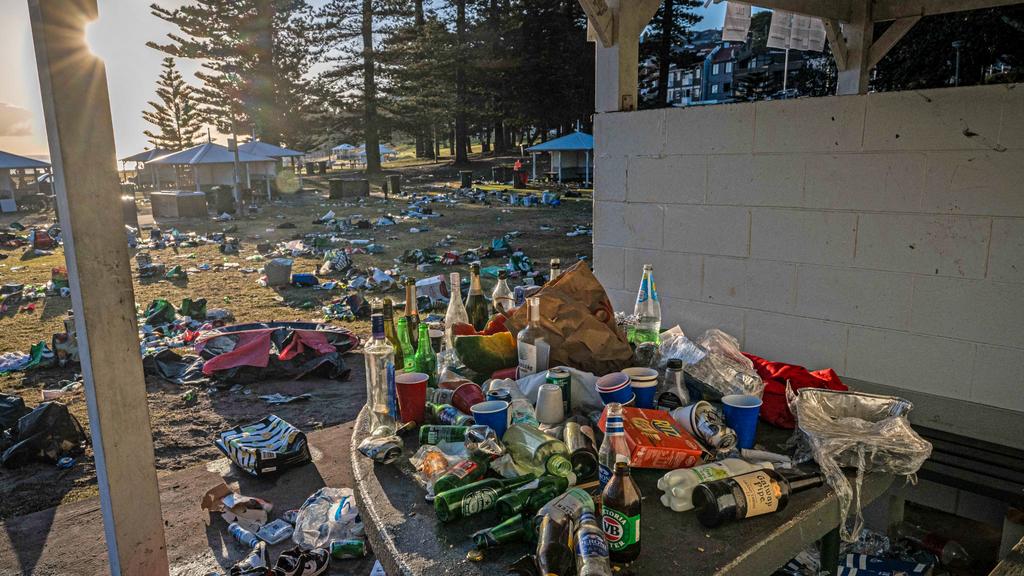
Who to blame? Those bloody English tourists, who littered Manly yesterday, as a shark patrolled the beach thirsting for their blood (there were also bluebottles, but the dragons were cute and out and about). 

Apparently they weren't just at Manly or Bondi. Bronte also felt the wrath of the tourist invasion, How the ‘festive’ season looked at Bronte Beach on the morning after Christmas, 2024. Picture: Flavio Brancaleone


Dammit, it wasn't just the tourist locust plague?There were local boofheads too?

That was enough to set the Craven off, and yes, the pond will say it again, all the pond had to do was sit back and watch.

Christmas and New Year’s are now safely past. The casualties have been counted and the implausible excuses workshopped. With just a touch of hindsight available, now is the time to ponder what on earth was going on.
Every festive season you can guarantee a certain number of depressing articles bemoaning the loss of the real meaning of Christmas and the excesses of December 31. This is one of those articles.
At least it is not at the thundering end of the spectrum. I am not threatening eternal damnation to those whose idea of a Christmas card is Visa or Mastercard plastic. Although a warning whiff of sulphur might be salutary.
This extended complaint is more sad than fulminatory. It’s just that I wonder where the transcendent meaning of Christmas – and what management consultants would call its net positives – has gone. The whole Christmas-New Year’s experience is now packaged under a brand name, The Festive Season.
What on earth does festive mean? It is not a word in common use. We do not have festive football premierships or – God help us – festive elections. The word comes from festival, which means some great celebration. It is first cousin to the idea of a feast, but not just any ceremonial tuck-in. Our notion of a celebratory December is inextricably linked to one of the great Christian feast days, the nativity of Jesus.

It wouldn't be a proper Xmas rant in the Catholic Boys' Daily without a snap of the main man, Pope Francis greets the crowd from the main balcony of St. Peter's basilica after the Urbi et Orbi message and blessing to the city and the world as part of Christmas celebrations on December 25. Picture: AFP


Then it was on with the ranting ...

Not that you would easily pick that up in these fallen days. Wandering about any of our capital cities over the past few weeks, you would think it was an extended industrial show for makers of tinsel and anatomically challenged plastic snowmen.
I do not want to be marked out as a religious crank – there is a long queue to do that already – but I admit to playing a sick little game every Christmas season. As I wander along the local shopping strip, which is saturated in festive decoration, I try to count the number of shops that show any recognition of the nativity that founded the whole thing.
These days my via dolorosa takes me down Military Road in Mosman. I have been doing it for 16 years now. Around 2008, about half the shops displayed at least some glancing recognition of the actual joy to the world. By 2016, it had fallen to about a quarter. This year, along the whole commercial heart of one of Sydney’s wealthiest suburbs, I spotted one small crib. Good on you, whoever put it up, but I suspect you lost custom.
I know that as an increasingly rare observant Catholic, I cannot expect everyone to buy into the whole reality of the virgin birth, the incarnation, the stable, the angels and the camels (my favourites). Mind you, it might be a sensible each-way investment against enduring the roiling fires of hell in the company of tedious unbelievers such as Tim Minchin and Phillip Adams.
But as a matter of common sense and imaginative intellectual capacity, it might be useful to recognise and celebrate the real values of Christmas, which are accessible to atheists and agnostics, alongside Christians and people of other faiths.

The pond is all for the real values of Xmas, and in that spirit offers up a sampling of Cunk. 

The pond isn't that big on Cunk, but in troubled times a Cunk in time saves nine ...


The pond does apologise for the interruption, do Cunk on in a free of Cunk way about the unrepayable gift of the nativity ...

The first is hope. In a thoroughly fallen world, where people are taken hostage, shot and starved every day, Christmas stands as a bonfire of hope. After all, what crazy, intemperate God would send his own son to suffer for and redeem humankind. If he is that maniacally generous, perhaps there is some modicum of hope for us all.
Even to dedicated God-deniers, that idea that hope is unquenchable whether by torture, starvation or persecution must have some resonance.
But the less commonly remarked virtue of Christmas is its gift of reflection. In the face of the vast, unrepayable gift of the nativity, what have we done to reciprocate? Are we so very certain about what nations we revile, what politicians we detest, which family members we forget to invite to Christmas dinner? We cannot even aspire to perfection. But we can at least let it simply illuminate our own grubby lives.
This is not the shallow reflection of the new year, where we set ourselves improbable targets for weight loss or unachievable ambitions for professional promotion, all the while spending like a drunken treasurer. It is when we admit the possibility that there is some badness within us, are sorry about it and at least try to do better.
Divine truth, evocative legend or the world’s most famous fairy story, Bethlehem impels us to this conclusion, regardless of race, religion or politics.

Speaking of fine fairy stories, the pond was deeply moved to see Xians at work, in Newborns are being left in dumpsters in Texas, but Republicans don't seem to care.

Talk about the Xmas spirit in action, but sorry, do keep ranting on ...

The great apologia for modern Christmas is that it is a festival of family. We gather together in our perpetually strained clans, augment them with a few genuinely dear friends and drink ourselves silly while showering each other with bargain sale presents.
There is quite a bit to be said for this. At least it brings the crazy aunt from Quirindi into the fold, even if it is only once a year.
But empathy comes at a price – literally. We compete to provide and receive the most expensive presents, resent others’ limited generosity, strive to put on the best Christmas dinner and gossip about the inebriation of old Bill after everyone has gone home. I know I do. Then on New Year’s Eve we have a repeat performance, but this time with fireworks and enough alcohol to inebriate Godzilla.

Splendid stuff, but we need another banal Xmas season snap to maintain the fury and the rage and the consigning of sinners to an endless eternity of hellfire. 

Come on down, Shoppers in the Pitt Street Mall in the Sydney CBD during the post-Christmas sales. Picture: Gaye Gerard/NewsWire


That did the trick, and sent the craven Craven off into another frenzy ...

The challenge is not merely that Christmas has become commercial, which it certainly has, but that it has become materialist. Not only was there no room in the original inn but there is no room for that translucent story in an orgy of turkey, reasonably decent wine and ear-piercing electronic dev­ices for the kids.
All of which is odd in a nation that ostentatiously pines for the spiritual. Millions genuinely seek or claim to be seeking something beyond the commercial veil. But even this desire struggles in an age of mindless mercantile self-help.
How often have you been regaled by someone waving the latest tome on self-realisation spouting that “I’m not religious, but I’m spiritual”. What on earth do they mean? By definition, the notion of spirituality involves believing in something beyond the human world. What is it for these cut-price mystics?
Too often, it is merely rebranded materialism. I believe in human actualisation, as expressed in a perfectly formed body. I demand that the planet be healed according to my personal prescription. I am a mystic raindrop therapist.
But however misdirected or amusing, all these desires go in a single direction: people long for a spiritual reality that transcends mere functional reality.
This is one of the reasons religion is growing, rather than shrinking, as a world phenomenon. In Australia, as old, white, cynical Catholics are deserting the pews, they are being replaced by young, vibrant, committed co-religionists from India and Africa.
More eccentrically, an Australia starved of spirituality has begun to manufacture or appropriate homegrown varieties.
The more extreme versions of climate crisis are obvious examples. The concept of Earth as a sort of incorporeal moral concept is celebrated from the worshippers of Greta Thunberg to nutters who glue themselves to major traffic facilities.
But perhaps the most fascinating example is European Australians who attempt to colonise an entirely genuine
Indigenous spirituality. They adopt and appropriate ancient practices and legends that not only are not theirs but that they would laugh out of any conventional redbrick church.
All of which shows that the desire of humankind for transcendence is ineradicable. It is a pity we cannot see it when it stares at us gently from a crib.
Greg Craven is former vice-chancellor of the Australian Catholic University.

Truly most excellent stuff, a splendid rant, and now in the continuing spirt of the season ...


Thanks George and so to a bonus from the Bjorn-again one, in the form of Smart and simple steps to a better world in 2025, Why aren’t we making more progress on lifting poverty in the world? In large measure it’s because in trying to focus on everything, we prioritise nothing. A new year offers a fresh opportunity.

...including a fresh opportunity to avoid discussing climate change, and its implications for world health.

The Bjorn-again one's piece opened with a flourish, Giving one multivitamin a day to a mother who is pregnant would mean her children grow up healthier, smarter and more productive. Picture: Glenn Hampson


The pond isn't sure that supplements are the solution. It seems like something of a first world solution.

Wouldn't a healthy diet be better for mother and child? You know, actually arrange for women and children and men in Gaza to be given access to food and medicine, instead of bunging on a genocide?

After all, the matter of supplements seems to be something of a first world issue, Is There Really Any Benefit to Multivitamins?

Half of all American adults—including 70 percent of those age 65 and older—take a multivitamin or another vitamin or mineral supplement regularly. The total price tag exceeds $12 billion per year—money that Johns Hopkins nutrition experts say might be better spent on nutrient-packed foods like fruit, vegetables, whole grains and low-fat dairy products.
In an editorial in the journal Annals of Internal Medicine titled “Enough Is Enough: Stop Wasting Money on Vitamin and Mineral Supplements,” Johns Hopkins researchers reviewed evidence about supplements, including three very recent studies:
  • An analysis of research involving 450,000 people, which found that multivitamins did not reduce risk for heart disease or cancer.
  • A study that tracked the mental functioning and multivitamin use of 5,947 men for 12 years found that multivitamins did not reduce risk for mental declines such as memory loss or slowed-down thinking.
  • A study of 1,708 heart attack survivors who took a high-dose multivitamin or placebo for up to 55 months. Rates of later heart attacks, heart surgeries and deaths were similar in the two groups.
Just asking for a friend who pops pills like they were candy, but  do go on ...

Now that we have closed out 2024 and are looking to the new year ahead, we can take the time during the holiday season to reflect on what we’ve achieved and how we can make 2025 better – achieve our goals, give back to our communities and contribute to the betterment of the world.
When we give, there’s no shortage of noble causes, from alleviating poverty and improving education to protecting the environment and advancing healthcare. We should, in theory, all align around shared aspirations to make 2025 a year of progress for all. But the hard truth is that global co-operation has struggled mightily during the past decade.
In 2015, the UN came up with a 169-point agenda to fix all the problems facing humanity by 2030. The so-called Sustainable Development Goals were agreed on by all the world’s leaders with the best of intentions.
Yet, with five years left to reach these goals, the world is wildly off-track on almost all 169 promises. The fight against poverty, disease and hunger has lost momentum.
Why aren’t we making more headway? In large measure it’s because we try to do too much. Trying to focus on everything means we have prioritised nothing and achieved very little.
A new year offers a fresh opportunity. Instead of trying to do it all – as a society but also as individuals with our own giving – we should focus first on the interventions that yield the most progress.
That means those that provide the highest returns on investment for people, the planet and future generations.
Here’s the catch: the best investments aren’t necessarily the ones that grab headlines or attract celebrity endorsements. I’ve worked with more than 100 of the world’s top economists and several Nobel laureates to find which of the many global goals deliver the most return on investment.
Across hundreds of pages of peer-reviewed, free analysis, we have identified the 12 smartest things we could do to make life better for the poorer half of the planet. These solutions are seldom making headlines but they are cheap and incredibly powerful.

Oh dear, whenever a snake oil salesman offers just 12 of the smartest things, you know you're being sold a pup.

Cue a snap ...

An Afghan burqa-clad woman asks for alms along a street in Badakhshan province in Afghanistan in December. Picture: AFP


Do the 12 smartest things include the abolition of barking mad fundamentalist religions, and their intolerance of women? You know, rid the world of fundie Xians, fundie Islamics, fundie Zionists, fundie Hindus, and so on and on, through the thousands of gods invented over the years ...

Of course not ...

When a pregnant mother lacks essential nutrients and vitamins, her child’s growth and brain development will be slower. Her kids will be condemned to doing worse throughout their entire lives.
A mere $US2.31 ($3.72) can ensure that an expectant mother receives a basic multivitamin supplement that means her children will grow up healthier, smarter and more productive.
Every dollar spent on nutritional supplements for pregnant women can yield up to $US38 in economic benefits. This is not a far-off utopia. It’s an actionable, proven solution that could be scaled up immediately.
Another simple but powerful investment is in improving learning. In the poorest countries, only one in 10 10-year-olds can read and write. We need to fix this, not just because it’s the right thing to do but also to reduce future strife and reliance on aid, and to ensure countries can write their own success stories.
Most schools group kids in classes by age, regardless of their ability. Some students struggle while others are bored. The solution is simple but transformative: teach children individually at the right level. Obviously, teachers can’t manage this for every child but technology can. Just one hour a day in front of a tablet with educational software can teach reading, writing and basic math.
Countless studies show that even if the other seven hours of daily schooling remain traditional and ineffective, after one year the student will have learned as much as normally takes three years.
The costs are modest: Sharing a tablet costs about $US31 a student per year. The return on investment is extraordinary; children who learn more become more productive adults, resulting in a return of $US65 for every dollar spent. This is a great long-term investment for a more stable, self-sufficient world.
There is a compelling case to focus on tackling the diseases that have already been wiped out in rich countries, such as malaria and tuberculosis, that have become diseases of poverty. The simple act of providing more anti-mosquito bed-nets and expanded malaria treatment across Africa would save 200,000 lives every year, with benefits worth $US48 for every dollar spent. Healthy, productive individuals are likelier to innovate, work and contribute to the world, ultimately benefiting everyone.

Um, so a tablet will wipe out bigotry, prejudice, hate, fear and loathing? 

Sorry, Bjorn-again one, the tech bros don't seem to have managed to work that magic in the United States ...


Sorry, the pond is feeling a little light headed, it being the seasonal thing ... 

This was the real snap to round out the Bjorn-again one's offering ... Volunteers and homeless people take part in a Christmas solidarity dinner called 'No Families Without Christmas' in front of the National Congress in Buenos Aires on December 24. Picture: AFP


Um, perhaps not the most astute reptile illustration, what with that Aljzeera story, Inflation down, poverty up as Milei takes chainsaw to Argentina's economy.

...To be sure, the belt-tightening that restored order to Argentina’s accounts has come at a steep social cost, triggering a punishing recession, an increase in unemployment and a fall in real wages across both the public and private sectors.
The brunt of the pain has fallen on the working class. Poverty surged to 53 percent in the first half of 2024, up from 40 percent in 2023 – the highest recorded jump in two decades. It has since dipped slightly to 50 percent, although the number of people estimated to be living in extreme poverty remains north of 6 million.
Nearly seven in 10 Argentinian children are growing up poor, up slightly compared with 2023, according to UNICEF. And 1 million boys and girls go to bed every day on an empty stomach.

No wonder there's a need for a solidarity dinner ...

And so to the final gobbet of inspirational snake-oil messaging ...

As we begin 2025, we need to stop chasing grand lists of unachievable goals and focus on what’s working. Our resolution should be to direct whatever resources we have – our time, attention, money or political will – towards the actions that bring about the greatest improvements in people’s lives.
In 2025, my hope for the world is that governments and institutions will finally stop dithering and focus on solutions that deliver the best returns. By concentrating on what works, we could achieve more in one year than we did in a decade of dithering.
As individuals, we can do our own small part to make 2025 the year we resolve to get serious about progress for all.
Bjorn Lomborg is president of the Copenhagen Consensus and visiting fellow at Stanford University’s Hoover Institution. His latest book is Best Things First.

What a splendid way for the world's greatest climate scientist to avoid talking about climate science and global warming ...

And so to a closing video offering, as bizarre as it is comical, surreal, sinister and desperate, a bit like a mix of Don Lane with Bert Newton.

It provides startling evidence that Vlad the impaler's state media folk are desperate to be Americans, right down to a threatening reference to a Tarantino film. 

As for the glitz and the kitsch, it almost out does America ... but pace the craven Craven, it's the spirit of the soon to close season ...


And here's another offering in the spirit of the Ruski season, and never mind the sociopathic Vlad the imapler taking out Ukraine ... why not take out Santa too ...