Sunday, December 29, 2024

In which Jennie and prattling Polonius manage another Hunger Games dead heat ...


Dear sweet long absent lord, when the judges sat down to consider the winner of the pond's Sunday hunger games, there was another dead heat ... perhaps out of an exhaustion that began early ...


Talk about the lucky country. It was simply impossible to separate out Jennie and prattling Polonius. 

Both were in seasonal celebration mode, both had splendid track records, and not even a racetrack camera could separate them by a nose.

As usual, one judge was outraged. There was a hugely amusing civil war unfolding in the United States. 

How could room be made for it if the pond indulged in a double header, instead of playing hard and sorting the reptile wind from the chaff?

To placate the tiresome judge, the pond wandered off to Axios for one of their potted summaries:

...Catch up quick: On Thursday, Musk ally and Department of Government Efficiency (DOGE) co-leader Vivek Ramaswamy posted a lengthy condemnation of American culture and its supposed embrace of mediocrity.
  • Musk spent the next 24 hours defending Ramaswamy and advancing his argument that America needs highly skilled immigrants to fill high-tech jobs.
  • That argument landed with a thud in the MAGA wing that wants to stop immigration and preserve jobs for American workers.
Zoom in: On Friday, cartoonist and right-wing commentator Scott Adams posted on X that MAGA was "taking a page from Democrats on how to lose elections while feeling good about themselves."
  • Musk agreed, and took it a step further.
  • "And those contemptible fools must be removed from the Republican Party, root and stem," he posted.
What they're saying: For people used to being called "deplorables" by Democrats, the condemnation from one of the most important advisors in Trump's inner circle stoked instant outrage.
  • "Calling people who have their country's best interests at heart and wanting to NOT sell out the American people 'contemptible fools' is the biggest L that I've seen Elon make in a long time. Dude needs to relax," gaming streamer Hooks posted.
  • Right-wing activist Laura Loomer tagged Trump in her message. "The Trump base is being replaced by Big Tech executives. So sad to see this. I feel so sad for MAGA," she said. Loomer has alleged Musk was censoring her for her opposition to his immigration comments.
  • Andrew Torba, the CEO of the far-right social network Gab, said in an X post: "He's declaring war on us btw. Should go over well for him as it has for everyone else who has tried."
Put it another way ... a devotee of trolls trolled by a mistress of trolling on the troll lover's home site. Sock it to the nutter, prime nutter Laura (the pond doesn't link to X, Y, or Z):

The elephant in the room is that  @elonmusk, who is not MAGA and never has been, is a total fucking drag on the Trump transition. @realDonaldTrump
 He’s a stage 5 clinger who over stayed his welcome at Mar a Lago in an effort to become Trump’s side piece and be the point man for all of his accomplices in big Tech to slither in to Mar a Lago. 
He told Bob Iger at @Disney to “go fuck himself” over Ad money, but he won’t tell Xi JinPing and Li Qiang to go fuck themselves and he’s perfectly happy to take their money to fund his Shanghai Giga Factory. 
Elon cock blocks the nominee meetings and tries to undermine anyone and everyone who doesn’t do his bidding. It’s wildly inappropriate how a guy with no experience in politics who has been a Democrat his entire life is now staffing the Trump admin. 
He’s completely compromised by the CCP and he has unfettered access to President Trump. 
This is fucked up and we need to stop it NOW! 
It’s the biggest elephant in the room and everyone is too scared to talk about it. 
Why is Jared Birchall, @elonmusk’s money manager who is also CEO of @neuralink ELON’S company that wants to put chips in everyone’s brains, at Mar a Lago interveiewing candidates to work at the state department? What the fuck are Jared’s qualifications aside from the fact that everyone who works for @elonmusk
 is a full time Xi JinPing dick sucker? How is he qualified to choose candidates to work in the State Department… you know the same @StateDept that’s supposed to handle CHINA? 
Hellllooooooooo @marcorubio what the hell are we doing here? 
Is this MAGA?
This is not “attention seeking” @elonmusk
It’s called accountability. You want to be so rich that you can bully everyone into not holding you accountable so you can pursue your own conflicts, which are EXTENSIVE. 
I’m happy to list all of them. 
I’ll need a larger character limit on X though to do that.

Put it another way. The subtards (so Uncle Leon calls them) are being verbally and monetarily assaulted, banned, banished, undone and sent to the cornfield:


It's a full-on civil war, Rolling Stone. It's all out, NBC. It's knee-capping time, Axios again. It's a helluva hill to climb. It's a Politico brawl.

Delicious. Even David Brooks joined in the braying, Why the New Fight Inside MAGA Matters So Much (paywall), concluding in a typically clownish both siderist way:

...the reactionaries have a point. One of my favorite sayings from psychology is that all of life is a series of daring explorations from a secure base. The reactionaries are right to point out that the past few decades of go-go change have eviscerated many people’s secure bases — stable families, vibrant hometowns, plausible career paths for those who didn’t want to go to college, the stable values that hold communities together.
I don’t know if Trumpism will ever evolve into a serious governing force, but if it does, then resolving the tension between its dynamists and its stasists will be its chief mission — that is, giving regular people a sense that they are being taken care of and seen, so that they feel secure enough to welcome all the bounty that skilled immigrants and technological change bring to our lives.
In its own cranky way, MAGA is now having an interesting internal debate.

Next time you see a cat and a dog go at it, conclude they're having an interesting internal debate. No wonder they're eating the cats and the dogs ...

Splendid stuff and perhaps the judge was right. Not even to the transition yet, and already in full squabble mode, with chaos sure to follow.



Up against that level of wankery, it's hard for local players, but some do try to do a Gout Gout in their own humble way.

Consider Jennie, consider her form guide. 

Jennie has been in training for a long time and is a worthy contender. Back on 4th February 2021 she had scribbled about The false promises of green-tech energy, The 100,000 ‘carbon workers’ in Australia deserve better than rubbery jobs figures about the transition to net-zero emissions.

Inter alia ...

...It was interesting to hear Scott Morrison embrace the mantra of green steel this week. The problem is that while it could provide opportunities for electric arc furnaces in mini-mills, it is not suited to blast-furnace steelmaking at Port Kembla. Again, it’s important not to raise false expectations.
It is a pity advocates of such technologies don’t tell the community the whole truth: that there are no proven and commercially viable technologies to replace coal/coke in the blast furnace steelmaking process at BlueScope in the Illawarra. Is it a just transition to see integrated steelmaking lost to the nation? Try convincing the thousands of workers and their families that this is the price they will have to pay.
Likewise, NSW’s Hunter region provides thousands of jobs in mining and coal-fired power generation. It will be particularly susceptible to proposed moves to carbon neutrality.
The Tomago aluminium smelter near Newcastle is a major employer whose future is problematic. The newly formed Hunter Jobs Alliance, led by the Australian Metal Workers Union and the Labor Environment Action Network, falsely raises expectations that the smelter could be powered by renewables in future.
It operates 24 hours a day, directly employs 950 people and produces 25 per cent of Australia’s aluminium. It is called on to reduce operations to avoid widespread blackouts when there is a system security risk.
Renewables are not commercially viable, nor can they guarantee the required reliability for the smelter’s continued operation. The largest South Australian battery today would power that smelter for less than 15 minutes.
Labor’s talk of a jobs and emissions compact and the government’s technology roadmap will be critical to the community’s evaluation of future plans. False technology solutions are as inexcusable as the rhetoric of a “just transition”, without the real economic costs and employment impacts of moving to carbon neutrality.

As recently as 24th October 2024 our Jennie scribbled Is Labor finally realising the folly of its energy plan?, Being a responsible global citizen and playing our part under the Paris Agreement should not be at the expense of our national interest.

Inter alia...

...Being a responsible global citizen and playing our part under the Paris Agreement should not be at the expense of our national interest. In 2017, then chief scientist Alan Finkel was asked at a Senate estimates hearing to comment on the impact on the world’s climate if carbon emissions were reduced by 1.3 per cent, around the level of our contribution. In reply, Finkel said the impact would be “virtually nothing”.
His response won’t meet with approval by the virtue signallers, but surely our energy transition must be based on a strategy that’s grounded in reality, is accountable for costs, accepts the need for baseload power 24/7, recognises that renewables can’t power the economy, and avoids potential harm.
No doubt the results of the US presidential election will have a profound impact on climate policy. If Donald Trump is elected, will he withdraw from the Paris Agreement? And what might that mean for global climate action?
It seems the Albanese government won’t provide their 2035 emissions target before the election, signalling it could be as early as February. The Coalition made clear that while it’s committed to net zero by 2050, it would not be making any interim commitments ahead of the election.
Both parties have an obligation to provide their whole-of-system costings and the modelling that underpins their plans. This will enable voters to make an informed choice between two distinct and competing visions for the way forward. The result will decide the shape of our energy policy which, as ever, will be fundamental to Australia’s future prosperity.

Over time that plea for dinkum sweet virginal Oz coal and co-adjacent dissing of renewables - how the anti-wind farm flock love her - morphed into an urgent plea to nuke the country to save the planet, in her very latest outing, Keeping the door closed on nuclear makes zero sense, The Albanese government wants us to believe it governs in the Hawke tradition. But Bob Hawke believed in the contest of ideas and on nuclear believed we should ‘put all the passions and prejudices to one side and look at the facts’.

As required by reptile rituals, the first snap always must feature if not Satan herself, then at least one of Satan's keen helpers, Minister for Climate Change and Energy Chris Bowen’s energy transition plan is anchored in magic pudding economics, held together by subsidy upon subsidy, taxpayer-funded relief packages and off-budget outlays. Picture: Jeremy Piper


Sure enough, that Satanic sighting sent George right off, down her by now very familiar path, with just a few Frontier Economics tweaks and bonuses ...

Many nations believe that achieving net-zero emissions by 2050 requires nuclear in their energy mix.
Australia is the only G20 country that maintains a nuclear ban. It has been 26 years since the Howard government agreed to the Greens’ amendment, a condition of proceeding with a research reactor at Lucas Heights in Sydney’s southwest. There’s no rational reason for maintaining the ban.
Just days ago the government signed an agreement with Britain described as “an important step in establishing a sovereign nuclear submarine build capability in Australia”.
Keeping the door closed on emissions-free, next-generation nuclear technologies makes no sense and is not in our national interest.
The recent Frontier Economics report outlined a less costly pathway to 2050 with nuclear in the mix. Labor clings to its mistaken belief that intermittent, weather-dependent renewables can power our economy.
With Climate Change and Energy Minister Chris Bowen rejecting gas even as a transition fuel, how will the government ensure reliable baseload power 24/7 to meet the demands of industry and households? Bowen’s immediate instinct was to score political points by challenging the credibility of Frontier Economics.
He described its costings as not passing the “sniff test” and claimed the figures were dodgy. Another minister said it had “the shelf life of a seafood milkshake”.
Bowen can’t sustain any credible argument about costs until the Albanese government makes public its whole-of-system costings for its Reliable Renewables plan. We know the government’s energy transition is anchored in magic pudding economics, held together by subsidy upon subsidy, taxpayer-funded relief packages and off-budget outlays.
The opaque underwriting of secret contracts for renewable projects provides a bonanza in what’s described as crony capitalism. The government’s costings remain a mystery, and the Energy Minister maintains the fiction that the plan would cost $122bn.
Bowen references the use of that figure by the Australian Energy Market Operator but conveniently fails to mention its exclusions. AEMO makes clear that “the $122bn value includes transmission augmentation, utility-scale generation and storage capex, and does not include the cost of commissioned, committed or anticipated projects, consumer energy resources and distribution network upgrades”.
What is being constructed is not the cheapest energy system for consumers, it’s the lowest-cost pathway to meet the government’s targets and objectives. That’s precisely why AEMO’s chief executive, at a Senate hearing, could not promise lower power prices.
Frontier Economics costed the opposition’s plan at $331bn, $263bn less than Labor’s at $594bn. How that 44 per cent cost differential will affect power prices is still to be revealed.

Still to be revealed? That's passing strange ...

But don't let the socialisation of nuking the country at vast government expense trouble you, instead admire The Darlington Nuclear generating station in Bowmanville, Ontario, Canada. Picture: Getty Images


The thought of an actual nuclear generating station sent Jennie into another reverie ...

Bowen argues that extending the life of coal-fired power stations is “terrible news for Australia’s emissions … and for the reliability of our grid”. His statement is disingenuous.
A few days earlier he’d reached initial agreement to give the states the power to mandate the extension of retiring coal and gas-fired plants if that was needed to keep the lights on and ensure reliable supply – yet another confirmation of problems with Labor’s transition. This is the inevitable result of Labor’s plan that prioritises meeting the 2030 targets at the expense of ensuring reliable and affordable power all day, every day.
NSW Premier Chris Minns understood this and reached agreement with Origin Energy to keep the Eraring coal-fired power station operating at least until 2027. The Victorian government, in secret contracts, extended the life of Yallourn to mid-2028 and Loy Yang A until 2035. That leaves 10 coal-fired plants in the national market scheduled to remain operating beyond 2030; three in NSW, six in Queensland and one in Victoria.
Then there’s the critical issue of power prices and the broken 2022 election promise of power bills to be cut by $275 a year by 2025.
In a recent interview Bowen was asked: “If it wasn’t for cost-of-living subsidies, would power bills be cheaper next year?” He replied: “Well, I don’t quite follow the logic of that question. But look, we’ve just had the largest reduction on energy bills in Australian history according to the ABS.” Why did he resort to spin instead of stating the obvious?
An analysis of Australian Bureau of Statistics data reveals that without taxpayer subsidies we’d be paying prices that were higher by 66 per cent. Power bills will keep going through the roof while reliability falls and the queues in energy poverty grow.
Energy and cost-of-living pressures will be key issues at the election, which could be held as soon as late February. This timing would suit the government to avoid disclosing its 2035 emissions reduction target (previously suggested at 65-75 per cent); the draft power price increases for 2025-26, due in early March; and the bad news budget scheduled for March 25.
The Albanese government wants us to believe it governs in the Hawke tradition. On nuclear energy they are miles apart.
Bob Hawke believed in the contest of ideas and as a known supporter argued we should “put all the passions and prejudices to one side and look at the facts”. It would be a fitting tribute to his legacy for the government to lift the nuclear ban, make public its whole-of-system costings and lead a meaningful debate on an issue of such national importance.
Jennie George is a former ACTU president and Labor MP for Throsby.'

Some might be disappointed that Jennie is still at the "teach the meaningful debate" stage of the fuss, when it's clear she's made up her mind, and if she can't have coal, she'll settle for nukes.

The reason that she managed to draw level with prattling Polonius became clear when the pond turned to the tired old war horse, and discovered that not even a battery-powered whip could flog away his obsession with the ABC, and the petulant sulk dressed as smirking wit which comes on to his face when anybody suggests anything outside his very narrow Sydney Institute universe.

Cue Hypocrisy, bad taste and other follies of 2024, On New Year’s Day 2024, morale was relatively high since the Year of the Dragon was expected to usher in a time of rational thinking. Not quite how it worked out.

Speaking of seasonal hypocrisy ...


An old new joke but a goodie and needed, because it was the start of  a five minute read, or so saith the reptiles, and Polonius needed a defibrillator to kick him in to action. 

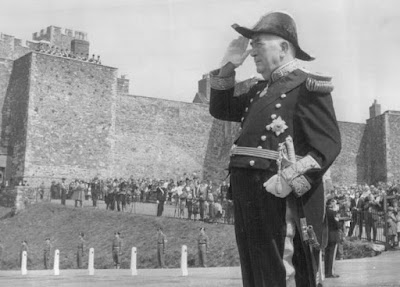
What better way than a snap of a phantasmagorical creature from the ABC swamp, The ABC’s Laura Tingle at Sydney Writers Festival this year described Australia as “a racist country”.


To be fair to Laura, if you happened to read the lizard Oz, the Murdochian tabloids or Sky after dark on a regular basis, you might well conclude that Australia is a racist country.

For confirmation, you don't need a Bill Leak cartoon, you just need to tune in to Rowan Dean:

Sky News host Rowan Dean says a new breed of “vile racist” has infiltrated our schools, universities, bureaucracies and corporations. 
“Vilifying, denigrating and treating as sub-human individuals because of the colour of their skin … white,” Mr Dean said. 
“Those extraordinary, brave people who brought industrial technology, modern legal systems and health care, prosperity and advanced civilisation to societies and cultures that had not experienced them before are now denounced as evil and criminal.”

Yes, Laura was right, it's a deeply racist country.

Okay, okay, that's just projection, a chance to flip the script and give uppity, difficult black folk a hard time, but it does suggest that however you cut it, racism seems to hover in the filthy Murdochian air.

Back to Polonius, noting all that got him agitated during the year, and being something of a prim pompous Pecksniff or Mr Pootle, that's a lot ...

On New Year’s Day 2024, morale was relatively high since the Year of the Dragon was expected to usher in a time of professionalism and rational thinking. However, that we live in a continuing vale of tears was evident as narcissism, anger, false prophecy, hyperbole, rudeness, intolerance, bad taste, double standards and ignorance prevailed over the land. On a monthly basis.
January. Leftist author Jane Caro welcomes the new year with a post on X declaring she is “blocking sanctimonious, creepy, misogynistic, human joy hating Christofascists on sight” and recommends all others “do the same”. There is no discernible change, probably because few, if any, know what she is on about. Nine columnist Jacqueline Maley enters 2024 declaring that Twitter “increased my contempt for humanity”.
February. The Australian Financial Review’s Rear Window column claims “spies in Canberra tell us (former Labor minister Stephen) Conroy has been an omnipresent odious smell wafting down the halls of parliament under the Albanese government”. Not to be outdone, Crikey contributor and non-funny comedian Tom Ballard asserts that “the Albanese government appears to have achieved the impossible: successfully polishing a turd”. The reference is to abolition of the full stage three tax cuts. Asked on the ABC TV documentary Nemesis what word springs to mind after “Peter Dutton”, Malcolm Turnbull replies “thug”.

The pond should have noted that in this traditional outing, Polonius is inclined to revert to his dog alter ego, and bark out some doggie wit at his victims, including: Bernard Keane for Crikey opined that Donald Trump’s ‘cognitive decline makes Joe Biden’s look benign’. Enough said.



Yes, enough said. King Donald I has already made some fine choices, at one with his tremendous cognitive powers ...


The pond has already mentioned the civil war raging, such that the Beast, in an epic troll, scribbled MAGA Crisis Could Mean There Is No Trump Inauguration on Jan. 20:

...“Johnson is f---ed,” one Republican lawmaker told The Daily Beast.
If the election isn’t certified by Jan. 20, the Constitution is clear that Biden’s term has ended, taking him and Vice President Kamala Harris out of the line of presidential succession. The speaker of the House would be next in theory, but since that position would be empty too, it would pass to the Senate president pro tempore, the majority party’s most senior senator.
That would be Senator Chuck Grassley of Iowa. Speaking of whom, has anyone checked on Grassley lately? The lawmaker turned 91 in September.

Enough said. The gerontocracy is in fine shape, and things will work out and what fun there will be for Mike ... or his substitute...


And there's no need to worry about the Donald I, who has already achieved his major policy aim ... a Diet Coke button on his desk.

On we go ...

March. The Monthly publishes its profile on newly appointed ABC chairman Kim Williams. Interviewed for the article, Phillip Adams opines: “I prefer Kim Jong-un to Kim Williams.” But Adams remains a resident near Scone, which is a long way from North Korea. ABC presenter Jonathan Green suggests a taxpayer-funded public broadcaster is a “voice for immutable truths”. Really. Crikey politics editor Bernard Keane writes that Donald Trump’s “cognitive decline makes Joe Biden’s look benign”. Enough said.

Didn't we just do the 'nuff said?


Then came another snap.

Jewish atheist and Israel critic Antony Loewenstein appeared on an ABC episode of Compass entitled Not in My Name, about how Israel should not have responded to the Hamas atrocities ‘in his name’. Somewhat narcissistic, don’t you think? Picture: Alan Place


Well that's one way of deflecting talk about the current Gaza genocide ... or its consequences ... or the sorry state of Israel. 
Per Dahlia Scheindlin in Haaretz ... Israel, Snapshots of a Disintegrating Society, Hostage families begging their fellow Israelis, hat in hand, for help. Furious parents of IDF soldiers pointlessly killed. Besieged Arab citizens emigrating. Rising addiction rates. In Israel today, 'unity' is a bitter word.

Inter alia...

...Haaretz's Sheren Falah Shaab reported this week on a not-yet quantified wave of Arab citizens who are leaving or considering leaving. Palestinians in Israel, it should be noted, are integral and often senior figures in Israel's medical system, and their flight surely won't help the problem there. But Arabs feel assaulted by the ultra-nationalism and political pressure against them, both during the war and before.
Once again, the data tells a heartbreaking story: In the 2024 Democracy Index by the Israel Democracy Institute, fully three-quarters of Arab respondents say they are trying to integrate into Israeli society, a net eight-point rise since 2018. Among Jews, however, the portion who believe Arabs want to integrate has fallen 30 points in that time, to just over 37 percent.
Even advertisements these days tell a dark story. One television ad sponsored by Israel's national lottery informs viewers of rising addictive behavior – smoking, drinking, popping pills or gambling – and encourages people to seek help.
Another ad urges parents to seek help for children suffering from depression. A warm and fuzzy spot for cellphone service provider Cellcom boasts that the company is sponsoring a nongovernmental organization, Sunflowers, which provides "emotional and social support" to children who have lost a parent. An organization for "emotional first aid" observed a 950 percent increase in calls from Israelis in the first half year of the war, compared to the previous year.
The words "unity" and "together" are popular these days, but increasingly they are uttered with sarcasm and despair. It will take more than pills to put Israeli society back together again.

Well at least it's not the Gaza genocide, and now back to Polonius, still ticking off the months ...

April. Former BBC Washington correspondent Nick Bryant comments in Nine newspapers that since Trump stands a good chance of returning to power, “the question of whether the United States is headed towards Civil War 2.0 no longer feels hyperbolic”. ABC television’s Compass highlights what turns out to be a soft profile on Antony Loewenstein, who presents as a Jewish atheist and critic of Israel. Titled Not in My Name, it covers Loewenstein’s claim that Israel was responding to Hamas’ attack on October 7, 2023, in Loewenstein’s name. And should not be doing so. Somewhat narcissistic, don’t you think?
May. ABC TV 7.30 political correspondent Laura Tingle advises the Sydney Writers Festival that Australia is “a racist country”. Tingle, however, rationalises her comment claiming she did not have the opportunity to put her remarks in context. At the same SWF, David Marr tells writer Melissa Lucashenko off stage that she is rude for having suggested, perhaps unfairly, that Marr should forward the royalties from his most recent book as reparations to Indigenous Australians.
June. Costa Georgiadis, the presenter of ABC TV’s Gardening Australia, tells Nine newspapers’ Good Weekend magazine “gardening is sexy … (it) is the ultimate release”. Thus joining the gardening band of hortosexuals. Former NSW Liberal Party energy minister Matt Kean links the challenge of climate change to the threat of Nazism during World War II and communism during the Cold War (in which nuclear war was a possibility). Kean is now chairman of the Climate Change Authority.
July. Commentator Quentin Dempster posts a warning on Elon Musk’s X. To wit: “With Trump/Project 2025 our American friends are at grave danger of turning their Country into Gilead (of The Handmaid’s Tale fame). Women will have no rights over their own bodies. Hope the women of America take a stand in November election.” Clearly most American women, who voted for Trump, do not follow Comrade Dempster. Nine journalist Maher Mughrabi criticises his colleague Peter Hartcher for condemning senator Fatima Payman’s decision to quit the Labor Party. He says Hartcher’s argument has disappeared up his own bum.

It's great that Polonius is a keen follower of Uncle Leon ...


It's been a long time since the pond has focussed on the savvy Sava, but here she is, arousing the Polonial ire ...Nine’s Nikki Sava twists her metaphors when writing about ‘Dutton’s clumsy dance of the seven veils on nuclear power’. Picture: Chris Pavlich.


That seemed a bizarre metaphorical thrust, but the pond read on ...

August. Nine columnist Niki Savva, a Dutton antagonist, writes in Nine newspapers about “Dutton’s clumsy dance of the seven veils on nuclear power”. Meaning he had not released details of his policy. Savva forgets that the original Dance of the Seven Veils was a strip tease act, which does not apply to someone who is allegedly without policy in the first place since they have nothing to take off.

Only a supreme pedant of the Polonial kind could come up with that one, and the pond spent hours celebrating the precocious pundit's ability to sound like a puritanical member of the metaphor police. What a finely honed wit he has ...up there with the original Polonius ...

September. Guardian Australia’s Amy Remeikis, who has since moved to the leftist Australia Institute, condemns landlords on Network 10’s The Project. Asked as to whom the anger of renters is directed, she blames capitalism, mostly, and those who uphold capitalism. It is later revealed that Remeikis herself rents out a property she part owns. Suggesting, perhaps, that capitalism is not so bad after all.
Melbourne media identity Jon Faine appears on the ABC’s Q+A playing down the extent of crime in Dandenong. He lives comfortably in inner-city Melbourne, about 35km from Dandenong.

It would have been remiss of Polonius not to mention Independent senator Lidia Thorpe treated King Charles to her own personal Get Out of Country tirade, an action supported by The Saturday Paper. Picture: Reuters

Just think of the snap ...


How the reptiles love that snap... and then on it was on with the agitated pedantry ...

October. The Saturday Paper (publisher Morry Schwartz, editor-in-chief Erik Jensen) supports independent senator Lidia Thorpe’s confrontation with the King during his recent visit to Parliament House. The paper editorialises: “Nothing Thorpe said is untrue; Charles sits on a throne of stolen land.” As the year ends, there is no evidence that Schwartz Media has returned its “stolen land” in the Melbourne inner-city suburb of Collinwood. (sic, the pond blames that on the lizard Oz, though perhaps it also reflects the way that it's been a long time since Polonius visited Smith street in search of a hit).
On ABC Radio Sydney, Richard Glover suggests of a bad taste Puerto Rican joke told at a Trump rally in New York that “maybe this is the joke that changed history”. Meaning Trump might lose the election because of a bad joke.

How could a bad joke be anything but a good joke? Sorry, FAFOers, no returns ...


At last, the final few months arrived ...

November. 7.30 presenter Sarah Ferguson is one of several ABC journalists who have headed to the US for the presidential election, most of whom speak to other Australians and none of whom anticipates Trump’s substantial victory over Democrat candidate Kamela Harris. On the eve of the election, Ferguson tells RN Breakfast she would be “listening” to Ann Seltzer’s polling in Iowa that favoured Harris. Seltzer was hopelessly wrong. In the aftermath of the election, Nine columnist Hartcher prophesies: “The American people are now abandoning it (democracy) as a failed experiment.”

For some reason that reminded the pond of a story in The New York Times, In Syria, U.S. Hopes to Avoid Replay of Afghanistan, American officials are wary as they try to persuade the rebels now in control in Syria to govern with an inclusive and moderate hand. (paywall)

Apparently the Gray lady's hide is so thick they haven't worked out to this very week that the US is about to be governed by an exclusionary and immoderate hand.

It meant the final few lines rose to a new level of irony:

...Mr. Clarke of the Soufan Group and other analysts said there was little room for trust when it came to the promises of militants.
“Talk is cheap,” he said. “So no matter what these groups say, believe their actions, not their words.”

Well yes ... believe away ... trust their exclusionary and immoderate actions:


And so to the final month ... with Polonius still having a soft spot for Uncle Leon ...

December. The year ends with a sense of bewilderment following reaction to ABC chairman Wil­liams’ late November appearance at the National Press Club. Following his criticism of US podcaster Joe Rogan, Williams is criticised by, among others, billionaire Musk. Fair enough, it may be thought. But Williams describes the criticism as “demonic”. Which leads to discussion about whether the ABC chairman really believes in the Devil. Paul Barry concludes his decade-plus time as ABC Media Watch presenter by showing highlights of his Media Bites segment including footage of him presenting as an ageing clown at a six-year old’s birthday party.
And so, the media year ended on a somewhat unprofessional and irrational note.

The pond has absolutely no idea why the media should have ended up sounding unprofessional and irrational ... that's a job usually reserved for the reptiles at the lizard Oz.

But Polonius is right, Uncle Leon is no demon, he's a bigly admired branch of government ...


... at least for the next few weeks, or perhaps even a few months.

What with the inspiration of Faux Noise and the Murdochians as a font of sanity, leading their tribe into the wilderness, perhaps the wildly irrational ABC obsessive has a point ...


Back to that civil war for uncivil laughs as all these Furk Arounders are busy trolling each other and Find Outing each other ...


Saturday, December 28, 2024

Oh it's a lucky country ... the Angelic one says so, and so does the hole in bucket man ...


The judges hadn't been expecting a classic conundrum when they sat down to sort out the winners of the pond's weekend hunger games.

Insiders had always expected prattling Polonius to have a lock on Sunday, with one of his patented dreary summaries of the year, but nobody had tipped a tie, a dead heat, where two brave contenders couldn't be separated, not even by a nose, for the pond's Saturday outing ...

At first it had seemed an innocuous enough effort ... an attempt to make the best of the Lib knifing in Victoria ...


You had to have sharp eyes to spot our Henry, co-joined with another, at the bottom of the digital edition's main feature, blathering about the lucky country ... but then if you turned to the extreme far right of the page, there was a hot contender, a keen rival, the Angelic one, also blathering about the lucky country ...

Peas in a pod, inseparable ...


The judges argued for hours, but simply couldn't separate the hole in the bucket man brooding about the lucky country, and the Angelic one assuring those living in the hive mind that they were the luckiest in the world.

One judge was particularly irked, all the talk of the lucky country meant that the pond had to ignore the rcent fuss generated by Vivek's classic tweet.

Oh dammit, just to keep all the judges content, if the pond calls it X can the pond confront the YOUNG TRUTH:

The reason top tech companies often hire foreign-born & first-generation engineers over “native” Americans isn’t because of an innate American IQ deficit (a lazy & wrong explanation). A key part of it comes down to the c-word: culture. Tough questions demand tough answers & if we’re really serious about fixing the problem, we have to confront the TRUTH:
Our American culture has venerated mediocrity over excellence for way too long (at least since the 90s and likely longer). That doesn’t start in college, it starts YOUNG.
A culture that celebrates the prom queen over the math olympiad champ, or the jock over the valedictorian, will not produce the best engineers.
A culture that venerates Cory from “Boy Meets World,” or Zach & Slater over Screech in “Saved by the Bell,” or ‘Stefan’ over Steve Urkel in “Family Matters,” will not produce the best engineers.
(Fact: I know *multiple* sets of immigrant parents in the 90s who actively limited how much their kids could watch those TV shows precisely because they promoted mediocrity…and their kids went on to become wildly successful STEM graduates).
More movies like Whiplash, fewer reruns of “Friends.” More math tutoring, fewer sleepovers. More weekend science competitions, fewer Saturday morning cartoons. More books, less TV. More creating, less “chillin.” More extracurriculars, less “hanging out at the mall.”

Whiplash? About a sociopathic teacher pushing his pupil beyond the boundaries of reason and sanity? Just what the country's education system needs ...


Sure enough Vivek brought the attention back from Uncle Leon to him, attention which had always been unfairly misplaced...


It was a thing of beauty, this outburst, this desperate attempt to save Uncle Leon and his desire to import engineers ...

Most normal American parents look skeptically at “those kinds of parents.” More normal American kids view such “those kinds of kids” with scorn. If you grow up aspiring to normalcy, normalcy is what you will achieve.
Now close your eyes & visualize which families you knew in the 90s (or even now) who raise their kids according to one model versus the other. Be brutally honest.
“Normalcy” doesn’t cut it in a hyper-competitive global market for technical talent. And if we pretend like it does, we’ll have our asses handed to us by China.
This can be our Sputnik moment. We’ve awaken from slumber before & we can do it again. Trump’s election hopefully marks the beginning of a new golden era in America, but only if our culture fully wakes up. A culture that once again prioritizes achievement over normalcy; excellence over mediocrity; nerdiness over conformity; hard work over laziness.
That’s the work we have cut out for us, rather than wallowing in victimhood & just wishing (or legislating) alternative hiring practices into existence. I’m confident we can do it.

Deeply weird shit, with the promise of much more to come as the immigrant wars heat up, and concentration camps organised, and mass deportations are planned, and might even begin, and might even sort out a few tech bros...

And now, judges overruled, honour served, the pond can turn to the Angelic one delivering the good news, her gospel if you will, in Cheer up, Aussies, we live in the best and luckiest country on Earth, Yes, with all the bad news from overseas it’s no wonder we sometimes feels like the barbarians are at the gates. But look around and you can see Australia is still the land of plenty.

When in doubt and in search of banal stock images, always go the beach, It is a great shame if Australians succumb to the pessimism that seems to permeate older cultures, the author writes. Picture: AFP


That set the Angelic one off on a euphoric journey of Oz triumphalism, an alpha and omega, an ending and a beginning ...

At the end of one year and at the beginning of a new one we are expected to look back with a critical eye but forward with optimism.
However, today we generally don’t hear much optimistic talk or feel much optimism. We seem to hear of nothing except wars, disaster and mayhem in world affairs.
We can add to that our own domestic worries about the cost of living, the electricity failing and even the gas being cut off.
This pessimism is the case all over the world. Recently on a trip to Norway, a beautiful, rich country, I was struck by a doleful remark from a man running a shop in the fish market: “All these wars and terrible things happening.”
It seems that people living in the rich and insulated West have forgotten how precarious is the peace and security we thought would never end.
NATO countries are told to prepare for war, the Middle East is in flames and the great Pax Americana appears to be crumbling into isolationism. Terrorism is everywhere and little kids are being blown up. No wonder many people feel as if the barbarians are at the gates.
However, it is a great shame if Australians succumb to the pessimism that seems to permeate older cultures because we Australians are living in probably the most blessed, resource-rich country on Earth.
We are not a continent suffering war or the threat of war, and despite having some internal divisions we should have every reason to be optimistic – yet we are not.

Bloody Norwegians, fancy getting upset about all these wars and terrible things. Why didn't he just go to the beach ...Australians enjoying the best that summer has to offer have every reason to be optimistic. Picture: AFP


Yes, the entire world should be Sydney-centric, even if you have to spend an hour on the bus to get to a beach, such that those silly western Sydney-ites had to invent a fake beach and surf to live out the dream.

What is it with the beach?


On with the dreaming and the celebration, though suddenly the Angelic one began to have saucy doubts and fears, raising sinister suspicions and memories of ancient reptile grievances...

The reason is a natural preoccupation with domestic policy. For instance, despite divisions blamed on multicultural policy, we are fortunate that we have not yet developed the level of domestic terrorism we have seen in Germany and elsewhere.
Live and let live multiculturalism in itself is not a recipe for division; rather, it is vehement religious and cultural intolerance that is the root of division, when people are threatened for just being Jewish or for just being Muslim.
Neither should it be an offence to tell someone they should go back to where they come from – even if it is a stupid, crude sentiment abhorred by many people.
Not all speech we might find seriously lacking in thought or kindness should be labelled hate speech or be an offence as long as it does not include incitement to violence.
On the domestic political front, the pessimists have a point.
The cost of living is too high and the No.1 culprit is the cost of energy, as it affects everything. The federal government’s renewable energy schemes, aside from unreliability, could make the cost of living worse. Changing the electricity network is very expensive and requires a huge number of electricians to install the infrastructure – electricians we don’t have. Nevertheless, the government ploughs on trying to convert all our electricity generation to renewables – although we have enough gas under the ground to supply half the world.
Meanwhile, the opposition says it is going to bring in nuclear, which also may take about 100 years to work with safety, although we have all the uranium under the ground that we can export to other countries so we don’t have to risk being contaminated by stored nuclear waste or blown up. So, energy policy is confusing and controversial, and energy supply is looking grim into the future.

Of course, of course, to live the beach dream, we must nuke the country to save the planet, but while things might be deeply grim, it's not as grim as elsewhere, The bedlam in Gaza and the Middle East shows we have much to be thankful for. Picture: AFP


Oh dear, that set the Angelic one off on another bout of pessimism ...

On top of that, pessimism is warranted about the multitude of social problems and useless social policy fixes.
Top of the list is mass ignorance caused by bad education. Those of us who were stuck teaching the Visigoths of 9E remedial English in the 1980s and ’90s could see that coming a mile off. Bad curriculum, bad methods, kids’ terrible behaviour and even worse expectations, and you have a recipe for social decline.
Then there are the sometimes well intentioned but failing schemes meant to plug a serious deficiency, the most notable of which is the National Disability Insurance Scheme. The NDIS, which was meant to help the truly disabled, is like almost everything the government has poured money into: out of control. As well as encouraging a broadening of the notion of disability, especially autism, the scheme leads to welfare churn, is riddled with corruption and encourages a mentality of government dependence.
Another one that is going to send us broke is the overly generous childcare subsidy for people with combined incomes of up to a gobsmacking $500,000. That strikes me almost dumb, but I will write more about this in the coming year.
Last, there is the even more appalling waste and human cost of “closing the gap” between our world and that of the Indigenous Australians, the national shame. Some of this, like the energy situation and the NDIS blowout, is fixable; some of it, like closing the gap, is not.

Sheesh, that all sounds a worry, it sounds like we're irredeemably rooned, but luckily the Angelic one has the perfect bromide ...

There are many reading this who will nod and think that optimism about Australia, whether it be government energy policy, multiculturalism or the international situation is succumbing to Pollyanna-like naivety.
But stop and think about our history. The great challenge for Australia is to do what our ancestors did. 

By golly, she's right. What we need to do is organise a few hunting parties, bung on a massacre or three, poison the waterholes and the flour, arrange for a little indentured servitude, and everything will be fine ...

And so to a few final thoughts ...

To be resilient and look into the future, to see Australia as what it should be and could be.
We have always been a young culture that looked to the future. I am descended from a 14-year-old boy who narrowly avoided the noose and a young Italian peasant in search of adventure and his own life.
Consequently, we are the youngest, most successful and one of the richest democracies on Earth. Aside from all our natural advantages, our geography, our wonderful climate and abundant resources, we have in ourselves, our own people, a unique breadth of culture and diversity of experience.
Unlike my miserable Norwegian friend, we should be optimistic. So, cheer up, Australia, and have a happy new year.

Is it any wonder the judges found the Angelic one irresistible? 

Mixing talk of how lucky the country is, how much better than miserable Norwegians, then spending almost the entire column mired in pessimism and moaning in the most miserable way about how everything was fucked. 

Such a gem, such a mind ... almost like talking to an ancient boomer revived by AI ...


And so to our Henry and a consorting co-conspirator, co-scribbling another, in an epic opus that the judges simply couldn't ignore or discard:

Sixty years on from Donald Horne’s instant classic, has The Lucky Country run out of luck? Published in 1964 and serialised in The Australian, the impact of The Lucky Country was immediate and all-pervasive. Donald Horne declared that ordinary Australian people were not the problem: the elites were. Today that seems truer than ever before.

Scribbled like a genuine member of the lizard Oz 'leets.

The reptiles promised this outing by Henry Ergas and Alex McDermott was a full 13 minute read, just the sort of thing you need to have in hand for that beach outing.

Naturally there was a penetrating snap and question to start the long haul off Has a nation of gamblers with a disdain for ‘theory’ ridden its luck for too long?


What a conversation starter ... and what a chance to plug the lizard Oz ...

“Join the Lucky Ones” ran the front-page headline of The Australian on Tuesday, December 1, 1964. Starting the next day, readers could enjoy “the first big instalment of Donald Horne’s controversial new book The Lucky Country”, which was being published that week.
Horne had a long association with Frank Packer and Australian Consolidated Press, but in a publishing coup Rupert Murdoch’s new national newspaper had secured exclusive rights for “the most candid, controversial book of the year”.
The Australian had begun life less than six months previously as a daring experiment, the first nationally circulated newspaper in a country beginning to fizz with a sense of expanding possibilities yet faced with new, sometimes daunting prospects in a dramatically changing world.
Horne’s much-anticipated “witty and irreverent study of Australians and their way of life” couldn’t have found a stage better suited to its bold approach or for the questions it was firing, at point-blank range, into the national conversation.
Australians were reintroduced to themselves in the weeks that followed as a people who “hate discussion and ‘theory’ but can step quickly out of the way if events are about to smack them in the face”.

There was a handy tie-in snap to promote the lizard Oz itself, Join the Lucky Ones: Page 11 from The Australian newspaper on December 2, 1964 featuring an extract of Donald Horne's 'The Lucky Country'


At this point a few of the judges became restless. Was this really about rounding the Horne or marvelling at Emeritus Chairman Rupert?

They found out that “to understand Australian concepts of enjoyment one must understand that in Australia there is a battle between puritanism and a kind of paganism and that the latter is beginning to win”. Competitive sport, they were now given to understand, had all the qualities of “a ruthless, quasi-military operation”, making it “one of the disciplinary sides of Australian life”.
As for mateship, it reflected “a socially homosexual side to Australian male life” that involved “prolonged displays of toughness” in pubs, where men “stand around bars asserting their masculinity with such intensity that you half expect them to unzip their flies”.
Perhaps most arresting was the argument that went with the title’s assertion. Australian life, combining scepticism and “delight in improvisation”, had resulted in dependence on a type of gambler’s luck.
As circumstances shifted, Australians’ “saving characteristic, ‘the gambler’s coolness’ ”, had helped them to “change course quickly, even at the last moment”.
But the aim of those swerves had always been to “seek a quick easy way out”. Now that strategy needed to be reconsidered.
Abrupt changes
The Lucky Country packed many punches – and they landed at the perfect moment.
The tremendous post-war growth of an educated and engaged public had been evident since the mid-1950s as new magazines proliferated and the market for Australian books expanded more prodigiously than at any other time in the century.
Coupled with that were global shifts even more dramatic and described in The Australian’s first editorial, which spelled out both the paper’s vision and the challenges the nation faced.
Since the end of World War II all the major European empires had ceded or lost control of the lands and people to Australia’s immediate north. As British, Dutch and French imperial power in Southeast Asia collapsed, new nations – including Indonesia, Malaysia and Vietnam – were born and ancient ones, such as Burma and Thailand, reshaped. Behind them lay “the brooding power and intelligence of the new China, a land with whose people’s desires and plans our own future is deeply entwined”.

But what of that reptile hero, Ming the Merciless? What of 'Nam and such like? What of the swinging sixties, and the desire to leave ancient patriarchs behind?

Well it was a tricky journey, but in the end, the pair managed the feat. There was plenty of time to downgrade Horne, and celebrate All the way with LBJ: The first Australian visit by a US President. United States President Lyndon B Johnson greets the crowd in Swanston Street, Melbourne. Picture: Ken Wheeler


Time then to slip in a quick celebration of visionary Blainers ...

These abrupt changes coincided with Britain trying to join the European Common Market, making it clear that wherever the United Kingdom saw its future, it was not primarily with the Commonwealth.
Losing the blanket of certainty that Australia’s close relationship with Britain had long provided was a blow. But, The Australian insisted, it could prove “a salutary shock”, as it helped us realise “that now, as never before in our history, we stand alone”.
Collection of snapshots
The Lucky Country’s impact was immediate and all-pervasive. Despite some scathing reviews (one confidently predicted the book would have been forgotten by the next football season), it flew off the shelves. Its initial print run of 18,000 sold out in nine days and the pace showed no sign of flagging.
In 1965 it sold another 40,000 copies before repeating the feat in 1966, a staying power beyond its publisher’s wildest dreams.
One of the books that truly defined the decade, it entrenched itself in the national consciousness in a way similar to Geoffrey Blainey’s The Tyranny of Distance, published two years later, another title that instantly entered the national lexicon.
Blainey’s deeply researched work, which reflected his training as a historian, was tightly argued. In contrast, even Horne admitted that his book was “a collection of snapshots of Australia”. An assemblage of ideas and insights that had been amassing for a decade, Horne thought it was part of the book’s success, handing readers a host of opinionated pages of observation and commentary.

The reptiles interrupted to show Donald Horne at home: the author constantly fretted that his seminal book’s title had been misunderstood and misused.


Then it was on with the journey:

More than the loose structure, though, the book’s style was crucial to its impact. That style came from Horne’s long spell as a journalist, editor and advertising man.
Horne had a keen understanding of what readers wanted to know and talk about. He had spent years honing his approach, addressing Australia’s burgeoning magazine and newspaper readers, and recognised their hunger for a new type of journalism that The Australian sought to embody: urbane, expository, intelligent, sparky, informed.
And if it worked for magazines and papers, why not for a serious – if chronically irreverent – book about who we were and how we now lived?
The Lucky Country introduced this sharp change in tone to Australia in the 1960s, marking it as ineradicably as David Williamson’s plays would do. The content matched the tone, too, aggressively insisting that the way we lived had changed so abruptly that the nation could no longer be served by the standard-issue ideas.
The national mythology, populated by bush legend figures (shearers, bushrangers, drovers) and grizzled
Anzacs, had no relevance to daily reality.
Australians were urbanites and suburbanites, and increasingly so: from 1947 to 1966 the percentage of Australian living in cities leapt from 68 per cent to 83 per cent.
Misappropriated and misunderstood
Horne’s coup was to bridge this gap between myth and reality. Certainly to his mind The Lucky Country’s success came from the fact it captured Australia as Australians experienced it, not through the fake lenses of a glorified past.
It was, Horne claimed, the first book to reflect “the suburban nature of the lives of most Australians without jeering at them”. What really cut through, however, was the book’s underlying thesis.
Despite its gadfly-like style, the book worked off a set of powerful assumptions that constituted a strong, even startling, argument.
Horne would complain ever after that its title had been misappropriated and misunderstood. But it is hard to deny that the title itself made the argument palpably clear.
Earlier exercises in self-reflection generally portrayed Australia’s journey to nationhood as a process of maturation. Nurtured under the shelter of Britain’s wing, foresight, hard work and inspired guidance had allowed the infant nation to grow into a strapping adult, capable of standing on its own feet.

Gad sir, surely not, surely not plucky Britain ...


Perhaps that's why the reptiles offered up instead Lucky for some: Dawn Fraser after splashing her way to victory in the 100m freestyle at the 1964 Tokyo Olympics. Picture: Getty Images


Always the patented visual cliché, the insatiable desire to do a march of time ...


But there was still that business of reconciling the march of time with the downfall of Ming ... slowly, slowly ...

Horne knocked that narrative for six. Australia’s prosperity and stability were not, he argued, the result of increasing national maturity, much less diligence and determination. They were due to sheer good fortune. To make things worse, it was a good fortune the country didn’t deserve – or know how to use.
The problem wasn’t the bulk of ordinary Australians, who weren’t a bad lot. It was “the people on top”. Our leaders and elites were second-rate provincial mediocrities who had got stuck in a groove some 50 or 60 years earlier and never budged out of it, even as one generation passed to another and still another.
Premature senility
Thanks to them, the nation was in a time warp, living out a fantasy that bore no relation to its realities – or its challenges.
The proper national metaphor, in Horne’s eyes, was not a maturational shift from boisterous youth to fully fledged adulthood; it was a leap from childhood to premature senility. Without “a radical overthrow and destruction of the prevailing attitudes of most of the nation’s masters” the decades to come would likely witness “a general demoralisation; the nation may become run down, old-fashioned, puzzled, and resentful”.
The radical overthrow and destruction of Australia’s outmoded approach, and the subsequent renewal, could, Horne speculated, possibly come through the rising generation. He was drawn to generational explanations of change, citing Walter Bagehot’s comment that “generally one generation succeeds another almost silently.
But sometimes there is an abrupt change. In that case the affairs of the country are apt to alter much, for good or for evil; sometimes it is ruined, sometimes it becomes more successful, but it hardly ever stays as it was.”

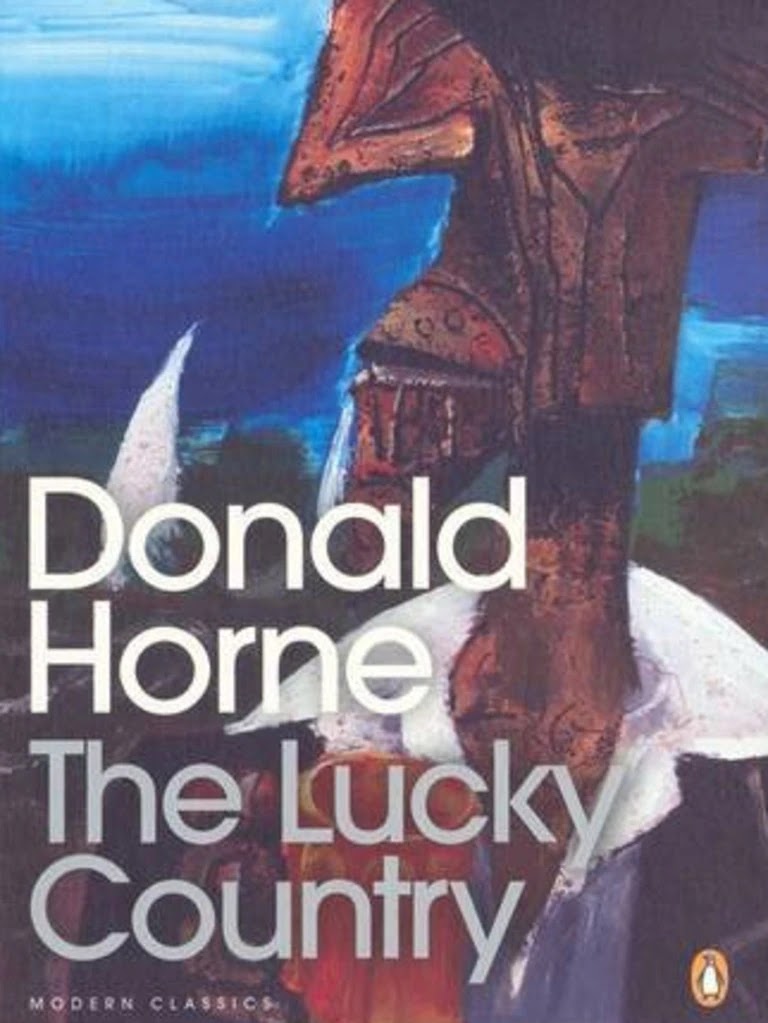
Of course there's the possibility vulgar youff might not have the first clue as to the topic, so the reptiles belatedly inserted a reminder... Modern classic: Cover of The Lucky Country, featuring the painting of the same title by Albert Tucker. Picture: Supplied


That should set vulgar youff straight ...

Generational change had salvaged the national project before. The great Australian initiative, when Britain and other outside models of development had been energetically rejected, had emerged in the decades at the turn of the 20th century. This was when a nationalism of mateship represented “the general egalitarian position” that, flecked with Irish anti-English hostility, had formed an explicit contrast to an England of wealth and privilege. To those who had experienced that earlier time, “this present pause would be unbelievable”.
Robert Menzies epitomised everything that had gone wrong. He had absorbed too much of the pro-British obsequiousness of the post-World War I world, notably “the ceremonial clinging to Britain” that was “part of the delusional structure of the people who were running Australia”.
Unable to escape that delusional structure’s grip, subsequent generations had fallen into Menzies’ stride rather than broken it. And while Menzies’ leading rival, Arthur Calwell, could not be accused of being unduly pro-British, he was no better able “to recognise and dramatise the new strategic environment of Australia”.
Fresh start
As a result, “the nation that saw itself in terms of unique hope for a better way of life is becoming reactionary – or its masters are – addicted to the old, conformist” ways of doing things. The inability to cope with change meant the “momentum towards concepts of independent nationhood has slowed down, or stopped”.
There were, however, inklings of a fresh start. Although “still full of mystery”, the generation born during and immediately after the war “seems fresher”. Who knew, “it may be the generation that changes Australia”.
Expressing the egalitarian pragmatism that Horne identified as the quintessential philosophy of the national consciousness, the baby boomers would be socially progressive, tertiary-educated, technocratic pagans and managerially gifted hedonists. As they gained control, the better qualities of the Australian people, sprawling and sunburnt on the nation’s beaches, would finally be able to express themselves unencumbered by the tired leftovers of a bygone era.
Exactly how this revolution would occur was left unclear.
Horne’s career had to this point been on the political right. He was still editor of Quadrant when (...)

At this point the reptiles interrupted the pair in mid-stride, because you can never get enough beach when you're doing a search of the national psyche ...Bathers at Bronte Beach, Sydney, 1964, from John William's new book Line Zero: Photo-reportage 1958-2003. Picture: Supplied


Then came the problem, how to reconcile the thought that Ming the merciless had been singularly useless, while downplaying the coming of Gough. 

Easy peasy ... take a sudden, sharp turn ... it turns out the interruption was handy, a chance to explain that this Horne was in fact a conservative who'd taken a wrong turn, and so needed a firm hand, a stern correction, and our Henry was just the right member of the lizard Oz 'leet do do it (with the help of that other scribbler Alex) ...

(...)The Lucky Country came out, a vigorous anti-communist who had run as a Conservative in an English election while living there in the 1950s.
In some ways, he might still have been a conservative – for example, in his identification of the ideals of egalitarianism and fraternity as the essence of a national culture that needed to be preserved.
What is certain, however, is that by the time of The Lucky Country, Horne was no conservator. His conservativism was what he now described as being of the “radical”, even “anarchist”, variety. Enormous social and political renovation was the order of the day and the book’s task, Horne said, was “to produce ideas that may prompt action at some later time” – but that would need a change agent only the future would disclose.
Whitlam the messiah
Given that sense of anticipation, it is unsurprising that Horne drank the Gough Whitlam Kool-Aid deeply and early. When Whitlam replaced Calwell as ALP leader, Horne declared that he “seemed to understand that not only the Labor Party but Australia as a whole needed a psychological reorientation, a new tone and style to make it adaptable in the modern world”.
In April 1973, less than six months after the federal election that brought “the ludicrous Menzies era” to a close, Horne predicted that Whitlam could easily become Australia’s greatest prime minister. Until then, it had begun to seem “as if our sense of nationality was going to remain rather grisly: a fairly second-rate European-type society cutting itself off from its environment and from the mainstreams of the age, trying to keep up its spirits by boasting about its material success, its mines and its quarries”.
Now he predicted a new national anthem within 12 months and a republic within 10 years. The eternal “tomorrow” of utopian political vision had suddenly become, as it were, Monday morning – and Whitlam was its messiah.
Inevitably, having soared to such heights, the deflation when the curtains fell on the new dawn was all the more traumatic. It exploded into visceral anger in the book Horne wrote immediately after the 1975 dismissal.
Whitlam, Horne said in Death of the Lucky Country, had been doubly “assassinated” – once by the governor-general, then again “by his defeat in an illegitimately called election, done in by strong and powerful enemies”.

The ludicrous Menzies era? 

But the reptiles have spent the past decade celebrating those picket fences. Time to expose the false messiah, In Gough we trust: Horne remained incandescent with rage long after the end of the Whitlam experiment. PIcture: Sunday Telegraph


Gad sir, it wasn't time, it wasn't time at all ... it was the 'leets ... as only members of the said 'leets would know ...

The elites had had their revenge. Public violence, Horne suggested, would be an entirely understandable response. Horne’s own response was unending, incandescent, outrage.
Mingled with bitterness, that outrage pervades everything Horne wrote after Whitlam’s ignominious end: largely second-rate works that have faded from memory. He had, it turned out, only one book in him – but it was, nonetheless, a book of immense importance, not least because of its tough-minded approach to Asia and its adamant rejection of non-alignment as a bastardised form of neutralism.
To say that is not to ignore the paradox that underpins the book. Horne’s discussion in The Lucky Country of Australia’s British inheritance was rich and nuanced. But as the years passed Britishness became a birth flaw to be denounced with ever greater ferocity.
Yet for all of Horne’s strident nationalism, The Lucky Country is redolent, if not derivative, of the Britain of the mid to late ’50s.
During his stint in Britain, Horne had fully absorbed the new concept of “the establishment”, coined by London columnist Henry Fairlie in 1955 to describe not simply the individuals who held and exerted political power but the whole network of institutions, practices and attitudes through which those in or near power maintained their ascen­dancy.
By 1960, denouncing the dead hand and crippling impact of a musty, hidebound elite had become the stock in trade of an emerging class of British com­mentators.
Horne brilliantly transposed that leitmotiv to Australia, just as he transposed those commentators’ biting tone and the advertising-influenced writing style of the new American journalism.

Now please remember that the main point of the exercise is to remind readers of the hive mind of how prescient the Emeritus Chairman was, A front page story pointing readers to an extract from Donald Horne's 'The Lucky Country' to be published in the Australian; the next day, on December 2, 1964.


Sure, it was long ago, and the rag never recovered from the sacking of Adrian Deamer, and the Chairman's sharp turn to the right, but keep living the dream ...a chance to celebrate the lucky country and at the very same time, celebrate the era of Ming the Merciless ...

But jingles are no substitute for deep analysis – and The Lucky Country’s marvellous hits come amid some disastrous misses.
No miss weighs more greatly, or has had more deleterious consequences, than Horne’s easy, airy dismissal of the extraordinary economic advance Australia had experienced since the ’40s. To describe that achievement as due to blind luck is simply absurd.
It was, in fact, achieved in the face of a world economy profoundly and increasingly adverse to primary exporters, who had to deal with plunging commodity prices, as well as the relatively slow growth, and chronic balance of payments problems, of Britain, which was still Australia’s crucial export market.
That Australia managed to not merely cope with that environment but grow rapidly was no gift of nature: it reflected the remarkable adjustment capability of its primary exporters, who, as well as turning to Asia’s emerging markets, reduced their costs more rapidly than prices were falling.
And it was the adaptiveness of its primary exporters, along with the entrepreneurship of towering giants such as Lang Hancock and Arvi Parbo, that set the foundations for the mining booms Horne derided as just due to luck.

Meanwhile, the reptiles still couldn't get enough of the beach, Party’s over: Bronte Beach, Boxing Day 2024. Picture: NewsWire / Flavio Brancaleone


Anyone who's lasted this long will be happy to help clean up the trash ...

The belief that Australia’s prosperity was the result of good fortune rather than entrepreneurship and aspiration became one of the left’s key illusions. It framed Whitlam’s disastrous economic policies, which assumed the Australian economy was “indestructible”; it has recurred in recent years as successive Labor governments have dismissed mining, low-cost energy and agriculture as mere residues of earlier ages. The blind luck thesis had a natural appeal to the new elites who, in the decades after Whitlam’s fall, committed themselves to the fundamental remaking of Australia.
So did the overestimate of the merits of technocratic bureaucracy and the underestimate of the merits of Australian traditions that permeates Horne’s work. In that respect, Horne was right: the baby boomer generation changed Australia. And it was armed with the Whitlam-Horne vision that its leading scions became the new establishment.
By the late ’80s this new order had almost entirely replaced Horne’s reviled old second-rate elites, taking the commanding heights of cultural institutions and regulatory bodies, as well as dominating acceptable political discourse.
Undoubtedly a classic
Under first the boomers, and then their children’s generation, the longstanding policies, prac­tices, norms and pronouns that had framed Australian life were upended, reversed, junked, repudiated.
In 1964, Horne declared that ordinary Australian people were not the problem: the elites were. Sixty years later that seems truer than at any other time in Australian history, but the elites in question are those whom Horne heralded and championed.
The great irony, though, is that the ordinary suburban Australians Horne brought to the forefront of national conversation have proven the immovable bulwark against which those new elites have collided, as they repeatedly rejected the new establishment’s wishes and projects.
Horne himself may not have appreciated this irony. But he can claim the credit for foretelling the two great protagonists in the national drama that continues to play itself out in the public square.
In the end, it is the hallmark of a classic that it is a book that can be read in a slightly or very different way by each generation, always having something new to say. Set against that test, The Lucky Country is undoubtedly a classic.
For all of its shortcuts and grievous errors, its insights still dazzle, no matter how often they are read or reread. So does its freshness, its sense of humour and perhaps most of all, its eager hopefulness and sense of aspiration.
On this joint birthday of The Lucky Country and of the newspaper that, 60 years ago, launched its career, renewing that spirit remains a task worthy of giants.

Oh FFS, if the legacy media really does think that it's part of the story, part of the renewing of the spirit, able to take on a task worthy of giants - in the era of the full to overflowing intertubes and vulgar youff and terminal phone addiction - then it's truly delusional. 

Credit where credit is due to this delusional pair, Henry Ergas is a columnist with The Australian. Alex McDermott is an independent historian.

Never have a pair laboured on at such length trying to reconcile the irreconcilable.

Onwards and upwards with the lizards of Oz, oh lucky nuked country ...