Friday, January 05, 2024

In which our Henry forces the pond to bring back a few graphics, and so does the alarmist lizard Oz editorialist ...


The pond had to abandon its strict anti-visual summer lizard Oz herpetology school stance, if only to explain why the pond had red-carded the grave Sexton ...


No matter how the reptiles try to slip the Lehrmann matter past the pond, the pond will not be gulled, so it was red card time for the grave Sexton ...

Milner minor from the deep north didn't even rise to the level of a banning, but the pond sadly had to let go the meretricious Merritt, briefly at the top of the pack yesterdat ...


The pond is always ready to discover the delicious dimpled delight of the dawn-drawn falcon of alliteration, but "Compo for communists" raised serious issues. It seems that the reptiles have fallen prey to the new fashion of abandoning capital letters, which is a capitol (legislative) cause for complaint ...

Using lower case when talking about communists places the term down with other uses like socialist, or liberal, or woke. 

It seems the meretricious Merritt was complaining about the Chinese Communist Party (CCP), and never mind that any connection to communism was long ago lost in the Xi dictatorship, emulating Mao's autocracy ...

The pond would have settled for Compo for Dictatorship Swine, in lieu of Commie Swine, while dinkum decent Aussie innocent virginal coal lovers go begging ...

Meanwhile, it's Friday and our Henry is on hand to delight ... and so the pond can revert back to text ..

Fifty years on, a warning the West still needs to heed

The pond immediately regretted its decision because it was followed by what the pond took as grand news. 

The return of the lizard Oz graphics department ...

Caricature by artist Eric Lobbecke of 1970 Nobel Prize winning writer, Aleksandr Solzhenitsyn, trudging through the snow and coming across former Soviet symbol in blood.

Sure enough, there was a genuine example of the master at work ...


And thereby hangs a tale ... but first the byline ...

By henry ergas
12:00AM January 5, 2024

And a first gobbet of our Henry ...

Fifty years ago last week, Aleksandr Solzhenitsyn’s The Gulag Archipelago was released in Paris. Far more than simply an account of the Soviet prison camps, Solzhenitsyn’s work still stands both as an extraordinary testimony about the past and as a stark warning for the present.
Like all of Solzhenitsyn’s prodigious output, the questions at its heart echo those Leo Tolstoy posed in War and Peace: “What does it all mean? Why did it happen? What made these people kill their own kind?”
And it is precisely because Solzhenitsyn focused on those questions that The Gulag Archipelago is not merely a searing indictment of Soviet communism but a work of moral analysis.
The proximate cause of the horrors it portrays was, no doubt, the Bolshevik regime that came to power in 1917. Yet the Bolsheviks’ murderous mindset did not emerge from thin air. Rather, it was the outcome of the philosophy that gained absolute sway over the “progressive” Russian intelligentsia of the 19th century. Epitomised by Nikolay Chernyshevsky’s What Is To Be Done? (1863), which Lenin considered a masterpiece, that philosophy rejected the notions of free will, human nature and personal responsibility, instead asserting that people’s behaviour depended entirely on their circumstances.
Having deduced from that proposition the complete malleability of human beings, Chernyshevsky concluded that the perfect society could be built on earth – so long as the elite that grasped philosophical materialism’s “scientific conclusions” had the grim determination re-engineering humanity required.

At this point the reptiles slipped in a snap, followed a little later on by another, an actual dinkum caricature, and the pond's heart began to pound ... could this be the return of a graphics dream, endless days of reptile graphics delights? 

Aleksandr Solzhenitsyn


And so to the beginning of that other tale ...

You see that snap of Sol turned up in the lizard Oz some time ago ... and while it was a landscape framing, as opposed to a vertical one, more snake than 4:3, it was recognisably the same, and so was the topic ...


The pond was tempted at this point to talk of apartheid and the Gaza gulag and ethnic cleansing and collective punishment, but instead decided to head back to our Henry for another gobbet ...

Chernyshevsky’s reasoning, which became an integral part of Soviet Marxism’s dogma, left no room for any transcendental morality. The contention that some actions could be absolutely right or wrong, was, said Lenin, “moralising vomit”; all that mattered was their results. And since “there can be no middle course” between communism and reaction, “nothing, however vile, should be condemned that (advances) the working people’s struggle against the exploiters”.
Seen within that prism of Manichean logic, incarcerating and even executing those who might undermine “the struggle against the exploiters” was more than justifiable: it was, regardless of their actual conduct, an obligation. So when Dmitri Kursky was formulating the new Soviet legal code, Lenin cautioned him that “the law should not abolish terror; it should be legalised, without evasion or embellishment”.
The code therefore treated potential crime as crime, extending culpability to “(1) the guilty, (2) persons under suspicion and (3) persons potentially under suspicion”, with NKVD chief Nikolai Yezhov’s infamous Order No.00486 specifying that the wives of “traitors of the motherland” were to be sentenced to forced labour, and even their children, who might wish to take revenge, were to be imprisoned.
The goal of mercilessly “hanging bloodsuckers” was, wrote Lenin, to ensure “that for hundreds of miles around the people can see, tremble and cry: they are and will go on killing”. But that, explained Lenin’s close associate, Nikolai Bukharin, was not terror’s only objective: “Proletarian compulsion, beginning with shootings and ending with labour conscription, is a method of producing a communist humankind out of the detritus of the capitalist era”:

At this point the reptiles slipped in a media link

Media-link
'Crisis of public morality': Western societies 'under assault from within'

... while our Henry concluded without a slip:

millions of inmates were to be “moulded into a new type of human being”.

Now for once the pond could agree. 

Many western societies are under assault from within by the Chairman Emeritus, his spawn, and associated bodies, from Faux Noise to News Corp ... and there seems to be no way to end the never-ending assault ...


(Bulwark)

But back to Morison's grim 2023 tale, and as well as showing off that caricature, later to slouch towards our Henry early in 2024 ...


... there seemed to be an unnerving similarity in topic and theme and style, with Morison covering the same turf ... and even worse, there came a graphics sting in the tale ...


So there you go, and there it was way back in 2023, and the pond's expectations - dreams, desires, hope beyond hope - of a return of the grand old days of the lizard Oz graphics department had been a chimera ... a delusion ...

It had just been a cheap, cynical recycling of ancient graphics department offerings ... even the descriptive text was the same, as if an image needed a reptile 'splainin' ...

And speaking of recycling, there was also the unnerving similarity not just of illustration, but of theme between Morison and our Henry, with the hole in the bucket man rabbiting on thusly ...

There was, however, a fundamental problem with this attempt to play God: even under the most horrifying conditions, its victims might resist its delusions of omnipotence. At some point, Solzhenitsyn observes, every prisoner faced a choice: should one “survive at any price”, that is, “at the price of someone else”? “There lies the great fork of camp life. The roads go right and left: to the right – you lose your life; to the left – your conscience.”
Reality thereby put Marxism’s claim that it could secure the “total surrender of our souls” to the ultimate test – and more often than one might have imagined, when utterly powerless convicts had “to declare the great Yes or the great No”, the claim failed.
Never did it fail more frequently than with people of faith, who were largely the humble of this earth. Like the self-effacing Alyosha, the gentle Baptist in Solzhenitsyn’s A Day in the Life of Ivan Denisovich, they were the ones with the moral courage to choose the path of truth over that of living a lie.
And while the regime’s pre-eminent intellectuals “all too often turned out to be cowards, quick to surrender, and, thanks to their education, disgustingly ingenious in justifying their dirty tricks”, ordinary “zeks” (as the convicts were known) led mass rebellions, which Solzhenitsyn scrupulously documented, for the first time, in The Gulag Archipelago’s magnificent third volume.
But there is, Solzhenitsyn well knew, “this terrible strength of man, his desire and ability to forget”; and he also knew that “a people which no longer remembers has lost its history and its soul”. He therefore dedicated The Gulag Archipelago, as record, tribute and threnody, to “those who did not live to tell it: and may they please forgive me for not having remembered it all”.
That is why Solzhenitsyn would have been appalled by the Putin regime’s whitewashing of Soviet history, which culminated late last year in the unveiling of a monument to Felix Dzerjinski, the founder of Lenin’s secret police and of the Gulag, who Solzhenitsyn branded a mass murderer.
The duty of bearing witness also impelled Solzhenitsyn’s stark warnings to the West. To say he despised the West is nonsense. It was because he valued it so highly that he feared for its condition.

This was the point where the reptiles offered up that Solzhenitsyn caricature to give our Henry a chance to take a breath.

Well, the pond is using text and screen cap to distinguish between our Henry and Morison, so it's hardly worth nothing that this is another Morison gobbet from 2023 ...


The pond can also report that our Henry missed out on one illustration deployed in 2023 ...


And so to a final gobbet from our Henry, with the pond by now thoroughly unnerved ...

The fact that so many of its “leading thinkers (are) against capitalism”; that “under the influence of public opinion, the Western powers (have) yielded position after position”, hoping “that their agreeable state of general tranquillity might continue”; the supineness to “brutally dictatorial” China; the intelligentsia’s “fierce defence of terrorists”, “greater concern for terrorists’ rights than for victims’ justice” and habit of calling terrorists “militants” – all these were symptoms of calamitous moral decay.
That “fashionable ideas are fastidiously separated from those that are not fashionable, and without ever being forbidden, have little chance of being heard in colleges”, only made the rot deeper and more pervasive.
Little wonder that Solzhenitsyn, having expressed those views, was savaged for ignoring America’s “vibrantly pluralistic society”, with The New York Times ridiculing his reminder that moral relativism leads to moral oblivion as the ravings of a “religious enthusiast”. And little wonder today’s Australian students are far less likely to have read Solzhenitsyn than to have poured over the idiotic scribblings of Leninism’s contemporary epigones.
Yes, Solzhenitsyn had his failings. But five decades after The Gulag Archipelago’s publication, the verdict of that other brilliant Russian Nobel laureate, Iosif Brodsky, who disagreed with Solzhenitsyn on many things, fully retains its validity.
“It is possible that two thousand years from now reading The Gulag will provide the same insight as reading the Iliad does today,” Brodsky wrote. “But if we do not read The Gulag today, there may, much sooner than two thousand years hence, be no one left to read either.”

Perhaps the major difference between our Henry's offering and that of Morison's - unfortunately the taste for platitudes is a shared one - comes from Morison's inability to match our Henry in pompous, portentous catastrophism, what with preferring a final reference to Xianity over the Iliad ... making the pond wonder if our Henry was really more interested in a strapping Spartan body than in Jesus ...


And there you have it, the amazing enough story of a story's rebirth, or at least the temporary rebirth of the lizard Oz's graphics department, cruelly snatched away like a mother's life in Texas ...

The pond then only had a short offering, a burst of alarmism and catastrophism from the lizard Oz editorialist ...

Too few workers threatens to short-circuit green transition

There was good news however, with the infallible Pope returning to spread joy to the world ...


It's astonishing how many ways the reptiles manage to be alarmed about renewables, in the guise of expressing deep concern, though the pond has to say it was more alarmed by a recent visual essay in WaPo ...


It's no doubt within the paywall, but here's a taster ...


Yep, there's some serious rapid change going down ... and meanwhile on another planet ...

By Editorial
12:00AM January 5, 2024

Always with the whining and the moaning ...

A shortage of qualified electricians has emerged as another significant obstacle to the Albanese government’s plans to quickly remake the nation’s energy system to combat climate change. Electrification of everything is touted as an essential part of the drive to reduce greenhouse gas emissions. It is why households are being told they must forgo gas cooktops and heating, and why drivers are being encouraged to buy expensive battery-powered electric vehicles.
Heavy industry is looking for ways to switch energy-hungry processes from gas to electricity where possible as well. But, like other areas of the energy transition, where infrastructure projects are taking longer and costing more than envisaged, the reality is proving to be somewhat different to the ambition. Highly skilled new workers are an essential part of the equation. But, as we report on Friday, a key Labor initiative to train the next generation of clean-energy technicians has filled fewer than 18 per cent the of available spaces.
The shortfall exacerbates a crippling workforce shortage that threatens to derail the nation’s transition to renewables. The Electrical Trades Union has warned that the sector needs an additional 32,000 electricians to help rewire the nation by 2030, or an extra 20,000 apprentices a year for the next three years based on current completion rates, representing a 240 per cent increase.

The pond had hoped to put this sort of reptile moaning to bed with the odd whack or two from a shovel...


(It could be found as a gif if you don't mind visiting Facebook).

Meanwhile, the lizard Oz editorialist was still rabbiting on in a state of sublime panic...

The reality is that the shortage of qualified electricians will take a long time to fix. The trade is one of the top three for shortages now, and just 1900 completed training in the June quarter, a couple of hundred up on the last corresponding figure pre-pandemic.
Skills Minister Brendan O’Connor is echoing the commonwealth workforce planning agency, Jobs and Skills Australia, in calling for more women to be employed as electricians. Just 2 per cent of electricians are women. But this assumes the reasons young men find electrical apprenticeships unattractive do not apply to women. They do – low wages, the quality of courses and the time it takes to qualify are gender-neutral. Addressing them will take time; electrician qualifications are part of a complete redesign of how trades are taught, commissioned by the commonwealth and states. Problems cited are courses that “stifle innovation and flexibility” in teaching and learning, and that make upskilling and reskilling slow.
For now, and years to come, we will face shortages of qualified electricians – which will slow projects down and create risks. Importing more skilled workers from overseas may be part of the solution. Mr O’Connor said he would resort to importing workers with the necessary skills – if they were not being trained domestically – through targeted skilled migration. But this can also have its problems, aside from the growing community resistance to higher levels of immigration. In NSW last year there was industry uproar over training providers accrediting migrants as electricians on the basis of recognised prior learning, demonstrated by people supplying videos of their doing basic work.

The pond was tempted to note more pressing issues ...speaking, as the lizard Oz editorialist is, of impending risks ...


Instead the pond wondered why it kept on being haunted by recurring nightmares of returning fossils, usually to be found littering the lizard Oz and cartoons ...


Not to worry, a final short burst of panic from the lizard Oz editorialist ...

But the shortage of suitably qualified electricians is a significant national problem. It will certainly make the hoped-for renewable energy transition more difficult and more expensive. But it will also add to inflationary pressures throughout the economy and make the federal government’s other key policy priority areas, including building more affordable housing, more difficult and more expensive as well. It is further evidence of the unintended consequences of a command system where setting a bureaucratic target is too far divorced from having a proper plan of how to get there.

... featuring a bunch of pious crocodile tears and much prayer and anxious, troubled reptilian paws lifted to the sky, as if this bunch of climate denialists gave a FF about the climate science known only to them as a religion or an ideology ...

And with all that done, it was time to relax with a few cartoons ...

Firstly, as the pond happened to mention Texas, one from Luckovich ... (and if you want an explanation, read Slate)


... and another from Le Lievre, who can be found these days at the AFR ...


Okay, okay, the pond is slowly shaking off the slough of summer school, but it's really all the fault of the hole in the bucket man ...


Thursday, January 04, 2024

In which summer school continues, as the pond observes a weird reptile obsession but instead prefers quality time with the Lynch mob and climate science denialists ...


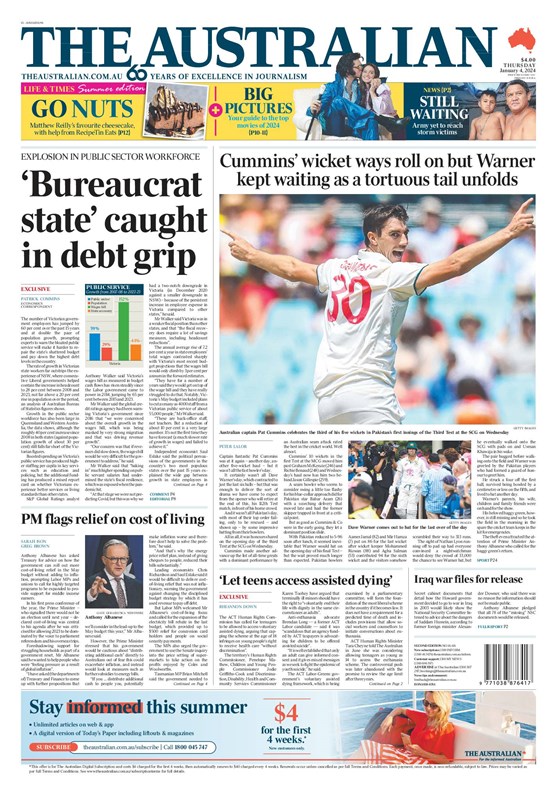
Meanwhile, the reptile silly season continues, and so therefore does the pond's summer school of reptile studies.

There's a thesis topic to hand for someone weird enough to take it on, and it involves the deeply weird, eternally abiding reptile obsession with Victorians (the local ones, not the ones that once ran the much loved, much reptile mourned lost empire) ...


"Experts"? The reptiles are now citing 'leets and experts, and even worse "experts warn"? Since when did the reptiles come to have any faith at all in experts?

The pond paused to spit on a griddle, thankful it wouldn't have to write up that thesis, before noting that the lizard Oz editorialist was blathering on about the same topic below the fold ...


Meanwhile, the pond was pondering bigger questions. 

Could this be the year that the chairman emeritus has his biggest triumph and helps instal an authoritarian, with dictatorial, not to mention not so crypto-fascist, white nationalist ambitions?

Judging by the latest news (paywall), the reptile love of the deeds of another wannabe authoritarian dictator anxious to avoid the clink suggests the odds are looking good ...

The lover of apartheid, ethnic cleansing and collective punishment is pushing ahead, suggesting that there's every chance that his good buddy might also score a win ...


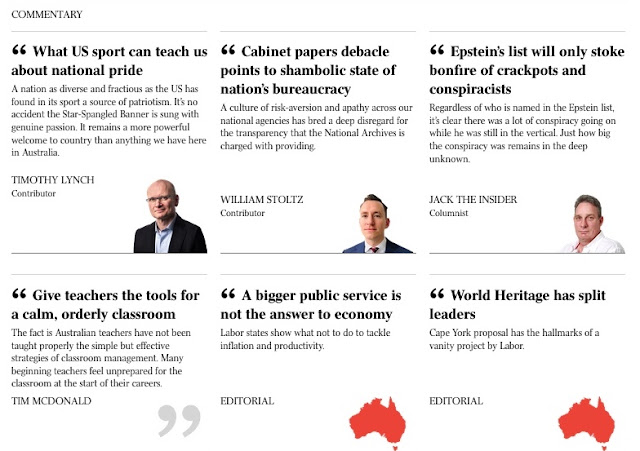
As further evidence, the pond cites the weird ramblings of the Lynch mob, offered as a space filler ...

What US sport can teach us about national pride

The best thing about summer school is that the pond doesn't have to bother with the illustrations, which are as deeply weird as the piece itself ...

Fans cheer as a Boeing C-17 Globemaster III conducts a flyover during the national anthem on opening day between the Los Angeles Dodgers and Arizona Diamondbacks at Dodger Stadium.

First the credit ...

By timothy lynch
5:00AM January 4, 2024

Then it was on with the Lynch mob, celebrating isolationism of a kind much preached by the mango Mussolini ...

My father-in-law died in August. Two months later, his beloved Texas Rangers won, for the first time, the baseball World Series. American sport was how I bonded with Don. It was also the source of our longest argument: why didn’t he take international sport seriously?
A man who never travelled abroad – he could count on two hands the number of American states he had visited – he had no time for international sport. The rivalries of the football (soccer) World Cup bemused him. Sweden vs. Brazil? Who cares? He told me he’d rather stab out his eyes with a spoon than watch “foreign kickball”.
He followed the Dallas Cowboys (American football), Dallas Mavericks (basketball), and the Oklahoma Sooners (college football) – he was born, raised and went to university in the neighbouring state. He was a somewhere man. He believed in place.
Don was unique in many ways. But he had a distrust of sport between nations that is enduringly American. While the US could dominate pretty much any sport it wanted, given its size and wealth, it has under-used team sport for nationalistic purposes.

Just as he was cranking into weird gear, the Lynch mob was interrupted by talk of complaining, whining womyn ...

Media-link
Matildas 'complaining' prize money not enough compared to men's world cup

The bloody harridans. The pond is reminded of Samuel Johnson's famous remark: "Sir, a woman playing soccer or any sport at all, is like a dog's walking on his hind legs. It is not done well, but you are surprised to find it done at all. The notion of paying womyn for the doing of it is entirely absurd. The idea of equal pay for womyn is completely far-fetched."

Well perhaps it wasn't quite in those words, but can the pond channel the reptile and the Lynch mob spirit or what?

Now back to the Lynch mob celebrating the sort of isolationism that might soon see the authoritarian mango Mussolini help the republic abandon its shambolic, derelict form of pseudo-democracy ...

The dullest clash in international football is the Three Lions vs. Team USA (see the 2010 and 2022 World Cups). Ancient enmities have not bred a sporting rivalry. England vs. Germany, on the other hand, is often titanic and dominates the English media for weeks (see 1966 and 1990). Ditto the Anglo-Argentina rivalry (see 1986 and 1998).
No one cares when Americans play international team sport.
Don, like so many of his fellow citizens, found something unAmerican in it. American nationalism does not need validation by beating foreigners on grass. English and Australian nationalisms do. The pinnacle of achievement for an English footballer is to play Germany or Argentina at the World Cup; for an Aussie batsman, to win the Ashes.
But an American baseball player? His goal is to win a “world” series in which teams from only two nations, Canada and the US, compete. An American football player has no foreign field on which to prove himself. When the NFL travels to Frankfurt or Wembley, the spectacle is bizarre. Some very odd non-Americans, in my experience, choose to follow US sports in preference to their own indigenous alternatives. They are almost as weird as people who love no sport at all.
The Ryder Cup is too infrequent and overhyped to count. It produces a confected nationalism against a non-nation: a team from Europe. The Olympics don’t count either. Americans took them seriously in the Cold War and invested in beating the USSR. Gold medals bolstered American nationalism. The end of the Cold War, however, led to a downgrading of the games in American eyes. The worst Olympics in history was held in Atlanta, Georgia, in 1996. They just stopped caring.

At this point the reptiles realised there was absolutely nothing in all this to pander to their elderly demographic, so they slipped in an appropriate ancient snap ...

The England Captain leads the team in a special cheer for Don Bradman, the Australian Captain, who is playing his last Test Match at the Oval in 1948.

Even the pond knows that today marks the appearance of an opening batsman playing his last game for Australia, but hand it to the reptiles. The ability to be out of touch, out of date, and out of mind might well help the USA revert to the sort of spectacular ratbag behaviour that marked the Joe McCarthy era ... and there's not a single word offered by the Lynch mob to suggest otherwise ...

Why is American team sport so isolationist? One answer is how different structurally US sports are from that of other nations. Outcomes are much harder to control in the international arena. Every major sporting league in the US is rigged, so no team can dominate for too long. The weakest teams in one season, under the draft system, for example, get first pick of the best new players to boost them in the next season.
It is a form of sporting welfarism that does not exist in international sport. National leagues, like the English Premier League, that provide players to international teams, all use promotion and relegation to reward and punish performance. The concept is alien to Americans.
Another explanation is how unexportable US sports have proved. India has used an English game to assert its nationalism. The West Indies, Pakistan, South Africa and, of course, Australia love cricket as a way of sticking it to their former colonial masters.
The American empire has produced no equivalent. Despite the huge wealth of the NFL, NBA, and MLB, no US ally takes these sports seriously. In Australia, basketball is dwarfed as a spectator sport by Aussie rules and rugby league. Even Japan, a nation remade by US occupation, would choose to win the soccer World Cup than have a Japanese-based franchise play Major League Baseball.
But the most powerful explanation is the one most often missed: sporting insularity reflects and contributes to the success of the American melting-pot. The assimilation of immigrants across 250 years has come at the price of international sporting mediocrity.
Three German Americans, in different ways, help us explain this: Henry Kissinger, Donald Trump and my father-in-law.
Henry Kissinger was one of very few American leaders who liked soccer. Kissinger, an émigré from Nazi Germany in his teens, saw in European football an arena where power counts. Wealthy clubs rule the roost over poorer ones. This free market is cutthroat, ruthless and unmediated by meaningful regulation that would make it more equitable.

At this point the reptiles inserted a snap of the authoritarian wannabe dictator ...

Donald Trump throws a ball during a press conference on the 2018 football World Cup in Helsinki


Strange, the pond could have sworn it was at another event ...


It turns out that it's the sort of cheap snap that turns up everywhere ...


Sheesh, the pond realised that for a moment it had broken summer school rules and fact checked a reptile snap ...

Speaking of sport, consider the mango Mussolini's rivals on the field ...


Game, set and authoritarian dictator fascist match ...

Enough already, back to the Lynch mob celebrating the incipient ascendancy of the authoritarian dictator ...

Trump, the paternal grandson of a German immigrant, is drawn to soccer for similar reasons. Though he disdains the European Union – progressive free-loaders – he loves its football leagues – where might makes right. If only the US could embrace football, America’s huge demographic and resource advantages would make it a soccer-superpower. Kissinger and Trump thought soccer would be a boon to American nationalism. This has not happened and is unlikely to. My father-in-law is the reason why.
Don reviled international sport because it obliged him to contemplate and rank his identities. Of German extraction, he wanted nothing to do with Die Mannschaft. He was an American, first and last (and Texan by the grace of God). An old-world sport which asked him to choose between an ethnic identity (Germany) and a political loyalty (America), he had no truck with.
Variations of Don’s position across the US population explain why international team sport is considered so inferior to national sporting codes. Many Latinos have a near religious reverence for soccer. The genius of the American experiment in mass immigration is that this loyalty is rarely tested in a match between a Latin American nation and the US.
If international team sport had the same resonance as it does in England or Poland, Mexican Americans would face a loyalty test each time their nations met. Because this match-up barely registers, the test is not posed. America does not stop when the US plays Mexico. The 35.9 million Americans who claimed Mexican heritage (in the 2020 census) can support either/both/neither with little consequence for their hyphenated identity.

Yep, the country is truly stuffed, and the reptiles reminded the pond of another reason why, with a snap of a man who entranced the reptiles while alive, and even more so when dead ...

Henry Kissinger

Then the Lynch mob dives deep ...

The primacy of football (in England) and cricket (in Australia) makes split national loyalties harder to hold. Not impossible, but harder. A test of cultural assimilation in both is whether the newly arrived, and certainly eventually their children, barrack for their new national team or their old. That test is not posed in the US because international team sport has such little socio-cultural purchase.
The US Women’s National Team, the most successful women’s soccer team in the world (winning four World Cups), confirms this thesis. Without Cold War nationalism, the women’s team, as the 2023 World Cup in Australia/New Zealand revealed, has become a vehicle for a woke, anti-Americanism. This is another reason why so many Americans distrust soccer. It is a sport of a Europhilic elite: progressivism in two halves with insufficient ad breaks and low scoring. It is unAmerican.
It is paradoxical, therefore, that the progressive, anti-American finger-wagging of the women’s game has become by far the most imperial and capable of export. While the rest of the world has demurred from adopting gridiron and baseball, major sporting bodies like the EPL and Cricket Australia have been taking the knee in obedience to the identity politics agenda that is currently afflicting aspects of US sport – an agenda that gestated on the college campuses that produce so many American athletes.
When 22 kneeling millionaires oblige their working-class audience to embrace left-wing nostrums, on a cold night in Leicester or windy morning in Perth, there is evidence of a new form of American cultural imperialism at work. What US sport could not conquer in its forms and passions, it has in its ideological packaging.

That last rant is so bizarre and singular that the pond realised that compared to the Lynch mob, and without any interest in sport at all, the pond knew more than the scribbler about certain sports.

"While the rest of the world has demurred from adopting gridiron and baseball..."?

Please, antique prof, consult the wiki, baseball in Cuba ...and contemplate these lines ...

Despite its American origin, baseball is strongly associated with Cuban nationalism, as it effectively replaced colonial Spanish sports such as bullfighting. Since the Cuban Revolution, the league system in Cuba has been nominally amateur. Top players are placed on the national team, earning money for training and playing in international competitions.

The pond only needed one exception to mock your exceptionalism, but please consult the wiki Baseball in Japan ... which began "Baseball was introduced to Japan in 1872 and is Japan's most popular participatory and spectator sport."

At this point the reptiles offered another snap ...

US soccer star Megan Rapinoe

The pond remains surprised that the Lynch mob didn't note the usual meme ... that women's sport is a refuge for lesbians ...

But he still managed an enormously fatuous amount of verbiage containing endless stupidities ...

But I remain optimistic. This fad will pass. The enduring popularity of American sport lies not in how it elicits shame but in how it reinforces national character. The progressive seizure is partial and temporary. A nation as diverse and fractious as the US has found in its sport a source of unity and patriotism.
It is no accident that the Star-Spangled Banner is sung, with genuine emotion, at the beginning of sports matches, large and small. It remains a more powerful welcome to country than anything we have in Australia.
There are many reasons the US remains the number one destination of migrants seeking a better life. The one we miss is possibly one of the most important: American sport. Its localism rather than its internationalism makes it a vehicle for social harmony, cultural inclusion and racial equality.
In a polarised nation, these are at a premium. Don, my father-in-law, understood this. Go Rangers!
Timothy J. Lynch is professor of American politics at the University of Melbourne.

And there you have the thoughts of a weird prof primed to vote for an authoritarian dictator blathering on about the progressive seizure of sport ...

Now consider this. Some cartoonists still think they might be able to lock him up ...


But that only makes the beast stronger and more likely to succeed, and with the Supreme Court in his pocket and the remarkable ability of the US court system to dither and delay, at best it's a long shot...

Thanks to the likes of the Lynch mob, things are looking up for orange Jesus's desire to stay out of jail. The pond never thought it would end up quoting Time, but needs must ...

It was meant, as ever, as a softball question for his pal, but former President Donald Trump couldn’t just take the gimme from Sean Hannity. The Fox News host wanted to bat down the ample reporting that Trump and his allies were already laying the groundwork for a return to power, replete with penance for his foes, punishment for his enemies, and penalties for those who stood in his way. “Under no circumstances, you’re promising America tonight, you would never abuse power as retribution against anybody?” Hannity asked Trump in Davenport, Iowa, back on Dec. 5.
But the former President, as ever, could not help himself. “Except for day one,” Trump replied. 
It was a stunning declaration, one that Democrats thought might be the key disqualifying piece of evidence in their case for ensuring Trump never again be allowed near the White House. Yet at that exact moment, the prestigious Des Moines Register poll was in the field, and what it found complicates the critics’ read of Trump’s answer. Among likely Iowa Republican caucusgoers, the poll found, a full one-fifth—19%—believe such a quest for vengeance makes it more likely that they would support Trump. 
The survey also found a full 14% were more inclined to back Trump based on his lies alleging fraud in the 2020 election justified his terminating parts of the Constitution. More broadly, 50% said Trump’s plans for "sweeping raids, giant camps and mass deportations" made him a more attractive candidate, and a solid 43% were more likely to vote for Trump based on his comments that "the radical left thugs that live like vermin" in the country needed to be rooted out. And 42% apparently experienced a similar surge of support when told that Trump has said immigrants who enter the United States illegally are "poisoning the blood.”
Put simply: Trump’s most audacious aspirations for an American autocracy are not costing him with the voters he needs the most at this moment, just weeks before Iowa, New Hampshire, and South Carolina prove to be his first test of a comeback. In fact, such comments may help Trump build a firewall against challengers like former South Carolina Gov. Nikki Haley, Florida Gov. Ron DeSantis, and tech bro Vivek Ramaswamy. All the while, Trump is singing the praises of dictators and setting off alarms among scholars of autocracy.

And so to the bonus of the day, and the pond will use the words of its resident poet as an introduction ...

Who knows what further treasures
Beneath her surface lie
Who knows to what far coffers
Her looted profits fly...

It was a story dear to the reptile heart ...


The actual story had a slightly less inflammatory heading ...

Energy security must be prioritised, Santos and Woodside insist as merger talks expected to resume

And it began with a media link that attempted to soften talk of war on the woke a little more ...

Media-link
Gas has ‘important’ and ‘long-term role’ in economy’s net zero transformation

Then came the byline ...

By colin packham
6:47AM January 4, 2024

And by golly, good old Col knew how to stir the climate science possum ...

Australia is in the midst of an “anti fossil fuels war” and it risks affordable and reliable energy supplies, the chief executives of two of the country’s largest gas companies have said.
As talks between Santos and Woodside over a potential tie-up are set to resume within weeks.
Australia is moving rapidly to reshape its $2.5tr economy and wean off its fossil fuel dependency, Kevin Gallagher, the chief executive of Santos, said the country is at risk of being dangerously idealistic.
“My biggest concern is for energy security and affordability, both at home and for our trading partners in Asia who rely on us for the energy that drives their economies. We cannot turn the taps off on oil and gas before there are replacement technologies,” said Mr Gallagher.
“Renewables are a big part of the solution, but we are still a long way from technologies that would replace fossil fuels in making steel, cement, fertilisers and the petrochemicals that make medicines, medical products, paint, plastics and the polymers that are the foundation for so many products we take for granted in modern life.”

The yarn was even blessed with a snap, with a most unfortunate label ...

“Renewables are a big part of the solution, but we are still a long way” says Santos CEO Kevin Gallagher. Picture: Kelly Barnes

It reminded the pond of its favourite saying: "much has been done, but much remains to be done" ... then it was on with the comedy stylings ...

Santos is moving to develop new sources of LNG, while also developing a carbon capture and storage project set to come online later this year.
Carbon capture and storage is controversial, with critics insisting it is unreliable and will delay the transition to renewable energy, while proponents argue the technology will minimise the disruption on the economy allowing for existing infrastructure to be used as well as sufficient time to build replacement renewable energy sources.
Mr Gallagher said Australia must embrace carbon capture and storage.

Good one, Monsieur Gallagher. Truly your comedy stylings verge on genius ...

Please, deliver another zinger ...

“My fear is that we continue to delay the transformation of energy markets because of a debate that centres on one solution or one technology rather than a pragmatic, market-led, technology-neutral approach that allows industry to get on with decarbonisation.”

Okay, okay, the pond has been to the Climate Council ...


But hustlers gotta hustle, grifters gotta grift ... and climate science denialists have to move in strange and mysterious ways to keep their businesses afloat ... and if it happens to stuff the planet, who cares ...

The vision for Australia’s LNG industry was echoed by Woodside’s chief executive Meg O’Neill, who said the country must demonstrate its commitment to the sector by removing regulatory uncertainty surrounding new LNG projects.
“Reform is needed to resolve ongoing policy uncertainty related to timely approvals of much-needed investment, not only in new gas developments but across the energy and resources sectors more broadly,” said Ms O’Neill.
“Without certainty around project approvals, Australia’s position as a globally competitive investment destination is challenged and we risk missing the opportunity to demonstrate leadership in the energy transition.”
Environmentalists have secured a spate of legal victories in recent months, challenging regulatory approvals.
Santos and Woodside have been hit most notably, and Ms O’Neill late last year said she expected further challenges to its $16.5bn Scarborough project.
The two LNG giants are still only in early stages of merger talks, Santos and Woodside confirmed late last year, and The Australian understands the two sides are expected to resume discussions later this month.
A deal would create a global LNG giant, allowing a combined company to profit from the near-term demand for gas.
Woodside, under Ms O’Neill, has positioned itself to capitalise on strong near-term demand for fossil fuels, while the company envisages demand for LNG to remain robust until 2050 as traditional sources of energy run low and new sources take longer to mature.
But a Woodside-Santos merger would not be entirely smooth. Some investors question the WA oil and gas giant’s interest in some assets owned by Santos.
Santos holds quality assets in PNG, but its WA assets service the domestic market, and doubt remains over whether the company’s massive investment in coal seam gas in Queensland was worth the money spent.

Luckily, Wilcox was on hand with a cartoon, though the pond suspects it had seen this one before ...but hey, what's wrong with recycling ...


Wednesday, January 03, 2024

In which the pond proposes retirement for sundry reptiles, notes the new brand of climate science denialism, and moves on to a distraction ...


The pond realises it has been pushing the summer school of herpetology for striving students a tad hard, and decided that the time was right for a break.

The inspiration came from Dame Slap's rousing call this morning ...


What to say, except perhaps to add that it's time for a new generation of reptile journalists to step up. 

Dame Slap has done her very best to fuck the country and the planet, and bet the house on the likes of "Lord" Monckton and Ian Plimer, and now it's time to hand over to a new generation of emerging climate science denying scribblers. 

It's not just her, the whole tribe of ancient reptile elders should pack up and go ... Dame Groan, the bromancer, nauseating "Ned", prattling Polonius, Killer Creighton, the dog botherer, they're all getting long in the tooth, and they should be standing aside and promoting their successors.

And that's about all the pond has to offer on the matter of Dame Slap, except perhaps an offer of unmitigated contempt... but as she's in the business of offering career advice to others, why not offer a little to her? Oh along with a goodly dose of profound contempt ...

And that way the pond wouldn't have to deal with this tired summer silly reptile season line-up ...


That Melissa Coburn in the far right slot isn't a dinkum reptile replacement offering. 

Only a week ago, she could be found scribbling in L'Age ... inter alia ...

...In a city of busy, scurrying workers preoccupied with the deadlines that must be met before the Christmas break, here was a pocket of beauty, like a waterfall stumbled upon by chance on a hot ramble through the bush. The hymns – such as Once in Royal David’s City and O Holy Night – swept around the foyer, spinning images of something precious that is sometimes lost in the pragmatic demands of the working day.
The words of O Holy Night, sung in thunderous, electrifying harmonies – “Fall on your knees! O hear the angel voices! O night divine, O night when Christ was born …” – resounded like a command or a rebuke, sending chills down my spine.
The words were truthful; we would fall on our knees, speechless, in the face of the reality of the extraordinary nature of God, both the creator of life and yet seemingly incongruously personal in His gentleness towards, and love of, the individual. The hymns resurrected another reality, characterised by a simplicity and grace.
They took the breath away and filled the eyes with trembling tears that could not be shed, not there, in the bustling business heart of Melbourne. Instead, I studied the shiny, patterned floor of that enchanting old building, mesmerised by the echo of something eternal that had found a voice and rung out across the city.

Dear sweet long absent lord, and for the reptiles she was scribbling about vulgar youff having a New Year's Eve party, shouting and rapping in a strange lingo while getting pissed as parrots while she was off to bed early ...

If the pond wanted nauseating nostalgia for old folk, it would just offer up a cartoon ...


Meanwhile, the top digital slot and the tree killer edition were being held by the usual reptile hysteria about renewables, solar and sun worship ...


It's astonishing how alarmist and hysterical the rag routinely is these days, just another tabloid in the fading tabloid of the Chairman Emeritus's dreaming.

Whenever the pond reads the reptiles ranting on about catastrophists and climate science as religion, the pond realises it's merely reptile projection.

The thrust, the point of the alarmist story, was the enabling of yet another lizard Oz editorial ...

Broken power system still fuelled by calls for subsidy
By Editorial
12:00AM January 3, 2024
A plea by energy retailers for higher prices to compensate for the rising use of household rooftop solar is an inevitable and predictable confirmation of the dysfunction that now characterises Australia’s electricity system. It represents another chapter in a tale of cascading subsidies that have become necessary as a system rooted in baseload generation from coal is forcibly switched over to one dependent on variable sources of renewable energy such as wind and solar.
If retailers get their way, energy users who have been forced to subsidise renewable energy projects, including rooftop solar, will be asked to pay more for the projects that these renewables were designed to force out of the market in the first place. The new cost would be included as part of the regulated price that retailers are allowed to charge. The power retailers also are largely the owners of the coal-fired power stations that still supply most of the nation’s electricity but are being rendered unprofitable by design and forced to close.
Climate Change and Energy Minister Chris Bowen has upped the ante on the subsidy regime with a turbocharged Capacity Investment Scheme that will underwrite the profitability of 32 gigawatts of new renewable projects, up from 6GW previously. Like rooftop solar, the overbuild of large-scale renewables is needed to meet Labor’s target to cut greenhouse gas emissions by 43 per cent from 2005 levels by 2030. This target also is being revised upwards.
A large amount of wind and solar is required to deal with the fact individual projects will produce for only some of the time. But when they are all working together it is likely there will be a glut, as is the case with rooftop solar on sunny days when there is low demand. Wholesale prices are now often negative in the middle of the day.
But regardless of how many wind and solar projects are built, it’s likely there still will be periods of shortage that must be plugged when intermittent power generation is not sufficient. The experience in Britain has been that baseload generators have demanded subsidies to be available still when needed under a capacity market. Renewable generators that are producing power that is not needed have demanded to be paid as well.
Projects designed to help, such as the Snowy 2.0 pumped-hydro and expanded transmission network, are proving to be slower and more expensive than promised. Under Mr Bowen’s latest scheme, taxpayers will be on the hook to ensure all of the projects approved as part of the 32GW target achieve a minimum rate of return. Ironically, the subsidies will make renewable energy, the so-called cheapest option, more expensive than it otherwise would be. But a price guarantee and overbuild ensure that other options such as nuclear will struggle to find space in the market to justify their cost.
If adopted, the latest call for assistance from electricity retailers will be felt directly by energy users. Retailers want a higher price because of fierce competition from rooftop solar as well as the looming impact of batteries and offshore wind that will depress prices in the evening, after the sun has stopped shining and when wholesale prices traditionally have spiked. Retailers are urging the Australian Energy Regulator to factor the rise of solar into its considerations when determining the default market offer from July.
After two years of big increases in the default market offer price, the political pressure will be for the AER not to approve another big increase. But the laws of physics dictate that power will have to come from somewhere and private sector economics suggests absorbing sustained losses is not an option for generators.
This leaves taxpayers and users on the hook to continue Band-Aiding a system that has been broken by ideology and a lack of proper planning.

"Broken by ideology"? As any dedicated herpetology student knows, that's reptile code for a refusal to bend the knee to climate science denialism, and a refusal to embrace the reptiles' eternal, undying love for dinkum sweet innocent virginal Oz coal ...

Luckily Wilcox had offered up a relevant cartoon as a way of starting the year ...


Yay, alarmist reptiles, where's the next generation coming from? 

Given the dearth of reptiles, luckily the pond had a piece on standby.

As any passing observer would know, the house of mouse has finally had to let go the earliest iteration of the mouse, after years of making US legislators do their best to keep the mouse in copyright (what a falling out that was between Ron DeSanctimonious and the house of mouse, what a ruination of the originalist concept of copyright, with SCOTUS always willing to take alms from the rich).

John Oliver had fun with the mouse late last year ...


The pond is now looking forward to a slasher pic starring the mouse, the fate that befell Pooh not so long ago in Blood and Honey...

Talk of copyright also turned up in the NYRB as The Dream of a Universal Library ... (possible paywall, the pond can never tell).

It was by Robert Darnton and it offered the lede Digitization promised to democratize learning, and despite countervailing forces the trend is toward more open access. But is an ‘Alexandria in the cloud’ really an open sesame? 

Ostensibly it was a review of a book ...

Athena Unbound: Why and How Scholarly Knowledge Should Be Free for All
by Peter Baldwin
MIT Press, 405 pp., $35.00

Of course the question of paywalls wasn't seriously discussed, but there were questions about the price of academic knowledge ...

In 1991 the World Wide Web seemed to provide a path to a dazzling future: everyone in the world would be able to communicate, at a minimal cost, with everyone else through the Internet. In 2004 Google promised to make that future even brighter. By digitizing library holdings, Google would create a modern Library of Alexandria: everyone would have free access to all the books in existence. Digitization promised to open up the world of learning to the excluded and the underprivileged, particularly in developing countries. But it touched off an equal and opposite reaction in the form of closed access, paywalls, and monopolies. The world of learning has become a battleground between the opposed forces of democratization and commercialization.
To be sure, the complex realities of technology, publishing, libraries, and authorship cannot be reduced to a Manichaean notion of progressives battling money-grubbers, because most of the participants in the knowledge industries pursue self-interest, whether it is profit or prestige. The recent history of academic books and journals shows how these interests have collided, driven by tectonic shifts in the global order of research and publication.
As soon as it began to digitize libraries, Google became entangled in copyright law, which protects rights to a book for the life of the author plus seventy years—that is, in most cases, for more than a century. A moving wall now keeps all books published since 1927 out of the public domain, but Google has forged ahead, digitizing everything (though without making entire texts available), despite having been sued by rights holders for infringement of copyright.
By agreeing on a settlement with the Authors Guild and the Association of American Publishers, Google converted what was originally a free search service involving only snippets from books into a profit-driven commercial library. In order to subscribe to Google Book Search, research libraries, which had made their holdings available to Google free of charge, would be required to buy back digital versions of their own books at a price set by Google, one that could escalate beyond their ability to pay. In 2011 the United States District Court for the Southern District of New York declared that the settlement violated antitrust law. Its decision prevented the creation of a new kind of monopoly, one that would control access to knowledge in digital form.
The death of Google Book Search nevertheless meant that most books published during the last one hundred years cannot be made freely available to the public except as volumes loaned by libraries one copy at a time. The nonprofit Internet Archive has bravely made digital versions accessible, also with restrictions to single copies (the digitized counterparts to the physical volumes in its collection), but in March it lost a suit to publishers who accused it of violating their copyrights. The Sonny Bono Copyright Term Extension Act of 1998 (known as the Mickey Mouse Protection Act because the copyright on Mickey was about to expire) cemented the extent of copyright at the author’s life plus seventy years. According to Jack Valenti, a champion of Hollywood interests, copyright should exist for eternity minus one day.
Yet Article I, Section 8 of the US Constitution requires that copyright should extend “for limited Times” only, subject to the purpose of promoting “the Progress of Science and useful Arts.” In the first US Copyright Act, in 1790, Congress decreed that “for the encouragement of learning,” the term should last fourteen years, renewable once. That act was modeled on the first copyright law, England’s Statute of Anne (1710), which, also “for the encouragement of learning,” limited copyright to a maximum of twenty-eight years. Today most books cease to sell in large numbers within a year or two. Protection for twenty-eight years would be adequate for all but a handful of authors, and it would leave room for a greater good—the public’s access to knowledge. In deviating from its original purpose, copyright legislation has gone only downhill since the time of the Founding Fathers.
Monopolistic abuses are far worse in the publishing of academic journals. Three publishers—Reed Elsevier (now RELX), Wiley, and Springer—dominate the field, producing 42 percent of scientific journals in the English language. They sell most copies to research libraries, ratcheting up the prices so mercilessly that they cripple acquisitions budgets. The average annual subscription price of a chemistry journal is now $7,014. The current price of a full subscription to The Journal of Comparative Neurology is $40,000—the average cost of five hundred to six hundred academic monographs.
Once a university library has subscribed to a journal, it is hooked, because it cannot cancel the subscription without alienating scientists on the faculty who demand an uninterrupted flow of up-to-date information. Faculty members do the research, contribute the articles, referee submissions by others, and serve on editorial boards, almost all for free, and then expect their library to pay for the journals they have helped produce, no matter how extortionate the price. Publishers claim to add editorial value to the articles, but the published version is often nearly the same as the submitted version, so they usually add little—and to buy them libraries have to subtract sums from their budgets for monographs in fields outside the sciences.
The irrationality of the system has been obvious for decades, yet despite many efforts libraries have failed to break the stranglehold of the publishers. The system seemed to reach a breaking point in 2019, when the University of California implemented a two-year boycott of Elsevier journals on all of its ten campuses. In March 2021, after intense negotiations, UC and Elsevier reached an agreement on a four-year contract. Nearly all of Elsevier’s 2,600 journals were made available for reading by UC faculty and students, and the journals were to receive publishing charges (subsidized up to $1,000 by UC libraries) for articles by UC researchers. Such charges, levied on the author, are common in scientific journals, and they often come to $5,000 or more, which is usually covered for the most part by the original research grant.
The agreement made the articles available as “gold” open access (OA)—that is, anyone could consult them without charge—a gain for the general public; but articles by non-UC authors remained behind a paywall, making the journals hybrid (part OA, part paid for by subscriptions). Far from promoting accessibility, hybrid journals maintain publishers’ subscriptions while providing them with additional income from authors. In the end the UC libraries had to pay as much as they did before the deal, about $13 million a year.
Although the millions of dollars in library budgets have not attracted much attention outside the world of libraries, the stakes are high and the issue is political. Most scientific research is subsidized by the federal government. Shouldn’t the public have access to the results of work supported by public funds? The government committed itself to that principle in February 2013 (and in 2008 for funding by the National Institutes of Health) when it directed federal agencies that issued grants worth more than $100 million to require recipients to make their research freely available from digital repositories. But it permitted an embargo of twelve months, which allowed commercial journals to cream off the demand.
Under President Biden, the White House Office of Science and Technology corrected this deficiency in a new directive issued on August 25, 2022. As of December 31, 2025, all agencies, whatever the extent of their funding, must require immediate open access, and the requirement covers data and metadata as well as the final text. The G7 leaders took a similar stand on May 14, 2023, as did the European Council on May 23. The tide is turning in favor of unrestricted access, but the countervailing forces are so complex that the future remains cloudy.To make sense of these issues and the vast literature surrounding them, the best place to begin is Athena Unbound by Peter Baldwin, an eminent historian of modern Europe and the welfare state who has made himself an expert on the history and current practices of scholarly publishing. In 2001 Baldwin and his wife, Lisbet Rausing, created the Arcadia Fund to preserve cultural heritage and promote open access. As a trustee of the New York Public Library and member of the advisory board of the Wikimedia Endowment, he has been a participant observer of recent attempts to free knowledge for the benefit of the general public. And in an excellent earlier book, The Copyright Wars (2016), he demonstrated his command of the legal issues, stretching back to 1710.
In Athena Unbound Baldwin takes a hard look at the world of knowledge. Have no illusions, he warns: journal publishers are gouging their customers, scholarly monographs reach a tiny audience, libraries are floundering under budget pressures, academics are pursuing careers rather than truth, and readers are not getting all the information they deserve. He expresses contempt for “cultural nostalgists,” who have a romantic view of creativity and an outdated attachment to the printed codex.
Yet he also argues that recent trends point to a favorable future. The widespread notion that we are being buried under unmanageable, expensive, and frequently false information is misleading, he claims, because the improvement of search engines will one day help us find everything we need, and the triumph of open access will eventually make all scholarly knowledge available for free.
Baldwin supports his assertions about current trends with plenty of evidence. His book contains sixty-eight pages of notes to an amazing variety of sources, and he relies heavily on quantitative arguments, many of them surprising. For example, on book publishing:
  •     The average scholarly monograph these days sells 60 copies….
  •     In the major Anglophone outlets, at best around 3,000 books are reviewed annually, out of              500,000 total published in the US and UK….
  •     Of the 10,000 US books published in 1930, only 174 were still in print in 2001.
On scientific journals:
  •     Elsevier posted robust results for 2020…with profits of over £2 billion on revenues of £7                billion….
  •     Two physics articles from the 1990s, presenting findings from work on particle accelerators,          had 406 and 271 coauthors respectively….
  •     China issued 21 scholarly journals in 1970, but over 11,000 by 2019.
And on research libraries:
  •     In a medium-size US university library, only 20% of books are checked out even once.
  •     Major research libraries in North America hold almost a billion physical volumes, but only 59      million distinct titles.

The statistics have a gotcha quality, which jolts the reader into questioning the status quo and considering policies that would change the rules of the game. The greatest change is the cause that Baldwin defends convincingly throughout his book: open access, or practices that would realize the promise of the Internet by making material on it freely available to readers. In fact, OA proposals have generated an enormous literature, which goes back to principles formulated in a manifesto, the Budapest Open Access Initiative of 2002. The declaration recommended two versions of OA: “green” (researchers deposit the final version of an article in a repository, which makes it available to everyone free of charge) and “gold” (journals publish individual articles free of charge to the reader, usually in exchange for hefty publishing fees paid by researchers or their funding sources).
Although the green–gold distinction may seem esoteric, it represents an important fork in the road for university policies. For example, in 2008 the Harvard Faculty of Arts and Sciences voted to take the green route, and their repository now provides readers with a vast amount of research. But journal publishers responded by imposing an embargo, which gave them a temporary monopoly on the material, usually for one year. And because the policy was voluntary, professors often failed to deposit their work. The University of Liège solved that problem by fiat: in deciding on faculty promotions, it refused to consider any articles that were not deposited in its repository. The recent decisions by the White House, which make government grants contingent on immediately accessible deposits, indicate that green is the way forward.
Baldwin, however, seems to favor gold. He concedes that it will not work if not applied globally, but he imagines a future in which journals will give up subscription fees in exchange for payments to publish. A great deal of “flipping” to publishing charges is already occurring. But it often results in hybrid journals, which pocket publishing charges (often paid in part by libraries) for articles they make accessible for free, while continuing to collect subscriptions, also paid for by libraries. Unless all the major scientific journals switch entirely to gold, library budgets will not be able to bear the burden.
In the best of all possible worlds, Baldwin imagines a global bulletin board that would make everything instantly accessible, fusing green and gold. All content, of books as well as articles, would be financed by the producers, stored in the cloud, and downloaded gratis by consumers—or, for readers who favor the printed codex, produced by publishers and sold in the manner of trade books.
The fantasy of a universal library has attracted many dreamers. Baldwin thinks that universal digitization can make the dream come true, because the cloud has infinite storage capacity, even though storage requires servers and financing, and because search engines will inevitably be perfected. Readers need not have doubts about finding what they want in “the new Alexandria in the cloud,” because technology will sort that out. “The perfect search engine will one day provide a universal index,” Baldwin writes. That may sound Panglossian, but Baldwin points to current advances in OA as evidence for optimism.
His argument is most convincing when applied to the publication of scientific articles, where the costs are greatest and the technology most advanced. The Public Library of Science, founded in 2000, publishes a dozen first-rate open access journals. The OA repository arXiv has successfully published more than two million “e-prints” in physics and several other fields, with some preliminary assessment but no peer review. For-profit scientific journals increasingly rely on publishing charges in place of subscriptions, thereby making their content free to readers.
But the prospect for open access looks less promising in the humanities and social sciences. Authors in those fields rarely receive grants that cover publishing charges, and their careers often depend on publishing monographs rather than journal articles. Baldwin makes a strong case that their work, along with that of scientists, should be treated as a public good like clean air and highways. Moreover, he sees vanity and careerism as the driving forces of academic authorship. Academics outside the hard sciences receive salaries, yet feel entitled to royalties on the relatively rare occasions when they publish a book. Baldwin considers such incidental income unjustified because it is earned on company time. The publications of nonscientists should be treated as work for hire, he claims, and should be made virtually free to the public.
That proposition accompanies a general assessment of the scholarly world’s infrastructure, which Baldwin considers antiquated and wasteful. His vision of the future therefore turns into an indictment of the present, and he carries his argument to such extremes that it loses the power to convince.
What, he asks, would be the role of book publishers in a fully digitized environment organized in accordance with open access? After the cost of a book’s first copy is covered, an unlimited supply of subsequent copies, provided directly from an electronic repository, would be virtually free. The publisher’s function as a gatekeeper would cease to exist because there would be no more gates—and therefore an end to “the university world’s thralldom to the prestige hierarchy of the established publishing venues.” Acquisitions editors would be superfluous. Already they do little more than weeding out inferior texts and “reading around on company time,” Baldwin claims. Improved search engines would handle the selection process, taking readers right to the works they want, which would be available on the global bulletin board. Peer review could therefore be eliminated, along with unnecessary apparatuses such as professionally designed layout, indexes, dust jackets, blurbs, and sales catalogs. Most bookstores would disappear; libraries would be reduced to storehouses of old-fashioned volumes; and virtually all cultural intermediaries—book reviewers, literary agents, advertisers—would be eliminated, because their functions would be replaced by the all-powerful search engines putting readers in direct communication with texts in the all-encompassing cloud.
A future in which all books, digitally unified, “become one massive tome,” as Baldwin puts it, sounds like the dystopias of Jorge Luis Borges’s “The Book of Sand” and “The Library of Babel.” In fact, it seems so extreme that Baldwin may dangle it in front of the reader as a provocation, intended merely to expose flaws in the current system. But he fails to consider a main objection to his argument: Is a “global bulletin board” even feasible, and if so, could improved search engines compensate for the elimination of editors, reviewers, librarians, and others who dominate the current process of selection? He does not address the problems of eliminating firewalls in countries like China, nor does he deal with the inadequacies of existing search engines. He barely mentions artificial intelligence, which could flood cyberspace with more misinformation than could ever be overcome by search engines of the future.
Cyberspace may have room for an infinite number of texts, but we must find a way to preserve them. Digitized works are fragile. They are made up of minuscule ones and zeroes that decompose, and they require metadata that is equally vulnerable and that can become obsolete, leaving them lost in the cloud. Present techniques of surveillance and migrating texts from one format to another are expensive and incapable of preserving a universal digital library. Baldwin’s assertion that “everything can be saved” is dubious. My advice to anyone who wants to preserve a digital work is: print it on paper.
Baldwin may have underestimated the staying power of the printed codex. More books are published each year than the year before; publishers are making more money; the number of independent bookstores is increasing; libraries are thriving; and despite the omnipresence of digital devices, readers continue to enjoy holding a volume in their hands and turning pages. The paratextual elements of the printed book—its page design and packaging—continue to be effective, even if only a minority of readers care about its aesthetic aspects, such as the smell and feel of print on paper. Talented professionals continue to produce and disseminate this valuable product, and they provide a public service while making money from it.
Baldwin is correct: the more open access, the better. And he rightly warns us that we live in a real world of vested interests, where the better can be sacrificed to illusions about the best. But he puts too much faith in the self-correcting capacity of “digitality”: “Throw all content against the wall and see what sticks.” I would suggest implementing open access, while covering the wall with shelves and filling them with solid, attractive, and durable books.

Robert Darnton’s latest book is The Revolutionary Temper: Paris, 1748–1789. He is the Carl H. Pforzheimer University Professor and University Librarian Emeritus at Harvard. (December 2023)

Bet the pond's readers weren't expecting that sort of distraction, a serious discussion of serious issues.

For those who lasted the distance, that warbling Coburn reminded the pond of what it got up to ove the silly season.

While doing some rote mechanical work on the computer, the pond listened to a mob of crusading atheists. 

The pond hadn't done that for what feels like forever. 

It was of course the fault of the logarithms. Once Bertrand Russell turned up and the pond did a fatal click of the mouse (always the bloody mouse), all sorts of ratbags turned up ...

There was the usual - a smattering of Hitchens, though the pond drew the line at angry Dawkins - but this was what started it ...


There was also some light comedy, because Seth Andrews started out as something of a preacher, and still has something of the Elmer Gantry about him ... it's the "my friends" that gives the Elmer in him away ...


Well, the pond promised a break from the usual reptile studies, and all that's left to wonder is how much of Hieronymus Bosch has found itself into modern cartooning ...


As always it's in the detail, including a clever person who has been far too date rape drug cleverly of late ...


Each day the pond walks past a couple of 3D toy figures it picked up while exiting via the gift store ...and if your browser can handle the pace there's a giant sized version of the painting here (warning, it is huge, and very slow to load, but which allows an inspection in detail of sundry earthly delights ...)