Tuesday, January 02, 2024

In which it's a busy summer school study day, though with a retro déjà vu déjà rêvé vibe ...


The pond well remembers the time that it heard the earth-shattering, knee-trembling news that Keith was shuttling off and Rebecca Weisser was the new Queen of Quad Rant, setting hearts aflutter. 

The pond was sitting down to a lunch of blackberries and yoghurt, and idly attended to the comments section of the pond, only to splutter a mix of blackberries and yoghurt over the iPad. Grifters gotta grift, hustlers gotta hustle ... and a quick check proved it was so ... and she was still married to that other great Australian journalist, the Caterist, and best news of all, the Schuttle was only shuttling over to Quad Rant books ...

The very next minute, as it was wiping off the congealed mess of blackberries, the pond was hearing the news that a dinkum Aussie gal was Queen of the Danes and sure enough, this day the reptiles were in a state of high excitement, with Matthew Denholm furiously scribbling Mary, our flannie Queen, wins hearts, republican and monarchist. 

The opening line ensured the reptiles gave the pond its nausea quotient for the day.

It’s a journey more over-the-top rom-com than traditional fairytale – from VB-drinking, flannelette-shirt wearing Tassie party girl to European queen. 

Then it was down to serious business, because the pond's summer school of herpetology doesn't have time to contemplate the business of assorted queens ...

Ancient, venerable Troy was in a state of high dudgeon, furiously scribbling Iraq cabinet papers debacle is either ‘cover up’ or pure farce. 

The pond seems to remember reading this last night and yet the date stamp read ...

By troy bramston
5:00AM January 2, 2024

No doubt there was some kind of reptile conspiracy involved ... and the pond must admit it cut short ancient Troy's rage by starting some way down after the start ...

...At the December 5 media briefing about the cabinet records to be released on January 1, it was confirmed there was no written cabinet submission about the benefits, costs and implications of joining the Iraq war. All of the critical briefings and discussions took place in the National Security Committee.
At the December 5 media briefing about the cabinet records to be released on January 1, it was confirmed there was no written cabinet submission about the benefits, costs and implications of joining the Iraq war. All of the critical briefings and discussions took place in the National Security Committee.

Astonishing really, given all the remarkable revelations about the recently discovered weapons of mass destruction discovered by the lying rodent's team.

Meanwhile, the reptiles offered one of their media link distractions ...

Media-link
Cabinet documents uncover Howard government’s entry into Iraq War

Then it was back to ancient Troy, in a pious rage ...

But the Department of the Prime Minister and Cabinet decided not to transfer any of these records to the National Archives of Australia for release on January 1, 2024, as required under the Archives Act 1983. There are only two possible explanations: supreme incompetence by the lead government department or a deliberate cover-up. The records have not gone missing. They have not been misplaced. They have not been forgotten about. Hundreds of cabinet records were made public on Monday.
But it just so happens that records relating to the most important decision taken by cabinet ministers in 2003, deploying forces to Iraq, which were largely NSC records, have not been released at all. How could this be an oversight?
Just one cabinet minute detailing the decision to join the Iraq war has been released but no submissions, no briefings by security or military agencies and no minutes recording discussions have been made public because they are all NSC records.
But guess what? The official historians of the wars in Iraq and Afghanistan have, or will be, given access to NSC records. The National Archives confirmed this. But what about the Australian people? Do they have to wait for official, often censored, histories to gain any insight into these NSC records?
The official cabinet historian, David Lee, was not allowed any access to NSC records. How do we know this? Because I asked him at the media briefing in December. This is utterly absurd. Lee, a highly respected historian, was not given access to records about the most important cabinet matter in 2003.
I subsequently asked Howard, former defence minister Robert Hill and former treasurer Peter Costello – all members of the NSC – if they had any role in the decision to keep records top-secret. They did not. Moreover, they called for them to be released without delay.
These interviews were followed up with a series of questions and phone calls to the department and the National Archives. My questions were as follows:
1. Why have these NSC records not been transferred to the National Archives for public release in accordance with the Archives Act 1983, which stipulates they should be after 15 years in order to be made public after 20 years?
2. Who made this decision and when was it made?
3. Does the government believe the Australian people have a right to know about deliberations undertaken in the NSC to commit forces to war more than 20 years ago?
4. Why has exclusive access to these records been given to the official historians of operations of Iraq and Afghanistan rather than the official cabinet historian and, on January 1, 2024, the Australian people?
5. What consultation was there with former prime minister John Howard and ministers in his government about withholding these records from public release despite being in the open access period on January 1, 2024?
6. When will records from the NSC be made available for public access?
These questions, however, were met with contempt. The department and the National Archives refused to answer them. Instead, they tried to deceive me by insisting many records from the NSC, and others, relating to Iraq were to be released. But, of course, no NSC records relating to Iraq have been released.
In a statement just hours before the cabinet papers were to be made public on January 1 that would make the writers of Yes Minister blush, the department claimed “due to apparent administrative oversights” a “small number” of records were not transferred to the National Archives.
This is high farce. They also blamed – can you believe it? – Covid disruptions in 2020. It is too convenient to blame the Morrison government. Did they not know that every year they release cabinet records from 20 years ago and the most important issue in 2003 was Iraq?
Moreover, following my queries, the records were suddenly “located” and “inspected”, and “transferred” 10 days before January 1. So why haven’t they been released? The announcement, in the New Year’s Eve statement, of an “independent review” by former departmental secretary Dennis Richardson may give us that answer.
Anthony Albanese, who promised to end the culture of secrecy and cover-up, and inaugurate a new era of transparency and accountability in government, needs to take action. It cannot be brushed aside.
The Albanese government is ultimately responsible for this debacle because it had time to address it four weeks ago when it was first raised and release the records, but declined to do so. The Prime Minister needs answers and so do we, the Australian people, who have a right to know.

War criminals covering up their war crimes and suddenly it's all the fault of Albo? Silly old ancient Troy does deserve a fair amount of contempt.

Relax. The astonishing news of all the WMDs discovered by the lying rodent's expert team can remain slumbering away peacefully in some cabinet somewhere ...

Then came Killer news from the US ...

Donald Trump’s top defence advisers warn against selling nuclear subs to Australia

Inevitably there was a snap of the mango Mussolini at the top of the piece, captioned thusly ...

Former US President Donald Trump’s top defence adviser says the US would be ‘crazy’ to sell nuclear submarines to Australia.

The pond wondered what to think, and was alarmed to discover that Australia was entirely defenceless, the bromancer having apparently taken time off for the silly season, and so unavailable to contemplate the Killer yarn ...

EXCLUSIVE
By adam creighton
9:33PM January 1, 2024

It turned out that the Chairman Emeritus's team had struck another blow for freedumb ... and that Killer had had a few EXCLUSIVE chats with mango Mussolini nutters ...

Sending US nuclear-powered submarines to Australia on current timelines is “crazy” and would deny Washington its “ace in the hole” in deterring Beijing, according to two senior national security analysts who are expected to play pivotal roles in the next Republican administration.
Just weeks after the US congress passed laws allowing President Joe Biden to sell Virginia-class boats to its AUKUS ally in Canberra, ex-Pentagon official Elbridge Colby and former republican Senate security adviser Alex Velez-Green say the superpower’s own navy has too few boats spare to sell to Australia unless production greatly speeds up.
The concerns of Mr Colby and Mr Velez-Green – two of the most respected thought leaders in US conservative circles – will raise questions for Anthony Albanese and Labor over how a Republican victory in next year’s presidential election might affect the AUKUS security pact.
Former president Donald Trump has held a consistent lead over Mr Biden in head-to-head polls in the lead-up to the first presidential primaries next month, and Mr Trump’s closest Republican rival, ex-UN ambassador Nikki Haley, leads Mr Biden by an even wider margin.
With the AUKUS legislation passed last month allowing both a future president and congress to stop the submarine sale if it is not certified as in the US’s national interests, growing scepticism from Republican security figures could sway the next GOP president against sending nuclear boats to Australia.
Mr Colby – who has advised Mr Trump, and ex-prime ministers Tony Abbott and Malcolm Turnbull – told The Australian it would be “crazy” to sell three Virginia-class nuclear-powered submarines to Australia.

Most respected thought leaders, and they're going to be working for the mango Mussolini? And so the abuse of the English language continues apace, with the reptiles wildly excited about the news of the fascist's progress ...

Media-link
Donald Trump commands a 34-point lead ahead of Iowa caucus

It was with some fair relief that at least the bromancer might soon be getting his war with Cheenah ...

The ex-US deputy assistant secretary of defence for strategy said the sale would leave American forces vulnerable “during the very time risks of war (against China) and defeat were elevating”.
“Australia is America’s best ally; it would thus be highly desirable to be able to provide Australia with US attack submarines, but these submarines are the ace in the hole for a fight with China,” Mr Colby said.
“The US has far too few available, many are in maintenance, and the production schedule is way below what we need.
“We cannot and should not do something crazy, the best way to avoid a serious problem on this is for Washington and Canberra to face facts and adapt early, rather than wait until it’s too late to miss the iceberg.”
Mr Colby’s comments came after the US House of Representatives passed the $US886bn National Defence Authorisation Act, which gave the green light for the sale of at least three Virginia-class submarines to Australia in the early 2030s provided the US president could then certify their sale would not “degrade United States undersea capabilities”.

At this point the reptiles slipped in a snap of a contender ...

Former UN ambassador and 2024 Republican presidential hopeful Nikki Haley.

What a slave to trends, but the pond couldn't help blaming the US education system for Nikki's mishap ...


Sorry, the pond realises that summer school herpetology studies must be barebones ... and went back to Killer, looking for more news of the impending war with Cheenah, hopefully - for the bromancer's armchair general status - by Xmas this year ...

Defence Minister Richard Marles and US ambassador Kevin Rudd hailed the passage of the legislation after months of wrangling on Capitol Hill between Republicans and Democrats over concerns about the transfer of the submarines undermining the US amid a naval arms race with China.
The Australian revealed last month that a future US president would have to certify to congress that the transfer of nuclear submarines to Australia would not undermine America’s military capabilities or foreign policy under the law allowing the Virginia sale.
Republican doubts over AUKUS also come in the wake of the Albanese government rebuffing a Pentagon request for a boat to help protect Red Sea routes from Houthi rebels amid the Israel-Hamas war, instead only sending six diplomatic staff to assist with co-ordination efforts for the maritime coalition in Bahrain.
Mr Velez-Green, a senior policy adviser in The Heritage Foundation, and before that Republican senator Josh Hawley’s national security adviser, said any submarines transfer should be contingent on US shipyards’ greatly increasing production of Virginia-class boats from 1.2 to more than two a year.
“If we’re not getting more boats out, we’re just not going to be able to do it,” Mr Velez-Green told The Australian.
“These are a set of assets that we need a husband to take care of, and really protect as much as possible for any contingency.”
The US submarine force, one of the few areas within the US military still more advanced and powerful than its Chinese counterpart, is considered the most important deterrent to any Chinese invasion of Taiwan, which many analysts predict could occur before 2030 as China engages in increasingly provocative behaviour in the Indo-Pacific.
“If you get into a situation where ostensibly we’re supposed to transfer these boats, but they are critical to our ability to maintain deterrence or win (against China) if deterrence fails, I mean, at that point, I have to question giving them up,” Mr Valdez-Green said.
“We’ve got to get to a place where we can transfer those assets without diminishing in any meaningful sense our ability to deter Chinese aggression.”

Say what? The bromancer's war with Cheenah might only happen "before 2030"?

That's simply not good enough, and even worse the snap was really boring ...

Joe Biden, Rishi Sunak and Anthony Albanese at the AUKUS summit.

Then Killer seemed to splutter a little as he finished his tale of woe ...

As part of the AUKUS agreement, first announced in September 2021, the navy is meant to acquire between three and five Virginia-class US submarines starting in 2032, while the government has undertaken to pay $US3bn to the US to help expand its submarine-building capacity, which has been plagued by supply bottlenecks.
In July, 22 Republicans in congress demanded the White House “immediately” provide a plan to lift production of Virginia-class submarines from 1.2 to “a minimum of 2.5” per year.
“The administration’s current plan requires the transfer of three US Virginia-class attack submarines to Australia from the existing US submarine fleet without a clear plan for replacing these submarines,” the letter, signed by influential Republicans including Ted Cruz and Susan Collins, said.
“This plan, if implemented without change, would unacceptably weaken the US fleet even as China seeks to expand its military power and influence.”
The White House proposed an additional $US3.4bn in funding for the US Navy, which is yet to pass congress, being part of a supplementary funding bill that includes contentious aid for Ukraine and Israel, and changes to US immigration law bitterly contested among Republicans and Democrats.

Had there really been anything in this EXCLUSIVE that we didn't already know about the Chairman Emeritus's GOP mob, designed to break the heart of the bromancer?
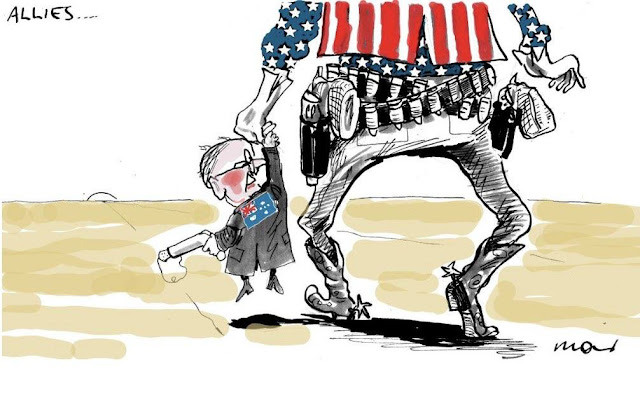


How can the bromancer fight his armchair general war armed with a pop gun?

Not to worry, the pond is sure the bro will deal with the issue on his return ...

Meanwhile, courtesy of the IPA-dwelling Riddster, BOM deserves criticism, but not over its short-term forecasts, the reptiles suddenly discovered that the weather had been acting strange of late.

There was a snap to prove it ...

Houses in Bloomfield, between Shire of Cook and Douglas, submerged in water during the Cairns Floods post Cyclone Jasper.

Sure there'd been many more floods since the ones that struck Cairns, but how could the reptiles know about them?


Enough already, the pond was forgetting it was in barebones summer school mode, and it was on to the Riddster's byline...

By peter ridd
5:00AM January 2, 2024

Inevitably the Riddster's generous forgiving of short term BOM errors was simply so the Riddster could discover an even deeper and more malevolent conspiracy ...

Recent criticism of the Bureau of Meteorology for failing to predict the recent spate of extreme weather is unfair, is ultimately counter-productive and misses far more serious failings of the BOM.
Weather prediction is difficult. At best one can hope only to improve probabilities. And the weather hardest to predict is extreme events associated with storms. These systems are extremely “nonlinear”, to use the parlance of meteorology.
When there are large quantities of moisture in the lower levels of the atmosphere, the air need be lifted only slightly to trigger a violent updraft.
It is a huge slow-motion explosion where the fuel is the invisible water vapour turning into cloud. The amounts of energy involved can be huge – think Hiroshima atom bomb – and a tiny perturbation can set them off. It is often stated that a butterfly flapping its wings could trigger the storm, at least theoretically.
This is one of the least predictable phenomena on Earth. At best, weather prediction can indicate only that such storms are likely at a rough time and place. Perhaps the BOM can get the final warnings out a little faster, but a storm can morph into a supercell in a few minutes.

Don't be fooled by this pious forgiveness ... the Caterist, an expert on the role that Queensland quarries can play in Queensland floods, was on hand to berate the BOM ...

Media-link
‘They’ve got to do better’: Nick Cater slams BoM for failing to warn of Qld floods

Time for the deep conspiracy ...

BOM’s performance in predicting the ultimate landfall of Tropical Cyclone Jasper was nothing short of brilliant. For days before it crossed the coast, the bureau predicted it would end up near Cairns. And that is where it went. The cyclone did minimal damage, but the rain cell associated with it sat stationary around Cairns for days, causing flooding. If the cell had moved, even slowly, Cairns would have been just extremely wet rather than breaking records. But that detail is beyond prediction.
The result of unjustified expectations of prediction accuracy will result in the bureau being forced to cover itself and issue warnings whenever there is a minute possibility of extreme weather. The predictions will become meaningless.
The BOM has a truly superb observation network of rain radars, rain gauges and flood levels. Millions of people use these, especially in country areas, for everything from bringing in the washing to gauging when it will be possible to drive across a flooded creek. This network gives us remarkable ability to see what is happening. Thirty years ago, we were almost blind compared with today.
So give the BOM a break, at least on this matter. But there are two BOMs. There is the operational weather BOM, which does the daily forecasts and measurements, and then there is the climate change part of the BOM. And that is where the criticism should be levelled.

Ah climate change ... and while the reptiles favoured an anodyne snap ...

Cairns Mayor Terry James addresses the media on the ongoing response after Cyclone Jasper and the subsequent flooding.

... the pond thought that the Riddster, with his IPA credentials, deserved a better and more fitting illustration ...


At this point, the Riddster decided he'd join in ...

The climate models used by the BOM and many other groups regularly are used to predict, with certainty, the end of the world because of “global boiling”. But those models are little better than a guess. We have no idea what caused historical climate change such as the Little Ice Age of a few centuries ago and the hot climate of the Egyptian period. Climate models fail on this. The bureau’s failure to acknowledge model weaknesses is unscientific. Uncertainties must be stated. If the BOM proclaims its predictions for the year 2100 are excellent, it can hardly complain when people get upset when its forecast for this afternoon turns into a dud.
Another major problem within the bureau is the section dealing with long-term temperature measurements. Most long-term measurements have been modified (homogenised), almost always making past temperatures cooler.
The BOM does not dispute it has done this, but there is a huge argument about whether it has done it in a justifiable way, and BOM has failed to release all its data about these temperature adjustments. This is inexcusable and breeds concerns about the bureau’s scientific integrity.
There is also the habit of the BOM to associate every extreme, or record-breaking, weather event with climate change. In fact, record events are inevitable every year because of the huge scale of the observation network.

The reptiles offered up another media-link ...

Media-link
Government to conduct review on BOM warning systems

But the pond was still marvelling at that Riddster line ...

In fact, record events are inevitable every year because of the huge scale of the observation network.

But what of the record events around the world?

The perfidious French at France 24 seemed to think there was some kind of global phenomenon at work ...


On and on the perfidious French carried on ...

Oceans suffered from extreme heat
The heat was not confined to land; the planet's oceans also experienced frighteningly high temperatures. March, April, May, June, July, August, September and October all recorded their hottest maritime temperatures ever.
On July 30, the average global ocean surface temperature reached an unprecedented 20.96°C, according to the European climate monitoring service, the Copernicus Institute. Just a month later, the Mediterranean Sea set its daily heat record, with a median temperature of 28.71°C, according to the main Spanish maritime research centre.
These repeated new records indicate an increasing frequency of marine heatwaves, something that could have dramatic impacts on biodiversity.

There was so much that the pond had to break summer school rules with another visual ...


What a relief to turn back to the Riddster to discover it was just a local conspiracy ...

There are thousands of weather stations, many of which have been operating for only a few decades. Each station has dozens of different types of record (minimum, maximum, daily, monthly, seasonal, annual, temperature, rain, wind). A year without breaking a record would be a record worth noting, especially in Australia, a land of extremes.
But the climate section of the BOM uses record events for political purposes.
Should we have an inquiry into the BOM? Yes. But the good guys of the BOM short-term weather forecasting department need to stand up against the anti-science catastrophists in their climate department. Otherwise they deserve to be tarred with the same brush.
Peter Ridd is a physicist, adjunct fellow with the Institute of Public Affairs and chairman of the Australian Environment Foundation.

Ah, yes, the anti-science catastrophists ... another victory for the Riddster and the IPA ...

The pond was reminded of Michael Pascoe's pre-Xmas offering in The New Daily, The IPA is taking Gina Rinehart for a ride down the garden path...

Inter alia ...

Your taxes at work
In a four-part series in 2019, Crikey argued that one of the IPA’s greatest successes had been to stitch climate denialism into the very fabric of the conservative political identity.
Maybe it’s just a coincidence that the IPA has been well funded – as a tax deduction – by mining profits.
Which is where the suspicion about motive arises. In my opinion, it’s hard to believe the IPA was seriously interested in working out how much land is likely to be used in our transition to renewable energy, given the pathetic quality of its “research”.
The Bannon call to “flood the zone” makes more sense. A CNN report on a court appearance by the former (and perhaps future) Trump advisor put the tactic in context:
“His quote is like a compass that orients this crazy era of American politics. ‘The Democrats don’t matter,’ Bannon told (author Michael) Lewis. ‘The real opposition is the media. And the way to deal with them is to flood the zone with shit.’
“That’s the Bannon business model: Flood the zone. Stink up the joint. As Jonathan Rauch once said, citing Bannon’s infamous quote, ‘This is not about persuasion: This is about disorientation.’”
At the time of writing, there had been 176,000 views of just that one silly IPA tweet. Some people gullible enough to be taken in by it including, going by her AFR awards night speech, Australia’s richest person.
Yet the rubbish circulates and finds supporters among those who want to believe it. It is reliably and uncritically regurgitated by denialists, turning up in comics like the Spectator and spread in the echo chambers of the deluded or self-interested.
And it is tax deductible, costing the rest of us money.
Merry Christmas.

Oh come on, be fair, it's not just the Speccie mob. The reptiles at the lizard Oz love to stink up the joint too ... and the Riddster is always ready to help with manure and poo duties...

By the way, that Crikey piece ...

How one think tank poisoned Australia’s climate debate
One of the Institute of Public Affair's greatest successes has been to stitch climate denialism into the very fabric of the conservative political identity.

... is now so ancient it could be found outside the paywall ... proving, with a retro déjà vu déjà rêvé vibe, that everything old will always become new again ...

Last, but certainly by no means least, good old Dame Groan, a true stayer, wasn't slacking for the holyday season, and was on hand to ask a penetrating question:

Did Covid really change anything about our economy?

Naturally the reptiles had the perfect snap for the piece ...

Flinders St station, in the heart of Melbourne, during one of the cities lockdowns in 2021.

Then came the byline ...

By judith sloan
5:00AM January 2, 2024

Then something truly peculiar happened.

Was Dame Groan aware of her reputation as a perpetual Groaner?

For some reason, she decided that she was a peace and flower lover ...

I am sitting at my desk looking at the peace lily that, amazingly, has a few flowers. I can remember when I bought it – the day the Morrison government closed the international borders as a precautionary measure given the outbreak of Covid in China.
I normally wouldn’t buy indoor plants because we move around a fair bit. But my green-fingered neighbour has kept this plant alive all that time. It prompts me to ask the question: did Covid really change anything, at least economically speaking?
In some respects, the post-Covid world looks better than before. After all, the rate of unemployment has been below 4 per cent from early 2022 compared with a rate close to 5 per cent going into the pandemic. The employment-to-population ratio has jumped by more than two percentage points and the participation rate is at a historic high.
When the pandemic first broke out and state governments, in particular, began to impose restrictions, including periods of lockdown, there was a widespread view that property prices would plummet, with any recovery very uncertain. As events panned out, property prices fell briefly but have since recovered, and a bit more.

It turned out that it was the preamble to a bit of a holiday egg beater piece, much froth and foam, but not much substance, and the reptiles recognised this by interrupting the groaning ...

Media-link
‘Win for common sense’: David Littleproud on FWC working from home ruling

It turned out that "Covid" was just an eye-catching headline, designed to appeal to Dame Groan's reptile demographic ...

With the exception of those quarters that significantly were hit by lockdowns – the June quarter of 2020 and the September quarter of 2021 – gross domestic product has continued to grow.
Certainly, many small businesses were hit for six by government actions, but the overall economy continued to grow. With the opening of the international borders, the absolute level of GDP has been inflated by the surge in net overseas migration, in part reflecting a catch-up for the period of closed borders.
It is important to note here that Australia has recorded falling per capita GDP this year.
The reality is that the real economic impact of Covid is not easily detected by simply observing the surface; it’s necessary to have a look at what’s going on underneath to make an accurate assessment. It may look like business as usual, but there have been several fundamental economic changes with ongoing consequences.
One of the most obvious fiscal features of Covid was the extremely large jump in government payments as households and businesses were supported in various ways to offset the impact of the imposed lockdowns and other restrictions. Federal annual real government spending went from $550bn before the pandemic to $654bn in 2020-21; from 24.6 per cent of GDP in 2018-19 to 31.4 per cent in 2020-21. This is an extraordinary increase, with net government debt increasing by $100bn in one year alone (between 2019-20 and 2020-21).
Two important points flow from this step-up in government spending. The first is the circularity of the arrangements; the state governments would not have been able to impose the lockdowns, border closures and other restrictions were it not for the federal government compensating households and businesses. Had the benefits been more limited, these governments would have had to give much more thought to the policies they implemented. In addition, the relative ease for some workers to work from home enabled the lockdowns to be ordered to an extent that would have been unlikely in the past. (The WFH phenomenon continues, with uncertain but probably damaging effects on worker productivity.)

It was such a slow holyday story that the reptiles felt the need to remind the pond that SloMo had once been a thing ...

Scott Morrison addressing the media during a press conference held at Parliament House in Canberra.

Meanwhile, Dame Groan meandered on, in a way only genuine cultists might relish and enjoy... while all the pond could think about was another serve of blackberries ...

There is also an argument that people went along with the limitations, notwithstanding their inconvenience and madness in some cases, because people were being compensated. This may bode badly in the future, with people now expecting the government to pick up the tab in the event of any adverse development such as the pandemic.
The second point is the seemingly permanent increase in the size of government, post the pandemic. This is the case for both federal and state governments. For example, if we look at the latest federal government mid-year economic and fiscal outlook, government spending remains above 26 per cent of GDP in every year to 2026-27. In other words, government spending looks like a one-way street: ratchet it up and don’t expect a return to the previous size of government.
Of course, it wasn’t only governments involved in offering economic support for the damage caused by Covid – or, to be more precise, government measures to deal with Covid.
The Reserve Bank was quick off the mark, implementing rapid cuts to the cash rate as well as engaging in quantitative easing. For those with a mortgage (or debt of any sort), monthly repayments quickly began to fall and many households were able to lock in low fixed interest rate mort­gages for several years. Unsurprisingly, the combination of cheap money and the massive surge in government spending set the scene for potential inflationary pressures to emerge. In the context of global supply-side problems affecting many goods as well as building materials, it was only a matter of time before inflation would become a problem.
(For a time there was some political discussion of the need for local production of key goods, including pharmaceutical and technology products. With the excep­tion of the US pushing on with local computer chips manufacturing, there has been little progress with this so-called on-shoring.)

The pond began to feel it was trapped back in the era when comrade Dan baiting was the reptile national sport ...

A quiet little bourke street near Myer, David Jones and the Emporium during Covid restrictions in July 2020.

Then came a remarkable thing. After all this blather about nothing much, Dame Groan tried her hand at whimsy ... actual, certifiable whimsy ...

All those years of very low inflation had seemingly inoculated policymakers from the dangers of sparking inflation through faulty policy settings. Demonstrating that things were overdone during the pandemic, we only need to look at what happened to the household saving ratio. Going into the pandemic, the ratio stood at 7 per cent of gross household income. Seven months later, it was 24 per cent; it was 19.2 per cent in September 2021.
To be sure, people were not able to spend money on certain goods and services and this partly accounts for the rise. But it’s not surprising that many households felt less financially pressured during Covid than before.
If we look at the most recent figures, however, we observe that those savings have been almost completely depleted, with the saving ratio a mere 1.1 per cent in the September quarter of 2023.
It’s understandable that policies decided during periods of great uncertainty – the onset of Covid is an example – can be highly defective (and ineffective). Everyone was uncertain about the seriousness of the virus, how quickly it would spread and what public health measures were really required.
Of course, Australia was not Robinson Crusoe in making these mistakes and, on the face of it, inflation is now returning to within target ranges in many countries. But there was no excuse for overlooking the economic policy lessons of the past and ignoring the risks that were being run by massively increasing government spending as well as running effectively zero interest rates.
Real household disposable incomes are now being hammered, making for lots of grumpy consumers (and voters). My peace lily seems blissfully unaware.

It was worth hanging in just for that final line ...

Real household disposable incomes are now being hammered, making for lots of grumpy consumers (and voters). My peace lily seems blissfully unaware.

Talk to Dame Groan's hand, or perhaps her peace lily ... there's never been any kind of human pain she hasn't loved ...

As they used to say in SF while wearing long hair, "peace, Lily" ...

Pictures of Lily made my life so wonderful
Pictures of Lily helped me sleep at night
Pictures of Lily solved my childhood problems
Pictures of Lily helped me feel alright

It all felt like a very "I'm alright Jill" New Year message from the Queen of Groaning, very holyday season, much like the current TT ...


Monday, January 01, 2024

In which the pond's summer school of reptile studies begins with a racist bang and ends with "Ned" whimpering as he flogs assorted neddies ...


Does the pond regret opening its summer school for herpetology on limited resources and with erratic hours?

Despite the occasional grumble, there have been splendid Murdochian YouTube links, and some epic verse ..

...Four science nerds
Three redheads
Two union thugs
And the tax-funded commie ABC!

The pond can go one better, four reptile stories, including one black basher, one bit of tedious history, a lizard Oz editorial, and a "Ned" beside a partridge in an Everest pear tree ... beats science nerds hands down.

Besides, time waits for no man, reptile or cliché (womyn can of course wait in the bus shelter).

Speaking of the commie ABC, already Polonius has begun compiling the ABC's ideological errors for 2024. 

You might think that waxing lyrical and getting hysterical over the exuberant waste of taxpayer money on blowing up the joint, at a time when the planet is under severe stress, might see them given a pass at least for a day, but as the pond didn't watch, it missed all the assorted thought crimes.

Speaking of a bust, what an extraordinary let down ancient Troy proved to be.  The pond got through all of his EXCLUSIVE, but while it was incredibly short, it was also incredibly TEDIOUS, so the pond could only manage a short excerpt ...

John Howard’s ‘when I’m 64’ hint gave Peter Costello little hope

As usual, due to budget cuts, there are no distracting illustrations in the pond's summer school, but they can at least be noted, and some will find pleasure in not finding them ...

Prime Minister John Howard and Treasurer Peter Costello in 2003.

Well it's ancient Troy doing ancient history in an ancient EXCLUSIVE way...

EXCLUSIVE
By troy bramston

...Mr Costello told The Australian he held out little chance of a leadership transition and did not contemplate a leadership challenge, even though he had been deputy to two leaders – Mr Howard and Alexander Downer – since May 1994.
“When he got a go of being prime minister, that’s what he wanted,” Mr Costello said of Mr Howard. “He did a term and he thought ‘I can do another term’, and then he went for another.
“In retrospect, I see now that he was just going to hang on for every day that he could. That was basically it. But every now and then he would talk about a leadership transition. And I’d say, ‘Oh yeah, fair enough. We’ll see what happens.’ It never happened.”
Mr Howard said he did not believe there would be a leadership challenge from Mr Costello. “I felt that the majority of my colleagues wanted me to stay,” he recalled. “And how did I know that? Because I spent a lot of time with them.”

Sorry, that's all the pond could be bothered to study.

Who apart from the lying rodent, Petey boy and ancient Troy himself gives a FF?

The pond had bigger and more important fish to fry, thanks to an expert exposition of the ancient art of black bashing, as begun by the British and continued to this very day by an imported black sheep with a dubious degree in sociology, but with a stunning mastery of the ancient art of whispering to wayward floodwaters in quarries ...

Some might joke about the Quad Rant, but here in the lizard Oz is an expert Quad ranter ...

Indigenous mastery of ecology is a historical delusion

As usual there were stills, but as already noted, with the summer school's limited staff, these can only be noted...

Climate Change & Energy Minister Chris Bowen at the COP28 in Dubai. Picture: Jacquelin Magnay

However the author can be noted, and the date ...

By nick cater
5:00AM January 1, 2024

And then it was on to a feast of black-bashing, an ancient art descended from the British ...

Archaeologists have been struggling to identify the rightful owners of the United Arab Emirates for decades. Could prehistoric stone tools discovered 12 years ago at Jabel Faya have been brought by migrants from East Africa 125,000 years ago? Or were the true indigenous people the camel slaughterers from Mesopotamia who arrived in the glacial period 5000 years before the birth of Christ?The question is more than ­academic in Chris Bowen’s mind. He appears convinced that indigenous people everywhere hold knowledge vital to the future of the human race. The Climate Change and Energy Minister began a speech at the UN climate change conference in Dubai in early ­December with a clumsy welcome-to-country performance that would’ve puzzled his hosts.

As well as snaps, there were exciting media links ...

Media-link
Chris Bowen lampooned for Indigenous acknowledgment during COP28 speech

Foolish Bowen. As everyone knows, you must turn to the floodwaters in quarries whisperer for any dinkum defamation action ...

He expressed his profound ­respect for the people “who have cared for our respective lands for millennia”, asserting that indigenous knowledge, cultures and traditional practices were “critical” to solving the climate crisis.
First Nations people, as Bowen fashionably calls them, possess the special knowledge that will allow us to solve the complex problems created by climate change.
It is hard to doubt his conviction. Bowen doesn’t just talk the talk, he is prepared put our money where his mouth is. In April, Bowen announced the formation of a First Nations Clean Energy and Emissions Reduction Advisory Committee as part of a $75m package to bring Aboriginal voices into the debate.
“We have to learn from the people who have had stewardship of our land for over 60,000 years,” he said. “We need to do that now, for example, with the Indigenous-led savanna burning carbon credit system. And there are many more examples where we could do better.”
What are those examples? The minister did not feel compelled to elaborate. The pseudo-science is settled as far as the climate cognoscenti are concerned. Indigenous people were diligent stewards of this land, living in perfect harmony with ­nature until white people arrived with the poisoned fruits of Western civilisation and trashed the joint.

As everyone knows, what's left of the tragic lizard Oz graphics department tends to turn to public domain illustrations to interrupt the flow of bile, the poisoned fruits of Western Civilisation and the Caterest trashing the blacks, and this day it was a snap of ...

Michel de Montaigne

Moving right along, it's time for a Quad Rant plug ...

Australian historian William J. Lines masterfully unpacks the ­intertwined narratives of ecology and indigenous exceptionalism in his recent book, Romancing the Primitive: The Myth of the Ecological Aborigine (Quadrant Books). Lines traces the strands of thought from Michel de Montaigne and Jean-Jacques Rousseau in the 16th and 18th centuries to Australian poets Mary Gilmore and Judith Wright, whose siren call had an uncanny influence on public policy during the Whitlam era.
The Albanese government also seems entranced with works of fiction, albeit stories that some consider history. Bill Gammage’s The Biggest Estate on Earth asserts that Indigenous mastery of fire turned the Australian continent into an idyllic, eco-friendly landscape, or as Lines describes it “an Edenic world of abundance ­resembling the cover image of a Jehovah’s Witness tract”.
Bruce Pascoe’s revelation in Dark Emu that pre-settlement Australians were not hunter-gatherers but cultivators, builders, town planners and hydrologists takes the romanticisation of primitive life to a fantastic level of ­absurdity.

Naturally the reptiles slipped in a snap of the wastrel ...

Bruce Pascoe

Then there was an expert explanation of how pesky, difficult, uppity blacks didn't have the first clue about floodwaters in quarries, unlike the author ...

Yet Anthony Albanese is an unabashed fan. “Bruce has unearthed the knowledge that we already had in our possession but chose to bury along the way,” the Prime Minister told parliament in February 2020. “Bruce has simply reminded us where the lights switch is … a complex mosaic of ancient nations is suddenly laid out before us.” Penny Wong told the Senate in November 2020 that thanks to Pascoe and Gammage, “we are no longer trapped in the ignorance of our own assumptions and prejudice, premised on the underlying supremacy of the narrative that white people know best”. Wong’s self-demeaning lapse into a race-based argument was unfortunate. The achievements of Western civilisation have nothing to do with skin colour and everything to do with the triumph of reason over superstition.
As it evolved in the West, the scientific tools of logic, deduction and probability are available to all. “Scientific knowledge is not ­restricted to the initiated,” says Lines. “Curiosity is the only ­criterion.”
The notion that Aboriginal Australians would be happier quarantined from modernity is ­absurd. So, too, is the fashionable idea that Western civilisation is no better than any other civilisation and probably worse.

And that's how you get to practise expert climate science denialism without a single scientific degree or field work to flourish ...

Anthony Albanese (R) speaks as he sits next to Penny Wong during a meeting in Parliament House.

At this point, the Caterist was really warming up in his Quad Rant ...

Against this, the romancers of the primitive invest hope in a different form of knowledge – ­traditional or cultural knowledge that they claim is the intellectual property of Indigenous people alone.
Lines points his finger at the naked emperor. “No one can precisely define what they mean by traditional knowledge,” he writes. The methodology upon which traditional knowledge depends is not explained. “Instead,” writes Lines, “they advanced terms such as ­“holistic”, “relational” and “interconnectedness”, which they contrast with “reductionist” and “linear” Western science”.
The claim Indigenous Australians “managed” the land is at the core of the primitive delusion. Lines disputes it. The expression “fire-stick farming” was invented by anthropologist Reece Jones in 1968, says Lines. The theory that Aboriginals possessed an “ecological consciousness” made them prudent ecological managers is ­belied by the absence of the words ecology or management in the lexicon of any known Aboriginal tongue.
Lines describes the hard reality of the hunter-gatherer lifestyle that runs counter to the narrative of environmental stewardship. A small population, speaking 250 languages, on a sparsely occupied continent domesticated only the dog and did not control animals stocks. “Wildlife management consisted of exhausting local prey and moving on,” he writes. “While horticulture and agriculture increase yield through human effort, hunting and gathering do not.”

The point, of course, is to limit the damage, and prevent loons fleeing from the lizard Oz to Quad Rant, so that they can enjoy meaningless snaps and Quad ranters in the luxury of their very own lizard Oz subscription ...

Professor Bill Gammage

Of course when you deliver a straight out racist Quad Rant, there must be a billy goat butt, just for safety and a little fig-leave covering, and so here it comes ...

This is not to deny the ingenuity and perseverance that enabled Indigenous Australians to survive on a continent that does not easily surrender its riches. Lines point is that knowledge is not exclusive and does not emanate from the ­received wisdom of a particular group. “Each human group faced specific challenges to which they divide specific solutions,” he writes. “Everywhere, humans draw on the same traits of adaptability, intelligence, and for Unity to adapt a local circumstance.”
Primitivism is unhelpful to ­Indigenous and non-Indigenous Australians alike. “Romanticising does not help the romanticised,” writes Lines. “Instead, it isolates them from rational thought and gives them an unrealistic assessment of their abilities and place in the world.
“Romantics continue to impoverish the Aboriginal world with the introduction of ­intellectually hollow and dubious pledges.”
For 21st-century progressives, however, romanticising the primitive was never an exercise in improving the lot of Aboriginal Australians any more than hopes of ennobling the savage inspired by Rousseau.
“Aborigines were Cyphers, carriers of a fantasy about pre-contact life and calculators of lessons about the failings of Western civilisation,” writes Lines. It is an exercise in ennobling themselves and asserting their moral and intellectual authority.
Nick Cater is senior fellow at the Menzies Research Centre and a director at Quadrant.

What a splendid racist, climate science denialist, quarry flood water whispering Quad Rant with which to start the reptile year ...

Then came a bit of a downer, full of cheap as chips public domain snaps ...

Federation’s promise shouldn’t be consigned to dust bin of history

Federation procession marching down Macquarie Street on January 1, 1901.

First the author ...

By Andrew Kemp
5:00AM January 1, 2024

And then the exposition ...

Australians tend to celebrate the anniversary of Federation, on January 1 every year, in the same way they celebrate an uncle’s birthday. They forget about it.
When the date January 1, 1901, was chosen, it seemed like a good idea at the time. There is romance in the idea that a new nation, boasting the most modern and democratic constitution devised, might come into existence on the first day of the new century.
But who celebrates it now? On New Year’s Day, people have kids to look after, beaches to go to, books to read. It’s our recovery from the Christmas period. Politicians should never compete with a public holiday.
At the time journalists warned that most Australians might be too hungover to notice the commonwealth come into existence; others pushed the colonial premiers to consider January 26 as an alternative date. Perhaps they should have.
But this is a shame. Federation remains largely misunderstood and understudied. Worst of all, it is considered boring. There was no revolution, no civil war, no repelling of foreign invaders (that was us). The most violent thing that happened on January 1, 1901, was a horse fatally kicking a policeman in the head. It rained a bit too.

This unkempt Kemp then does his best to be boring, and by golly does he succeed in spades ... such that the reptiles broke for a media-link featuring fireworks ...

Media-link
Crowds camp out in Sydney ahead of New Year’s Eve fireworks

This is by way of reminding folks of the role that the B picture and the quota quickie played in the nation's cinema history. 

First you had to endure a first half, though the serial and the cartoon could be fun ... and then came a short feature from the empire, a bit like the Poms exporting the Caterist ...

But, if you are so inclined, take some time to look at the photos of New Year’s Day from 1901. Look at the monstrous crowds jamming Sydney’s thoroughfares: crowds of half-a-million lining the footpaths, sitting on makeshift grandstands, shop awnings or windowsills. Tens of thousands gathered at Centennial Park to see the proclamation of the commonwealth. It’s hard not to think that at least some of these spectators understood something that we do not.
One of them, the nine-year-old William McKell, a future governor-general, remembered the day vividly. He remembered the crowds, and of being swept off the road by a police guard to make way for the first governor-general, the stately but fragile Lord Hopetoun.
Most of all he remembered a banner stitched together by volunteers: “This day a nation is born”. The slogan “became a part of me,” McKell remembered. He felt part of something new, something bigger. Call it patriotism. Call it a sense of civic pride.
The founders of Federation were wrong about many things, but they were right about one big thing: democracy needs more than a new constitution if it is to survive. It needs a people dedicated to making it work, “to take the business of citizenship seriously”. To do that, we need to be educated about our democracy.
The Australian Constitution, activated on January 1, 1901, is the foundation stone our democratic system. And as the voice referendum made clear, it is a living document. We care about it when we need to.

Yes, there were illustrations, but you can find them in any public library ... in the public domain and ripe for the looting ...

Bird's-eye View of Macquarie Street, showing Queen's Square.

Then it was on with the mind-numbing exercise in patriotic tedium...

The Constitution says something fundamental about our identity, who we are and who we want to be.
It is easy to take something so dry for granted. But I suspect those vast crowds lining Sydney in 1901 were aware that they were undertaking a new experiment. No written constitution had ever been so democratic: “the high watermark of popular government” the great legal scholar James Bryce then ­described it. The US constitution seemed positively old fashioned in comparison.
Australians had federal voting rights virtually unprecedented the world over. It guaranteed anyone who could vote in colonial elections would be entitled to a federal vote. In practice this meant most Australians above voting age would have the vote, including ­Aboriginal voters who were already enfranchised in the colonies.
It is often forgotten that the Barton government intended to enfranchise all Indigenous Australians, not just those who already had the vote. It was met with strong opposition. The disqualification from the franchise of Indigenous people who did not already have the vote under state law, by the Franchise Act 1902, is a blot on our early federation and the ­intensely racialised politics of the day.
We cannot deny the racial culture in which Australian federation was achieved. Equally, we can celebrate the progress that came after, in the victories of legal and political equality for all citizens. What is striking is how most of this progress came about without the need for constitutional amendment. It is a remarkably flexible document.

There is of course a splendid irony and it's not the illustration ...

Sir Edmund Barton

It came with the line ...

We cannot deny the racial culture in which Australian federation was achieved.

Keeping in mind the Quad Rant this day, we cannot deny the racial culture in which the Australian federation and the lizard Oz continues to this very day ...

Its flexibility derives from its democratic character. This is ingrained in the Australian political culture. The first book ever published by an Australian-born ­author was William Wentworth’s Description of the Colony of New South Wales (1819), a book that cried out for a free press, trial by jury and greater political representation.
Likewise, I think of the great Chinese-Australian pamphlet, The Chinese Question in Australia, published in 1879 by Lowe Kong Meng, Louis Ah Mouy and Cheok Hong, which gave us something that Wentworth could not – a lesson in liberal universalism. “Human nature is human nature all the world over,” they wrote in vain, justifying their right to live as equal citizens.
So let’s look at January 1 ­another way – not as an achievement, but as a promise to achieve great things. We do not have to give up our New Year’s Day holiday for that, but we can spend a moment to think about that promise, and to take seriously the business of citizenship.
Andrew Kemp is a Melbourne-based writer.

Barely pausing for breath, the pond raced on to another history lesson, this time from the lizard Oz editorialist ...

Learning lessons of history to chart uncertain times

This was a ripper demonstration of the reptile art of preening self-congratulation, and worthy of study before main picture offering "Ned" hovered into view as the reptile Everest for the day ...

By Editorial
12:00AM January 1, 2024

The pond will only interrupt once ...

For a prosperous and optimistic nation the new year brings both opportunity and challenge. How we respond will define the kind of place Australia will become after the dust has settled on a period of rolling upheaval. The challenges are not unique to us and they include international and national events that are sometimes beyond our control. But history and geography put us at the centre of great shifts that cannot be avoided or ignored.
As The Australian enters its 60th anniversary year as a newspaper our mission remains the same as it has alway been: to deliver excellence in journalism to help our readers better understand the complex world around them and to make up their own minds. As editor at large Paul Kelly writes in a major essay published on Monday, Australia is heading into a future of multiple challenges defined by the need to improve its economic performance, lift living standards and manage the transformations from technological innovation, climate change and geo-strategic threat. 

Nauseating really, as if climate change poses any kind of problem. Why the lizard Oz spent 2023 in splendid climate denialist form, and surely the year ahead will offer much more of the same ...

As for the rest, the pond will allow one cartoon as a visual distraction ...


We must improve on our domestic underperformance of the 15 years since the 2008-09 global financial crisis while tapping into opportunities offered by shifts in global power and economy. We must also navigate an uncertain international environment. This includes current wars in Europe and the Middle East as well as the potential for conflict closer to home. The “end of history” hopes that came with the end of the Cold War are over. Anti-Western forces led by China, Russia and Iran are joining to exploit what they perceive as weakness in democratic nations to assert their claim to an alternative world order. This year’s presidential election in the US carries extra weight for the world.
There are lessons to be found in history. Some of these are plain to see in the release of the 2003 cabinet records that offer a reminder of how the big issues evolve over time but never go away. As they are today, the economy, defence, national security, climate change, China and Indigenous affairs were defining issues of the period. In 2003, the Howard government was being urged by Treasury to adopt an economy-wide carbon trading scheme as a free-market way to reduce greenhouse gas emissions. We became the first major country to recognise China as a market economy while laying the groundwork to negotiate a free-trade agreement. On Indigenous affairs, the experiment with ATSIC was coming to an end as the nation grappled with policies of shared responsibilities in Aboriginal and Torres Strait Islander affairs. Fast-forward two decades and climate policy remains contested, China has used the West’s economic accommodation to assert a claim for global power and issues of Indigenous representation are as a fraught as ever.
The political leaders of that period, John Howard and his treasurer, Peter Costello, have used the release of the cabinet records to urge the Albanese government to rediscover the virtue of fiscal discipline and tax reform. The Albanese government is cautioned to maintain the budget surplus and use it to retire debt rather than spend it, ensure the stage-three income tax cuts are delivered, and consider raising the GST as part of broader taxation reform.The cabinet papers give a window into how government performed when we were last called to join our allies in a “Coalition of the Willing” in the second Gulf War. The lesson from history is that decision-making in times of crisis is an imperfect science. Mr Howard admits he was “surprised, disappointed, and not a little angry” when it transpired that Saddam Hussein did not have stockpiles of weapons of mass destruction. But given the advice he had, Mr Howard says he would make the same decisions. Cabinet papers reveal that the Howard government decided to commit forces to Iraq in March 2003 without a written submission to cabinet on the costs, benefits and implications, leaving detailed briefings and lengthy discussions principally to the National Security Committee. As Troy Bramston reports, no records from the NSC about the decision were released on Monday. The Department of Prime Minister and Cabinet said this was due to an “administrative oversight”. Mr Howard and Mr Costello, and former defence minister Robert Hill, told The Australian they were not involved in the decision to keep the records classified. The former ministers support disclosure and urged the National Archives to release the documents without delay. They are right to do so in order that a full appraisal of events can be made. Leaders have a responsibility to absorb the lessons of history and to not repeat the mistakes. Let that be the message for a happy new year.

And so at last to the main picture. The pond trusts everyone has at least some peppermint Lifesavers, or perhaps popcorn to hand (the pond could never afford the popcorn), because "Ned" tends to be a bit like Christopher Nolan doing Oppenheimer, or Sir Ridley Scott GBE doing Napoleon ...

It's a real test of the bladder, a three hour marathon, and just the header and the opening snap show why ...

Anthony Albanese must seize the moment to face future challenges

Seize the moment!

Ah, If only ...

The Value of Time and Opportunity: Kipling underscores the value of time and the importance of making the most of each moment. The poem advises individuals to make the most of the "unforgiving minute," suggesting that time is a precious resource that should not be squandered./ This is a call to seize opportunities and make the most of them. (crib away here)

Heck, seize and squander away ...

It's a new year of wasted time in the long forgotten British empire and the 1950s with the reptiles ...

Then came the snap that must be imagined ...

Jim Chalmers and Anthony Albanese front the media at Parliament House, Canberra. Picture: NCA NewsWire / Martin Ollman

Then came the credit, a tad shorter than the end rollers to be found in a Nolan epic ...

By paul kelly
12:00AM January 1, 2024

Then came the thing itself ...

Since it was founded by Rupert Murdoch in 1964, The Australian has provided unparalleled news and analysis to the nation. As the newspaper enters its 60th anniversary year, we have invited some of our senior journalists to give their views on the future in their areas of expertise. We begin a short summer series of articles with this thoughtful essay by the peerless master of political history, Paul Kelly.
Australia is heading into a future of multiple challenges defined by the need to improve its economic performance, lift living standards and manage the transformations from technological innovation, climate change and geo-strategic threat.

Usually the pond would begin to interrupt and heckle, and the usher would roam the theatre with a flashlight, just like they did in the Capitol theatre in the old days in Tamworth, but this time it's undiluted "Ned" ... ponderous, pompous, portentous, pretentious and preening, together with many borrowed quotes.

Some pond readers have wondered why "Ned" keeps on doing it, but what else can old men do when they come down from the attic, but ramble on and bore everyone silly ...

Australia is part of the immense 21st century experiment: can Western democracies keep thriving in a world they have never before experienced? The task for Australia is to improve on its domestic underperformance of the 15 years since the 2008-09 Global Financial Crisis while tapping into opportunities offered by shifts in global power and economy.
The country needs to be agile, smart and internationally competitive. Above all, it needs to act faster and escape from much of the heavy regulation and bureaucracy that burdens decision-making and implementation.
The immediate challenge falls upon the Albanese government and its senior ministers, Prime Minister Anthony Albanese, Treasurer Jim Chalmers, Defence Minister Richard Marles and Foreign Minister Penny Wong. But it goes far beyond government – the coming era will test Australia’s elites and decision-makers in companies, trade unions, the public service, the universities, the professional classes and the media.
The future belongs to nations that have internal coherence and a sense of shared national purpose. This is the foundation for effective leadership. The potent threat is internal dislocation arising from weak economic results, excessive inequality, cultural division and a loss of shared values. In politics, the chief task is to restore the political centre and check the destructive polarisation based on the extremes of Left and Right.
Politics is a symptom of deeper cultural and economic forces. For almost a decade political dysfunction has been the dominant theme in much of the West, notably the United States and the United Kingdom. While Australia has been spared the worst – assisted by its compulsory voting – it is not immune from the systemic tribulations of the rich democracies. The political risk is a fractured system where the quality of public policy declines – a test for Australia’s future.
When launching the August 2023 Intergenerational Report sketching the trends shaping Australia over the 40 years to 2062-63, Treasurer Chalmers said: “At a time of change, one goal is clear, pressing and foundational. To make Australia the biggest beneficiary of the shifts under way in our economy in ways that create more opportunities for more people. This is how we own the future.”
Australia suffers the problems of other rich democracies – a hardening of the economic and social arteries when audacity and mobility are the qualities required for the future.
Chalmers identifies five generational revolutions that lie ahead: the transition from fossil fuels to renewables, the shift from information technology to artificial intelligence, managing the demographic time bomb from an ageing population, the rise of the care economy and the retreat from globalisation towards a world more divided and burdened by geo-strategic danger.
Any one of these challenges would be daunting. But they arrive in a fusion that is complex and devoid of any “silver bullet” answer. Yet they must all be addressed. Chalmers says each is both a challenge and an opportunity. He said: “Across the board these five big shifts in our economy and society compel us to make the most of the energy transformation, foster a digital revolution that works for, not against us, provide quality care for an ageing population, prepare our people for work in new and broadening industries and locate and leverage our economic interests in an uncertain world.”
In short, the tides of change cannot be resisted. Nations and their leaders will need to possess three qualities for future success: intelligence to formulate the necessary national strategy; resolve to implement the policy prescriptions required; and the indispensable art of persuasion – to bring the public to cross the bridges that lie ahead.
This won’t be easy. Australia suffers the problems of other rich democracies – a hardening of the economic and social arteries when audacity and mobility are the qualities required for the future.
The national conversation along these lines is urgent. It needs to be launched now and run for years. What is required is nothing less than a change in Australia’s political culture. It is not beyond us. During the great reform era – running from 1983 under Bob Hawke and Paul Keating and maintained by John Howard and Peter Costello – till around Howard’s final term in 2004-07, Australia engaged in possibly the most comprehensive reshaping of its economic and social policies and institutions of any industrial democracy.

It took a long time to get to the visual break, and as might be expected, it was extremely tedious ...

Then treasurer Paul Keating, left, with former prime minister Bob Hawke, whose leadership led to significant reforms.

Of course for "Ned" it was the time when he was more than a desiccated fossil, a bit of parched coconut ...

Australia became a state-of-the-art global leader. That spirit of ambition and resolution needs to be resurrected. It begins with a frank discussion with the Australian people. The narrative has been put on the table, notably in reports from the Productivity Commission, the latest IGR and the August report from the Business Council of Australia titled “Seize the Moment” the most comprehensive document from the corporate world on the nation’s future.
The Productivity Commission warned that over the decade to 2020 average annual labour productivity growth in Australia was the slowest in 60 years, failing to just 1.1 per cent compared with 1.8 per cent over the 60 years to 2019-22. The consequence of such difference is mammoth. For example, the time it takes for economic output per person to double increases by 25 years – approximately the length of a generation, from about 39 to 64 years.
The BCA blueprint warned Australia’s economic base was too narrow. Six products: coal, iron ore, natural gas, education, gold and wheat make up 60 per cent of Australia’s exports. On current trends the size of Australia’s economy by 2050 will fall from 13th to 21st on the global table, behind Mexico, Egypt, Saudi Arabia, Pakistan, Turkey and Bangladesh among other countries.
Business investment is near a 30-year low as a proportion of GDP. The nation suffers from project announcements followed by project choke. It takes years and multiple approvals to launch new projects. Too few new businesses are being created. The public, after the Covid-19 experience, looks too much to state power to solve problems. Inventions are not being scaled up to penetrate global markets. This point is that more of the same is not adequate. There is a widespread recognition of this reality among decision-makers. The public is restless and impatient. It wants more action and higher living standards.
Where Australia has strengths they are conspicuous – the nation excels in resources, mining, agriculture, finance, education, creativity, migrant inclusion, areas of scientific research and community co-operation. They constitute a powerful platform for higher ambition.
The future will be a picture of many, different contradictory forces, operating across intersecting domains. It is likely to be a story of rapid changes in global power amid a multilateral world, wealth expansion, the struggle in democracies to retain the social impact, periodic crisis triggered by climate, environment and financial institutions, technological breakthroughs that enhance human life, the risk of pandemics, the prospect of large-scale people movement, rising cultural conflict between traditionalists and progressives, tribalism based on sex, gender and race, biological experimentation and the ever-increasing risk of catastrophic conflict from weapons of mass elimination.

Can anyone remember the reptiles' brilliant idea of "Ned" reading his own text?

No-one? Never mind, apparently the art form still lives ...

Media-link
The year that was: Paul Kelly on 2023

Dear sweet long absent lord, not only does he bore the readership with blather about the future, he must harass them about the past?

Australia’s social values are more deeply entrenched than many realise, a vital asset in managing future shocks. Australia possesses internal strengths and resilience and has a proven record of managing change with skill and safety. Australia came to nationhood in a democratic vote of the population with the colonies agreeing to become states in the Federation.
Our constitutional federation based on public consent seems well positioned for the future. Australia has been a highly successful democracy for more than a century with an ability to grow and adapt. Its three main traditions are the British foundations, the migrant or multicultural contribution and the Indigenous inheritance, a story that will evolve in terms of respect, recognition and reconciliation. There is no reason to think our ability to combine these traditions in a cohesive nation will not be maintained.
However, the Intergenerational Report outlines the contours of Australia’s future growth and development and it reflects slower population growth and population ageing. Rich countries will demand more from governments, notably in health, aged care and asset accumulation. Current trends suggest real economic growth over the next 40 years at 2.2 per cent – that is 0.9 per cent below the average of the past 40 years.
Australia on current trends will have a population in the early 2060s of only a touch more than 40 million, far below the dreams of some founding father foreseeing a nation of more than 100 million. Migration will stay important but probably contribute a falling share to population growth. It means the domestic market will be relatively modest; Australia must succeed as a trading nation drawing upon its enterprise and international competitiveness. There is no other way.

At this point there was another visual interruption, and the pond quotes the text as it presented itself in all its Graudian glory ...

Anthony Albanese meets Chinaese President Xi Jinping during the G20 summit in Indonesia on November 15, 2022.

Steady on, the pond doesn't do the spelling. Send any complaints to the lizard Oz, or just enjoy the Chinaese expertise of "Nedese" ...

But the decline in average annual income growth will be unmistakeable. On current trends the average real income growth per head will be 1 per cent over the coming 40 years compared to 2.1 per cent across the past 40 years. There are two main reasons – the decline in export prices for our commodities and the decline in our productivity. Australia will still be rich; but it will need to renew the creativity and aspiration of its great reform period to retain its rate of income growth.
This goes to ambition and motivation. There needs to be a pioneering or frontier spirit in approaching the future. That means striking a different centre point in the balance between security of life and boldness in innovation.
Much of Australia’s future depends upon its management of the two looming transitions – to net zero carbon emissions and the advance of digital technology. Combined they spell change on an unprecedented scale. The government estimates that decarbonisation needs an extra investment of $225bn by 2050 and it envisages that renewable energy will lead to the creation of new industries and export opportunities such that Australia becomes a renewable energy superpower.
Delivery on such vision is an immense challenge in terms of infrastructure, investment and public support given that high energy costs for consumers are likely to prevail for some years and reliability in the transition is imperative. The stakes for Australia are high. Its comparative advantage in fossil fuels will erode. Australia’s geology is rich in critical minerals needed for the clean energy world – there is confidence this will lead to new mining and value-added industries but that constitutes an arduous enterprise.
Current trends highlight the imperative for exceptional fiscal management in Australia for many decades. Deep forces will propel higher spending across health, aged care, the National Disability Insurance Scheme, defence and interest payments on debt. The size of government will increase significantly over the decades.

At this point, realising that ennui was setting in, or decomposition, and at such a rapid rate that emergency measures were needed, the feeble remnants offered up two snaps, including one of Rish! himself ...

Albanese participates in a trilateral meeting with US President Joe Biden, centre, and British Prime Minister 

Rishi Sunak, right, during the AUKUS summit in San Diego, California, on March 13, 2023. Picture: US Embassy Australia

The pond decided to allow one splendid visual distraction celebrating Rish! and 2024 ...


Then it was back to grind the nose on the grindstone, grinding away ...

Taxation is expected to rise but, in this situation, tax reform is essential to improve the efficiency of the system overall and ease the contribution being made by personal income taxes. Tax reform is vital in keeping the nation competitive. One shock from the IGR trends is that without serious corrective policy, Australia’s budget will be in deficit for the next 40 years.
One lesson from the radical government interventionist stance of the Biden administration and its resort to tax breaks, government subsidies and trade protectionism is that while such policies might work for the biggest dog on the block, the US, they won’t work for Australia. There is a tougher, more competitive, more dangerous world coming.
The task for politicians will be to contain the risks and seize the opportunities, the point Chalmers makes. The challenge for Australia will be to maintain what it has done successfully in the past – grow the economy to buttress the good society.
Global governance will remain a work in progress while nationalism will prevail, fuelled by the rising economic success and pride in developing countries. Competition between the US and China is likely to run for decades. Its course and outcome defy predictions but Australia will be deeply affected as a US alliance partner that has China as its major trading partner.
Recent decisions by the Morrison and Albanese governments have laid for basis for security strategies likely to endure for decades. Australia is investing more in defence. The defence budget is forecast to reach 2.3 per cent of GDP (still an inadequate level).
The AUKUS agreement means Australia will become a nuclear submarine nation, a whole-of-nation transformation. It will involve a more skilled workforce with Australia acquiring the technical capacity to build submarines at home in partnership with the UK and US. AUKUS Pillar Two envisages a wide range of technical co-operation between the three nations in terms of defence and security. The expansion of defence-related industry is slated as one of Australia’s most important advances over the next 40 years.
There will be a debate about civil nuclear power. That is inevitable. But any progress on that front will require the sort of political bipartisanship that delivered AUKUS – and that is hard to envisage at present.
Finally, Australia’s role as a metropolitan power will expand in relation to the South Pacific and Papua New Guinea. The immediate region will become a focus of rivalry as the competition between the US and China expands and intensifies. That raises the risk Australia will face potentially threatening military bases in the neighbourhood and far more intense strategic competition close to home. It will demand time, economic resources, diplomacy and new security arrangements.

Did the pond miss the mentions of sundry wars? 

Never mind, here's one the reptiles have been celebrating, grinding on with ethnic cleansing in a way that a Quad Ranter or a ranting "Ned" would appreciate ...


Oh, it's going to be a great year ... (for cartoonists)


And for those who lacked the visual imagination, here's a few examples of reptile illustration at its public domain finest ...

Points will be awarded for matching snap to text ...